 Dominique ( Personal Injury )
New York’s personal injury law focuses on giving people clarity and comfort. When someone has the right information, it becomes very simple to move ahead with calmness.
Even though the topic may sound heavy at first, once the rules are explained in everyday language, everything feels natural. This makes the whole process positive.
Many people hear the term personal injury case in this context because it describes the process where someone presents their situation and seeks a fair outcome. The purpose of this law is to help people restore their balance and move ahead with confidence.
Now let’s take a clear look at the important parts in a comfortable, simple flow.
Important Concepts That Shape the Law
New York’s personal injury system uses a few simple ideas to bring fairness. These ideas help people understand how the process works and why certain steps are important. The system is made to support clarity, not complications.
Comparative Fault in New York
New York follows a rule where both sides can share responsibility. This concept, known as comparative fault, means the law understands that many situations have multiple sides. This rule helps the final decision remain balanced. It also allows each person to feel that their side is heard properly.
Even when sharing responsibility, the process stays positive because the law focuses on fairness. This creates a smooth experience for everyone involved.
Role of Evidence
New York law encourages people to collect useful information like reports, photos, or witness statements. These items help build a clearer picture. Simple proof helps officials understand the event better. This process stays positive because the focus is always on clarity and truthfulness. People feel reassured when they know they can show their side with ease.
Fair Claim Evaluation
When someone presents a personal injury matter, the claim goes through an evaluation step. This evaluation is done with care. Sometimes an insurer attempts to undervalue the claim, but the law gives the person enough room to share their information and request a better and fair look at the details. This step feels encouraging because it supports the person’s right to clarity.
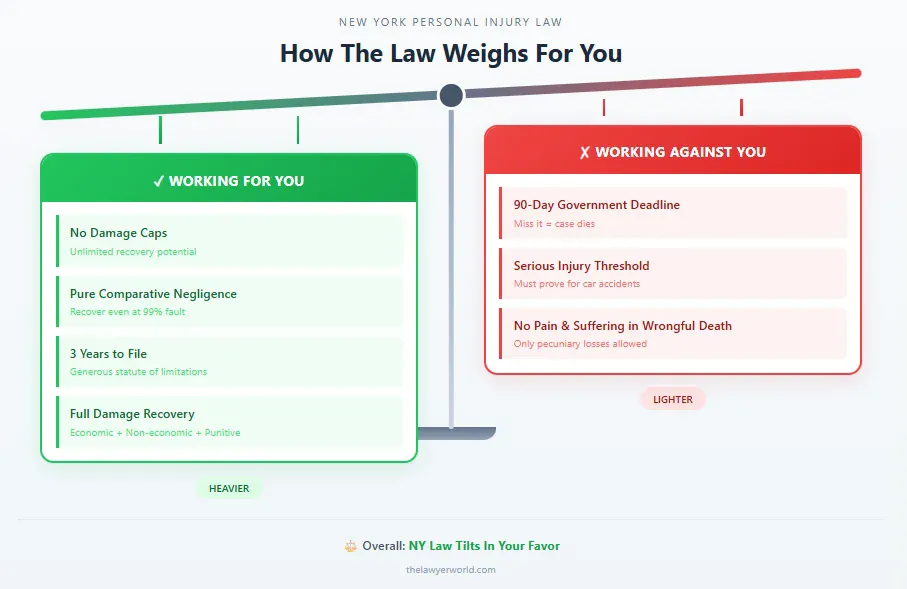
Most Favorable — No Damage Caps Exist in New York
According to Eric Subin unlike Texas capping medical malpractice pain and suffering at $250,000 or Florida limiting punitive damages to three times compensatory awards, New York refuses to put ceilings on what injured people can recover. This applies across the board—economic losses, non-economic damages like pain and suffering, and punitive awards meant to punish reckless defendants.
Why this matters practically
Severe injuries with strong evidence can result in full compensation because no statute steps in to artificially reduce what a jury decides you deserve. Judges can lower verdicts under CPLR § 5501(c) if they “deviate materially from reasonable compensation,” but courts apply this sparingly rather than routinely slashing awards.
Strongly Favorable — Your Own Fault Reduces Recovery But Never Eliminates It
CPLR § 1411 establishes “pure comparative negligence,” and the word pure does real work here. Even at 99% fault, you collect that remaining 1% of damages.
How New York compares
- Alabama, Maryland, North Carolina, Virginia: Being 1% at fault bars you completely
- Most other states: Crossing 50-51% fault eliminates your claim entirely
- New York: Fault percentage reduces your award proportionally but never to zero
The tradeoff is that defense attorneys fight hard to inflate your fault percentage since every point they add shrinks what they pay. Expect arguments about distraction, safety protocols, whether you could have avoided the situation.
Favorable With Conditions — Three Years to File (With Exceptions That Can Trap You)
The standard statute of limitations gives you three years from injury date, more breathing room than many states. But the exceptions matter:
Shorter deadlines
- Medical malpractice: 2.5 years from malpractice or end of continuous treatment
- Assault/battery: 1 year
- Wrongful death: 2 years from death date
Extensions that help you
- Minors: Clock starts at age 18 (medical malpractice caps this at 10 years from the act)
- Discovery rule: Resets clock when injuries weren’t immediately apparent
- Defendant leaves state: Time absent doesn’t count against you
Mixed — No-Fault Car Insurance Helps Fast But Blocks Lawsuits
New York’s no-fault system under Insurance Law § 5102 means your own insurance pays first regardless of who caused the crash. PIP benefits cover up to $50,000 for medical treatment, 80% of lost earnings (capped at $2,000/month), and $25 daily for other expenses.
The catch
You can’t sue the at-fault driver for pain and suffering unless injuries meet the “serious injury threshold.” If your injuries don’t qualify, you’re stuck with PIP benefits only—no matter how clearly the other driver was at fault.
What qualifies as serious injury
- Death, dismemberment, significant disfigurement
- Bone fracture, loss of fetus
- Permanent loss of use of body organ/member
- Permanent consequential limitation of body function
- Significant limitation of use of body function
- Non-permanent injury preventing substantially all normal activities for 90+ days within first 180 days post-accident
Motorcyclists fall outside this system entirely, meaning they can sue without meeting threshold requirements but also don’t receive PIP benefits.
Less Favorable — The Serious Injury Threshold Gets Weaponized Against You
Meeting the threshold sounds straightforward until you realize defendants challenge it in nearly every case where there’s room for argument. Even when the other driver clearly caused the crash, their attorney files a motion arguing your injuries don’t qualify—and if they win, your case dies before reaching a jury.
How the 90/180 rule gets attacked
Defense attorneys scrutinize your social media for evidence you went to dinner, attended events, did anything suggesting normal activity. They argue “substantially all” means nearly everything, not just work. They point to treatment gaps as proof injuries weren’t that limiting.
What courts actually require
- Objective medical evidence from shortly after the accident (not assessments done months later)
- MRIs, CT scans, range-of-motion testing with quantified measurements
- Meaningful limitation compared to normal function, not just your testimony about pain
Soft tissue injuries, whiplash resolving within months, strains without objective documentation—these often fail the threshold and leave people without legal recourse.
Least Favorable — Government Claims Have 90-Day Notice Requirements That Kill Cases
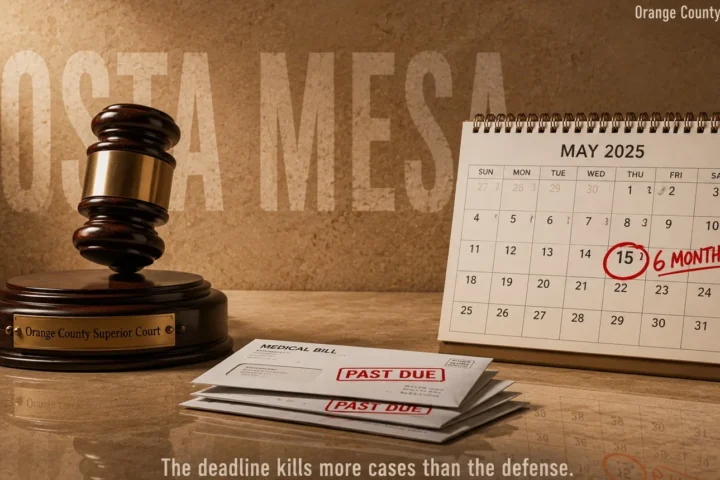
Suing a city bus, state agency, or municipal employee requires filing a Notice of Claim within 90 days of the incident. This isn’t the lawsuit itself—just preliminary paperwork identifying you, describing what happened, and specifying your claim.
Why this destroys valid cases
Missing the 90-day window typically ends your case regardless of merit because courts treat notice as a condition precedent to suing at all. Some courts grant extensions for reasonable excuse, but standards are demanding with no guarantees.
After filing notice, you get one year and 90 days total from incident date to file the actual lawsuit—significantly shorter than three years against private parties.
What Recovery Actually Looks Like When You Win
Economic damages (documented losses)
Medical expenses past and future, lost wages, diminished earning capacity, rehabilitation, home modifications, property damage. Calculated from actual records and expert projections.
Non-economic damages (quality of life impacts)
Physical pain, emotional distress, loss of enjoyment of life, disfigurement, loss of consortium. No fixed formula—juries assess based on severity, duration, and how injuries affect daily life.
Punitive damages (rare, punishment-focused)
Only available when defendant showed “conscious and deliberate disregard” for safety—drunk driving, intentional misconduct, willful recklessness beyond ordinary negligence. Requires trial verdict since insurance typically excludes coverage. No cap in New York, but courts can reduce disproportionate amounts.
References
- NY CPLR § 1411 (Comparative Negligence) – https://codes.findlaw.com/ny/civil-practice-law-and-rules/cvp-sect-1411/
- NY Insurance Law § 5102(d) (Serious Injury Threshold) – https://www.dfs.ny.gov/consumers/auto_insurance/nofault_faqs
- NY Courts Statute of Limitations Chart – https://nycourts.gov/courthelp/GoingToCourt/SOLchart.shtml
- Nolo: New York Personal Injury Laws – https://www.nolo.com/legal-encyclopedia/what-is-the-personal-injury-statute-of-limitations-in-new-york.html