 Irma C. Dengler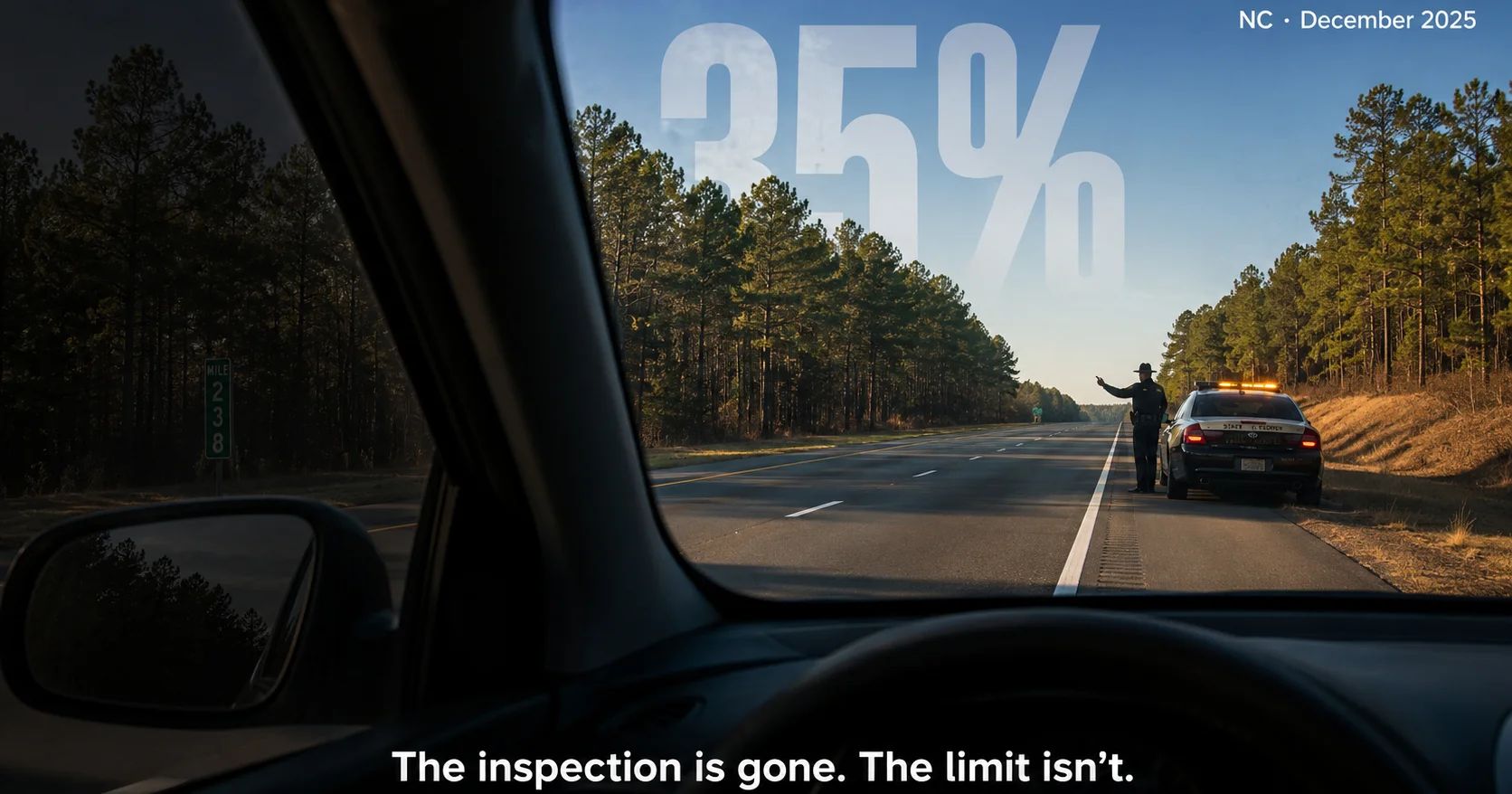
Since December 1, 2025, North Carolina stopped checking window tint during the annual safety inspection but the darkness limits didn’t budge, so your front windows still have to let in 35% of light, it’s just the roadside now instead of the inspection lane that catches you.
- The 35% rule still rules — front side windows on every vehicle, car or SUV, need at least 35% VLT (a meter reading of 32% or up counts as legal, thanks to a 3% variance).
- SUVs and pickups get a pass out back — rear side and rear windows can go as dark as you like, no second mirror needed since the 2017 change.
- Medical tint is windshield-limited — even with an exemption, only the top 5 inches of the windshield can be darkened, a 2019 tightening that surprises a lot of people.
- New for drivers: the roll-down rule — get pulled over with any tint and you’re now legally required to lower the window on whichever side the officer walks up to.
Current legal limits, quick glance:
- Windshield (all vehicles): non-reflective tint, top 5 inches / above the AS-1 line only.
- Front side windows (all vehicles): 35% VLT minimum.
- Rear side & rear window — cars: 35% VLT (unless dual mirrors).
- Rear side & rear window — SUVs/trucks/vans: any darkness, no mirror rule.
Now the first two headings.
What Actually Changed and the Big One Is Newer Than You’d Think
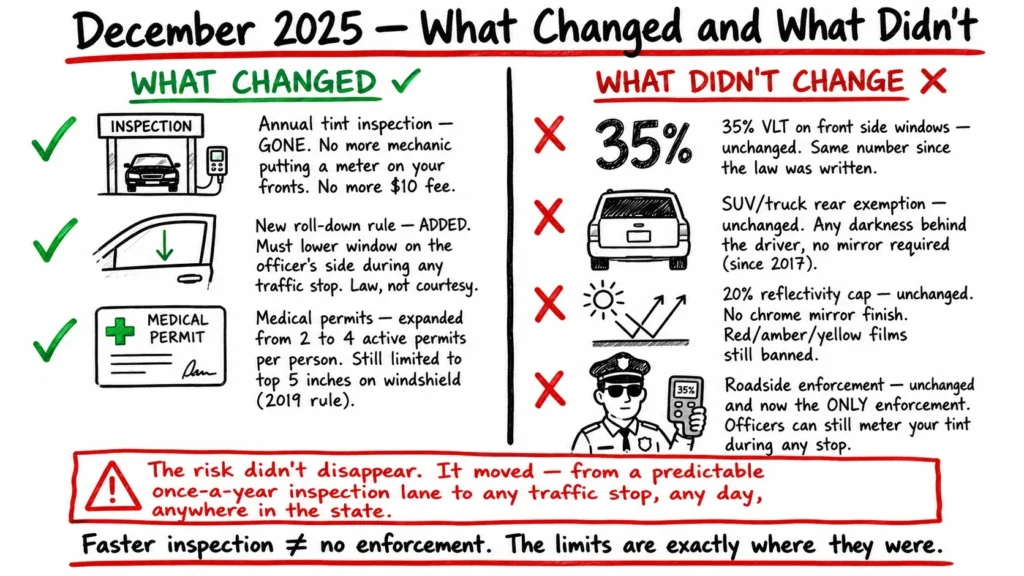
So here’s the thing that tripped me up when I started digging and it’ll probably trip you up too if you’ve read older guides floating around — the headline change everybody talks about, the end of tint checks at inspection, is recent. Not a decade old, not buried in some 2010s budget — it landed December 1, 2025, through Senate Bill 391, which the governor signed into law. Before that, if you rolled into your annual inspection with aftermarket film, a mechanic had to put a light meter on your front windows and confirm you were letting in enough light and there was a ten-dollar fee tacked on for the privilege. That whole step is gone now and so is the fee.
But — and I cannot stress this enough, because it’s exactly the kind of thing that gets travelers in trouble — the limits didn’t change. Not one percentage point. The inspection just stopped being the place anybody checks. Which means the risk didn’t disappear, it moved — from a predictable once-a-year lane to any traffic stop, any day, anywhere in the state. A faster, cheaper inspection is not carte blanche and you can still be ticketed.
The One New Rule a Visitor Absolutely Has to Know: Roll It Down
If you take nothing else from this, take this, because it’s brand new and it’s behavioral, not technical — the same December 2025 law added a requirement that has nothing to do with how dark your glass is and everything to do with how a stop goes. If you’re pulled over and you’ve got tint, you have to lower your window so the officer can see in — driver’s side if they approach from the driver’s side, passenger side if they come up on the right. A Greensboro police officer put the reasoning plainly when the change took effect — if you can’t see out and the light can’t come in, they can’t see in either and the rule is there for everyone’s safety. For someone driving through from out of state, that’s the move that keeps a routine tint question from escalating into something tenser.
The 35% Rule in Plain Numbers and Why SUV Owners Get the Better Deal
Let me put actual figures to this, because “35% VLT” gets thrown around like everyone’s supposed to already know what it means — VLT is just visible light transmission, the slice of daylight your glass lets through and the higher the number the lighter the tint. NC sets a floor, not a ceiling, so your window can’t be darker than the limit. Front side windows on every vehicle — car, SUV, doesn’t matter — have to allow more than 35% of light in. And here’s the wrinkle nobody mentions until you’re arguing with an officer: the practical number is closer to 32, because the state allows a 3% variance for meter calibration, so a reading of 32% or above is treated as compliant. Good installers aim for that 32-to-35 band on the fronts so you get the darkest legal result with no gray area.
Where it splits is the back half of the vehicle and this is the part that genuinely surprises out-of-state drivers — sedans and SUVs are not playing by the same rules. For a passenger car, the rear side and back windows still have to hit that 35% minimum. For SUVs, vans and pickups, the back windows can go as dark as you want — full blackout privacy tint is fair game. So the same limo-dark glass that’s perfectly legal on a Tahoe would get a sedan owner cited. Worth knowing if you’re, say, renting something for a road trip and it came from the lot already tinted.
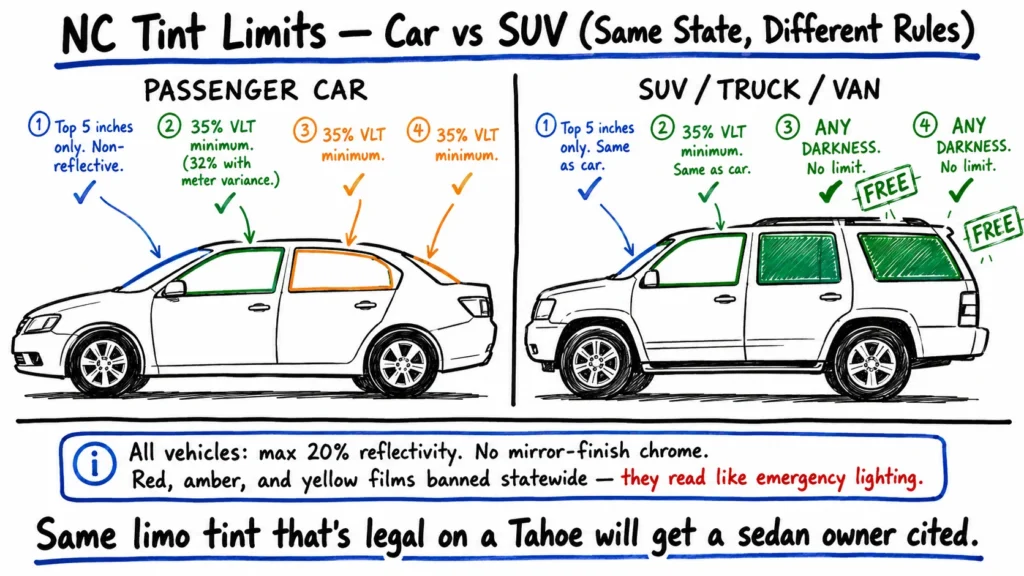
The reflectivity line is the same for everyone, by the way — your tint can’t be more than 20% reflective, so no mirror-finish chrome look and red, amber and yellow films are banned outright statewide because they can read like emergency lighting. You can dig into the underlying statute, N.C. Gen. Stat. § 20-127, if you want the exact wording — that’s the section every one of these rules traces back to.
Why SUVs and Trucks Stopped Needing That Second Mirror
There’s a reason the back-window freedom above isn’t tangled up in mirror requirements and it goes back to 2017. Before then, NC made a weird demand — if you wanted dark glass behind the driver, the vehicle had to have dual outside mirrors, one on each side. Problem was, plenty of trucks and SUVs rolled off the factory line with dark privacy glass and only one exterior mirror, which technically put a brand-new vehicle in violation of state law the day you bought it. Goofy situation.
So the legislature carved out an exemption — multipurpose vehicles, pickups and vans no longer need that second mirror to run dark tint on their rear side and rear windows. The darkness and reflectance restrictions simply don’t apply to the windows behind the driver on a multipurpose vehicle, pickups and minivans included. Sedans, though, didn’t get that pass — if a car runs dark rear glass, the dual-mirror rule can still come into play. One more reason the car-versus-SUV distinction keeps mattering.
And a quick note tucked inside that same source that’s pure gold for a traveler — vehicles registered in another state are treated under their own state’s requirements, as long as they meet them. So if you’re passing through in a car that’s legal back home, you’re generally on solid ground. (I’d still verify that against the specifics before betting on it, but it’s a meaningful cushion for out-of-state drivers.)
Medical Tint Isn’t the Loophole People Hope For
Here’s where folks get optimistic and then disappointed. Yes, North Carolina has a medical exemption — if you’ve got a condition that makes you photosensitive, you can apply for a permit, it’s tied to a specific vehicle, runs two to five years depending on what your physician recommends and has to be carried in the car. So far so good. What trips people up is how little it actually buys you on the windshield, because a 2019 reform tightened that hard. Even with a valid permit, only the top 5 inches of the windshield can be darkened — the same strip everyone else is limited to and the rest of that glass stays off-limits. The exemption mostly helps you go darker on the front side windows, below the usual 35%, not turn your whole windshield into a cave.
There’s a paperwork piece too that’s easy to botch — the DMV issues a sticker that has to be displayed (lower corner of the rear window) and missing or misplacing it can land you in the same trouble as having no exemption at all. So if you’re driving through NC on an out-of-state medical exemption, the honest answer is: it may not map cleanly onto North Carolina’s rules and the windshield restriction here is stricter than a lot of states. Don’t assume your home-state permit covers you the same way.
If You’re Just Passing Through — How Not to Get a Ticket
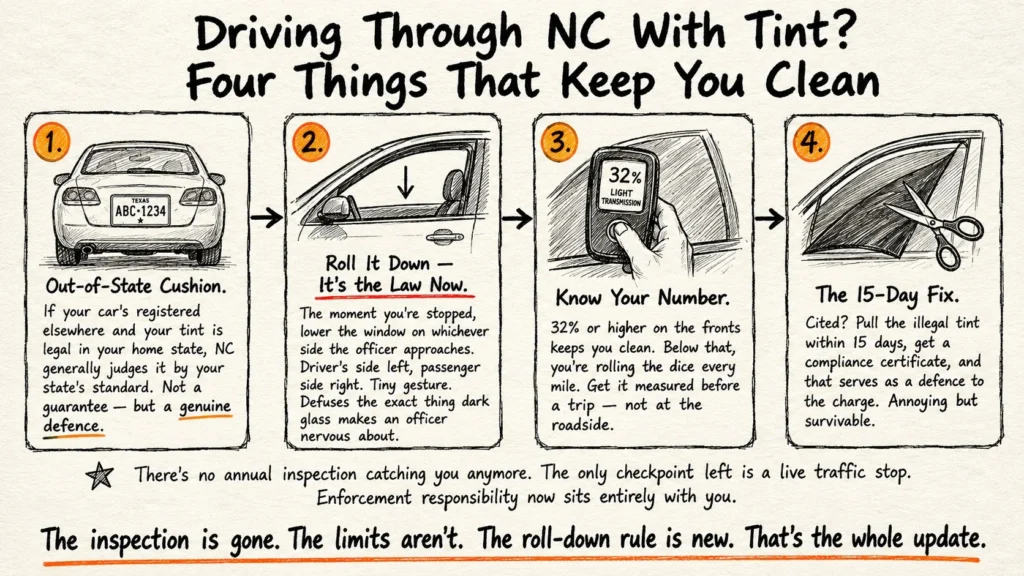
Alright, the practical part, because this is a travel site and you probably care less about session-law numbers than about whether you’re going to get pulled over on I-95. A few real-world things:
First, that out-of-state cushion I mentioned earlier is your friend — if your vehicle’s registered elsewhere and your tint is legal in your home state, North Carolina generally judges it by your state’s standard. Not a guarantee against a curious officer, but it’s a genuine defense.
Second, the roll-down rule is the single highest-leverage thing you can actually do. The moment you’re stopped, lower the window on whichever side the officer’s approaching — driver’s side if they come up on the left, passenger side if they’re on the right. It’s the law now, it’s a tiny gesture and it defuses the exact thing dark glass makes an officer nervous about.
Third — and this is the mindset shift — there’s no annual inspection catching you anymore, which sounds like freedom but really just means the only checkpoint left is a live traffic stop. Enforcement responsibility now sits entirely with drivers and the limits can still be cited. So if you’re getting tint installed before a trip or buying a used car with film already on it, measure the fronts. A reading of 32% or higher keeps you clean. Below that, you’re rolling the dice every mile.
And if you do get cited, it’s not the end of the world — NC offers a practical out: pull the illegal tint within 15 days and show a compliance certificate and that can serve as a defense to the charge. Annoying, but survivable.