 Mohammad Abdel-Rahman Accident & Injury Lawyer
The car was “driving itself” — and that’s exactly the reasoning that doesn’t let the person behind the wheel off the hook. The 2018 Uber fatal crash in Tempe, Arizona, the first pedestrian death involving a self-driving car, settled that question painfully clearly. The backup driver, not just Uber, faced criminal charges. Civil liability ran in several directions at once. And the legal framework that came out of that case now shapes how every U.S. state defines responsibility when automation and human oversight fail at the same moment.
What Happened in Tempe and Why It Became a Legal Turning Point
On the night of March 18, 2018, an Uber Advanced Technologies Group Volvo XC90 running in autonomous mode hit and killed 49-year-old Elaine Herzberg as she crossed a road in Tempe, Arizona. The car was doing 39 mph in a 35 mph zone. Rafaela Vasquez sat in the driver’s seat — not driving, but there to monitor the system and take over if it came to that.
She didn’t take over. The NTSB final report (HAR-19/03) found the automated system had detected Herzberg 5.6 seconds before impact but kept misclassifying her — first an unknown object, then a vehicle, then a bicycle — never once predicting her path correctly. Emergency braking had been deliberately disabled by Uber to stop the car behaving erratically. The system was counting on Vasquez. And Vasquez was streaming a TV show on her phone, eyes down for nearly 7 of the final 22 seconds before impact.
She looked up half a second before the collision. Too late.
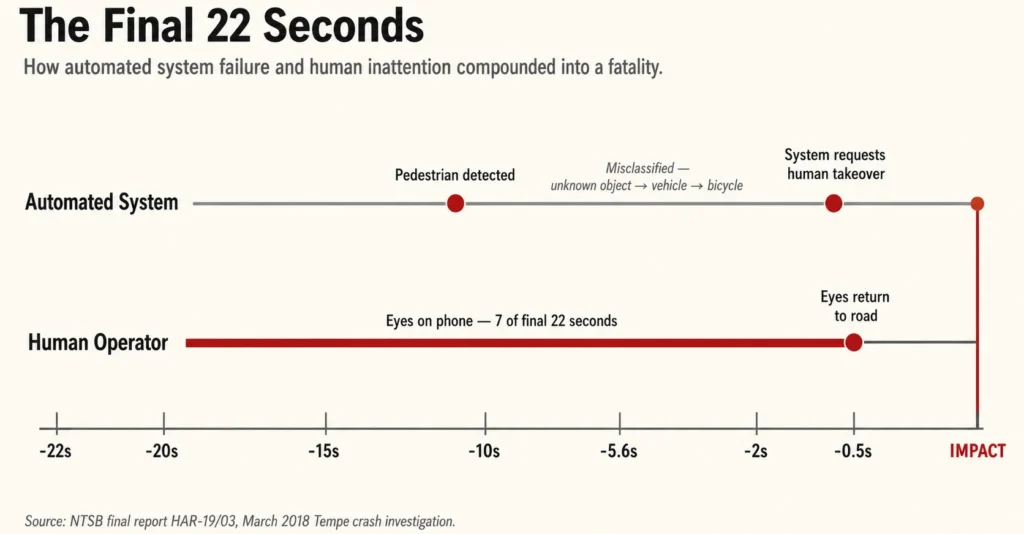
The NTSB pinned probable cause on both the automated system’s design failures and Vasquez’s inattention, made worse by Uber’s inadequate safety culture. That dual finding — machine failure plus human failure — became the factual bedrock for everything that came next in court.
Criminal Liability: Can a Backup Driver Be Charged With a Felony?
Short answer: yes. The Vasquez case proved it.
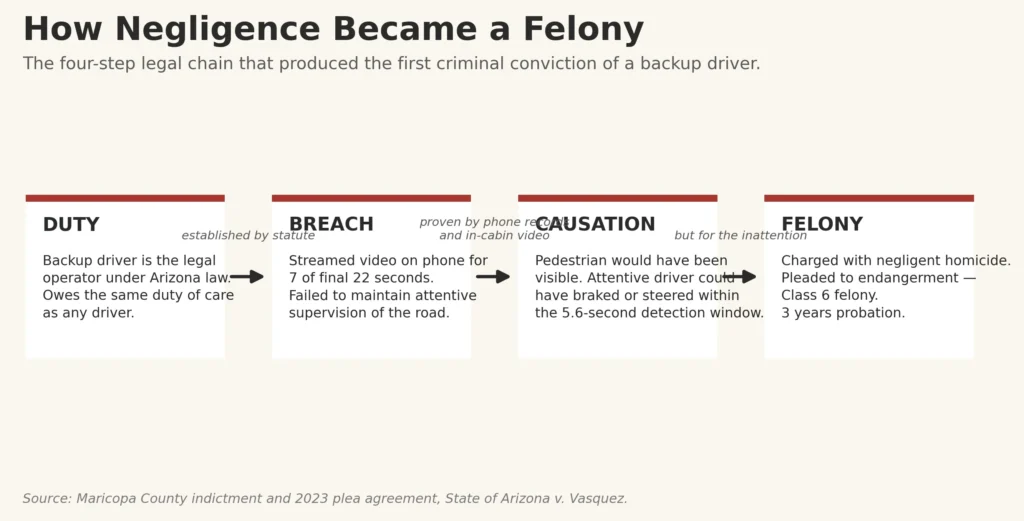
In September 2020 a Maricopa County grand jury indicted Vasquez on one count of negligent homicide, a Class 4 felony under Arizona Revised Statute § 13-1102. The theory was straightforward. She caused Herzberg’s death through criminal negligence — failing to perceive a risk so substantial that missing it was a gross deviation from what a reasonable person would have done in her position.
The evidence wasn’t complicated either. Phone records and in-cabin video showed her eyes angled downward, actively watching a streaming program while supervising a vehicle moving at highway speeds through a residential area.
She pleaded not guilty at first. By July 2023 she’d taken a plea deal — guilty to endangerment, a lesser charge, a Class 6 undesignated felony under § 13-1201. The court handed down three years of supervised probation and 300 hours of community service. No prison time.
That reduced charge reflected a genuine prosecutorial problem: the automated system had failed so completely that pinning causation entirely on Vasquez, beyond a reasonable doubt, was hard. Her defense leaned hard on the AV’s inability to classify or brake as the primary cause. It worked, partly.
What didn’t shift is the part that matters. She still pleaded guilty to a felony. And that plea locked in three things that now stand as precedent:
- A human safety driver is legally the driver, no matter how autonomous the vehicle is.
- Streaming entertainment while supervising an AV test is inattention gross enough to support felony charges.
- The automated system’s own failures don’t wipe out the backup driver’s independent legal duty to act.
It’s still the only U.S. criminal prosecution of a backup driver in a fatal autonomous vehicle crash. Every AV company running human-supervised test programs now operates with that precedent sitting in the background.
| Element | Detail |
| Incident date | March 18, 2018 |
| Location | Tempe, Arizona |
| Vehicle speed | 39 mph (35 mph zone) |
| Time of distraction | ~7 of final 22 seconds |
| Original charge | Negligent homicide (Class 4 felony) |
| Plea | Endangerment (Class 6 felony) |
| Sentence | 3 years probation, 300 hrs community service |
| Case status | Closed — first-ever backup driver criminal conviction |
Civil Liability: Who Pays and Who Gets Sued?
Uber settled with Elaine Herzberg’s family inside ten days of the crash. Confidentially, quickly, before any lawsuit was even filed. That speed was deliberate. A public civil trial would have forced Uber to defend every one of the NTSB’s findings under oath, in open court, through discovery — and they sidestepped all of it. The Reuters settlement report confirmed an agreement was reached but disclosed no figure.
No lawsuit means no judicial ruling. But the legal theories that would have applied are well-worn, and they point several ways at once.
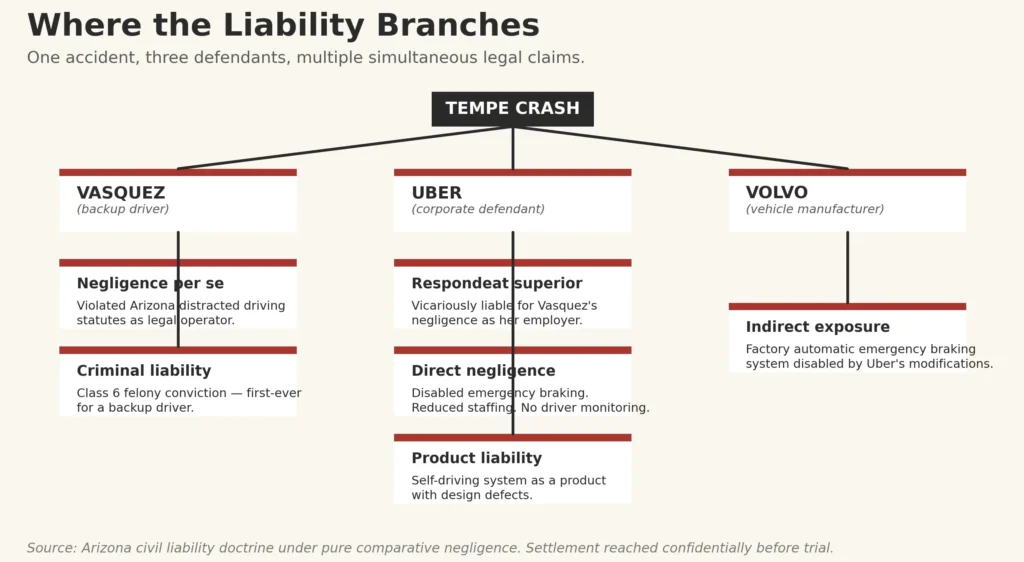
Vasquez personally was exposed on two theories:
- Negligence per se — Arizona’s distracted-driving statutes make phone use while operating a vehicle illegal. As the legal operator, Vasquez broke those statutes directly.
- Ordinary negligence — a reasonably attentive backup driver watching the road would have had several seconds to react. Watching a streaming show instead breaches that standard on its face.
Arizona runs on pure comparative negligence, so a jury would split fault percentages across every responsible party — Vasquez, Uber, possibly Volvo. Her personal assets could in theory be reached, though Uber’s indemnification or insurance would most likely absorb any judgment, unless her conduct was found grossly negligent enough to trip an exclusion.
Uber’s exposure was the real target, and it ran on three tracks.
- Respondeat superior (vicarious liability) — Vasquez was an Uber ATG employee acting inside the scope of her job. Under Arizona law, that makes Uber jointly liable for her negligence automatically.
- Direct negligence — Uber disabled the Volvo’s factory automatic emergency braking. It programmed the system to give the backup driver no alert when a hazard was detected. It cut staffing from two backup drivers to one. It had no working distraction-monitoring system. Each of those is an independent basis for a direct negligence claim.
- Product liability — the self-driving system Uber built could be treated as a product with design defects. Strict liability doesn’t require proving negligence, only that the product was unreasonably dangerous.
How State Laws Define the Backup Driver’s Legal Status
The criminal and civil outcomes here weren’t free-floating. They sat on a specific foundation — Arizona law treating the backup driver as the vehicle’s operator. Every other U.S. state with AV testing regulations lands in the same place, just through slightly different statutory wording.
Here’s how the major frameworks compare:
| State | Key Statute / Rule | Backup Driver Status |
| Arizona | A.R.S. § 28-9601 et seq. | Operator when ADS requires human monitoring; all driver duties apply |
| California | DMV AV Testing Regulations | “Test driver” = operator; must be employee, no secondary tasks, clean record |
| Nevada | NRS 482A.030 | Human in driver’s seat = operator when overseeing ADS |
| Texas | SB 2205 (2017) | Person causing ADS to engage = operator; backup driver subject to all driving laws |
| Florida | Fla. Stat. 316.003(3)(b) | Person in driver’s seat = operator if vehicle not fully autonomous |
| Michigan | MCL 257.665 | Human in seat = operator when ADS cannot function without supervision |
The pattern holds across all of them. The moment a human is required to supervise or step in, that human is the driver — with every duty, every liability, and every criminal exposure that comes with the label. Automation doesn’t rewrite it.
What has shifted since 2018 is how hard states enforce that status. Arizona tightened its testing rules right after the crash. California went further, banning secondary tasks outright and requiring real-time driver-monitoring cameras. The NTSB specifically recommended companies put driver-attention monitoring in place — and not deploying it now could itself become evidence of negligence in a future civil suit.
What This Means Going Forward
The Uber crash produced more than one criminal plea and one quiet settlement. It produced a template.
Any future fatal AV crash involving a backup driver gets measured against Vasquez — phone records subpoenaed, in-cabin video read frame by frame, duty-of-care arguments built on the same operator-status doctrine. Prosecutors now know the charge that sticks. Plaintiffs’ attorneys know which corporate decisions to go after in discovery.
One frontier is still open. As the industry pushes toward fully driverless vehicles, “remote backup operators” — people monitoring several vehicles at once from an operations center — are shaping up as the next legal question. NHTSA’s current guidance hasn’t fully settled whether a remote monitor carries the same duty of care as someone in the vehicle. The latency, the split attention, the sensory gap — none of it maps cleanly onto existing doctrine yet.
But the baseline the law built around Vasquez will anchor that analysis too. When a human is given the job of safety supervision, the law holds them to a high standard of attention — whether they’re behind the wheel or watching a screen in a control room twenty miles away.
The car may be autonomous. The legal responsibility isn’t.