 Olivia Florio Roberts ( Florida )
All windows on the front side of every Florida vehicle should have a VLT of over 28 percent (visible light transmission), but back side and rear windows have varying requirements based on the type of vehicle you have- sedans need over 28 percent VLT, whereas trucks, SUVs and vans just need over 6 percent VLT. The tints applied on the windshields can not be more than the AS-1 line. A medical exemption allowing a darker tint may be available to you, should you have a qualifying medical condition, such as lupus or photosensitivity. Tint violations are non-moving ones, so you do not receive any points on your license, however, the fines can be as high as $116 per window and failure to pay the ticket can ultimately result in a license suspension.
Understanding Window Tint Measurements
Before diving into specific numbers, it helps to understand what those numbers actually mean — especially if you’re coming from outside the U.S.
What Is VLT?
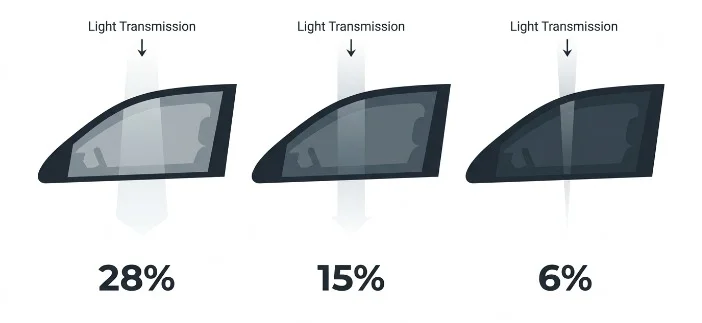
VLT is an abbreviation that means Visible Light Transmission. It is a percentage which informs you how much light can go through the glass and the tint tape on a window. The lesser the percentage of VLT, the darker the color – and the less light passes through.
Therefore a window that has 28% VLT will permit 28% of the exterior light to enter it. A 6 percent VLT window is much darker, allowing in a very little light. The Florida law that a window has to have an allowance of more than 28 percent, means that the total VLT of the glass and the tint film combined should be more than 28 percent.
📌 Note for international readers: VLT measurement standards in the U.S. are similar to those used in the UK, EU and Australia, though the legal limits differ significantly from country to country.
What Is the AS-1 Line?
The AS-1 line is a marking found on most windshields, typically located about five inches from the top edge of the glass. It’s a federal safety standard reference point. Florida law permits non-reflective tint on the windshield, but only above this line — the reasoning being that tint below it would obstruct the driver’s forward vision.
If your windshield doesn’t have a visible AS-1 marking, the general rule of thumb is to treat the top five inches as the permitted zone.
The ±3% Tolerance
Florida’s enforcement rules include a ±3% measurement tolerance, meaning that if your tint measures slightly below the legal threshold during a roadside stop, there’s a built-in margin before a violation is confirmed. That said, this is not an invitation to deliberately tint as close to the line as possible — the tolerance exists to account for measurement instrument variance, not to create a legal loophole.
Florida’s Legal Tint Limits by Window and Vehicle Type
This is where many drivers get tripped up. Florida doesn’t apply the same rules to every window on every car — the limits vary based on which window you’re tinting and what type of vehicle you’re driving.
The Two Vehicle Classifications
Florida Statutes §316.2951–316.2957 divide vehicles into two categories:
- Passenger cars — sedans, coupes and similar private automobiles.
- Multipurpose Passenger Vehicles (MPVs) — a category that generally covers trucks, SUVs, vans and similar vehicles.
The distinction matters most for your back windows. Rear-seat privacy is treated differently depending on your vehicle type.
The Legal VLT Table
| Window | Passenger Cars (Sedans/Coupes) | MPVs (Trucks, SUVs, Vans) |
| Front Side Windows | Must exceed 28% VLT | Must exceed 28% VLT |
| Back Side Windows | Must exceed 15% VLT | Must exceed 6% VLT |
| Rear Window | Must exceed 15% VLT | Must exceed 6% VLT |
| Windshield | Non-reflective tint above AS-1 line only | Non-reflective tint above AS-1 line only |
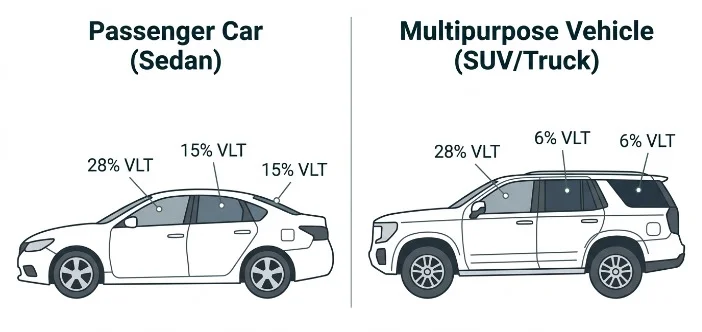
A few things worth noting from this table:
- Front side windows have identical rules for both vehicle types — 28% VLT across the board
- SUV and truck owners get considerably more flexibility on rear windows, with a legal minimum of just 6% VLT — that’s quite dark
- Sedan drivers need to stay above 15% VLT on all rear windows
💡 Tip: Not sure which category your vehicle falls under? As a general rule, if it has a separate trunk compartment (like a traditional sedan), it’s a passenger car. If the cargo or rear passenger area shares the same enclosed space as the driver (like most SUVs and minivans), it likely qualifies as an MPV.

Reflectivity and Color Restrictions
Tint darkness isn’t the only thing Florida regulates. The law also places firm limits on how reflective your tint can be and which colors are permitted.
Reflectivity Limits
There are tint films which are metallic or mirror-like and whose light is reflected outward. Although this may minimize the amount of heat in a car, too much reflective quality is a danger to other road users, especially during the Florida sunshine. According to Florida Statute §316.2954,, the limits are:
| Window | Maximum Reflectivity |
| Front Side Windows | No more than 25% |
| Rear Side Windows | No more than 35% |
| Rear Window | No more than 35% |
Mirror-like or highly reflective tints are outright prohibited on any window, regardless of which category they fall into.
Prohibited Tint Colors
Florida law is explicit: all tint must be black or non-colored. Three specific colors are expressly banned on any vehicle window:
- 🔴 Red
- 🟡 Amber
- 🔵 Blue
These colors are prohibited likely because they’re associated with emergency and law enforcement vehicle signals — using them on a civilian vehicle could create dangerous confusion on the road.
⚠️ Note: Even if a colored tint film technically meets VLT requirements, it is still illegal in Florida if it falls into one of these prohibited color categories.
Medical Exemptions
The tint laws in Florida are not universal. The state has a formal exemption process to allow darker tint than the standard limits to drivers with some health conditions. It is one of the kinderly quarters of the Florida vehicle regulations and is worth knowing whether you or some member of your household has a qualifying condition.
Who Qualifies?
The Florida Statute §316.29545 allows people with medical conditions necessitating restricted exposure to light to request an exemption. The act specifies lupus as an instance, but the conditions qualifying are generalized to:
- Any autoimmune disease
- Albinism
- Photosensitivity disorders
- Other medical conditions that a licensed physician determines require reduced light exposure
If you’re unsure whether your condition qualifies, the best first step is to speak with your treating physician — they’ll be familiar with the documentation process.
How the Exemption Works
The Florida Department of Highway Safety and Motor Vehicles (FLHSMV) issues the exemption certificate. All the details concerning the application can be found on the FLHSMV’s official website. The following is what you should know about the way it works:
- The certificate is non-transferable — it’s tied to a specific vehicle, not to the person
- If you sell or transfer the vehicle, the exemption certificate becomes void immediately
- You must carry the certificate in the vehicle at all times and present it to law enforcement upon request
- The exemption does not give you unlimited freedom with tint — darker tint must still be medically justified and documented
📌 Important: If you move to Florida from another state and already have a medical tint exemption from that state, it does not automatically carry over. You’ll need to apply through the FLHSMV for a Florida-specific certificate.
Other Exemptions
Beyond medical exemptions, Florida law carves out specific allowances for certain professional and vehicle categories.
Law Enforcement Vehicles
Vehicles used in undercover operations or canine (K-9) units are exempt from Florida’s standard window tint requirements. This makes practical sense — unmarked police vehicles often need a degree of visual privacy to carry out their work effectively. This exemption is built into the statutes to ensure that law enforcement operations aren’t hampered by the same rules that apply to civilian vehicles.
Process Servers and Private Investigators
Florida extends a similar exemption to vehicles owned or leased by:
- Certified process servers
- Licensed private investigators
- Licensed investigative agencies
Such professionals often have to spy or get close to people and the legislature has acknowledged that their work might demand a degree of window privacy that cannot be enjoyed by ordinary citizens.
Factory-Installed Glass
When the manufacturer of your car already had tinted glass installed in the car, you are usually okay, provided the glass meets the requirements of the Federal Motor Vehicle Safety Standard (FMVSS) No. 205 which regulates the glazing materials used in motor cars.
Knowing this is important in case you have bought a second-hand car and are not sure whether the tint is official or not. Glass that is of federal standards but is factory glass does not have to meet the percentages of VLT requirements of Florida in the same manner- but any aftermarket tint placed on top of the factory glass would have to comply with the Florida regulations.
💡 Tip: When buying a used car, ask the dealer or previous owner whether any aftermarket tint has been applied. If you can’t verify this, a professional tint shop can measure the VLT and tell you where you stand.
Labeling and Installation Requirements
If you’re having tint professionally installed — rather than driving a factory-tinted vehicle — Florida has a specific requirement that often goes unnoticed until someone gets pulled over.
The Door Jamb Label
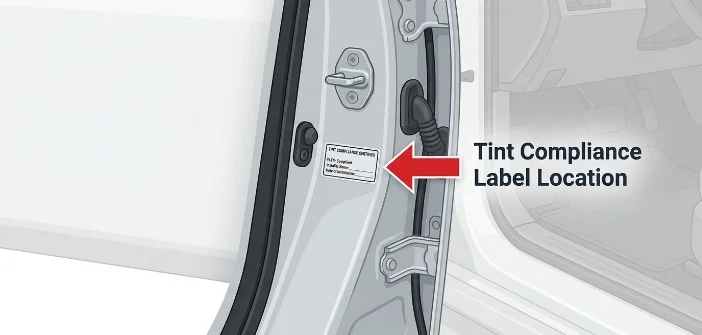
In the case of window tint film being installed on your vehicle by a commercial installer they must place a certification label on the door jamb on the driver side. This label should ensure that the tint film is legal in Florida.
What is the significance of this to you as a driver? A law enforcement officer might investigate one of the first things during a traffic stop since that label is one of the first things they could check. It acts as direct testimony that the tint was furnished by someone qualified and that at the time of installation, he/she certified that it was in compliance.
Glass installed in factories and meeting FMVSS No. 205 is not subject to this labeling requirement – the federal compliance standard replaces the state label in such cases.
⚠️ Note for DIY tint buyers: If you install tint yourself using an aftermarket film, there is no professional installer to affix a compliance label. This puts the burden of proof on you during any enforcement stop. In practice, this means self-installed tint can be harder to defend even if it technically meets VLT requirements.
Enforcement, Penalties and What to Do If You’re Stopped
It is one thing to learn the rules, to learn what happens when the rules are violated is equally important whether or not you are a resident of Florida or a visitor driving through the state.
What Kind of Violation Is It?
A window tint violation in Florida is classified as a noncriminal, nonmoving traffic infraction. That means:
- ✅ No criminal record is created.
- ✅ No points are added to your Florida driver’s license.
- ❌ Fines still apply — and they’re not trivial.
- ❌ The illegal tint may need to be removed.
How Much Will It Cost?
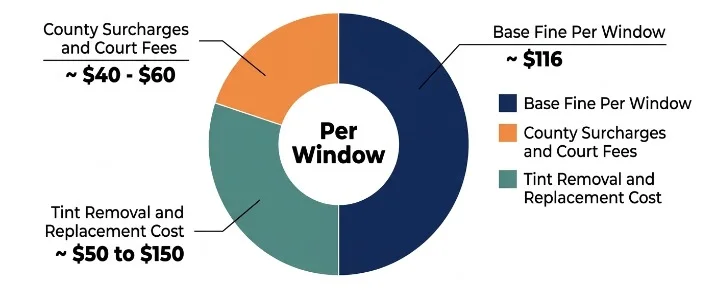
Violations of the tint include fines that are around $116 per window though it may differ depending on the county. When two side windows are discovered to be non-compliant in a single stop, a possible fine of up to $232 or more may be incurred before even considering any other county fines.
Can You Be Pulled Over Just for Tint?
Yes. The Florida legislation only allows a police to make a traffic stop based on suspicion of an illegal tint of the window. This is notable since a tint stop can occasionally go out of control – once they have been pulled over, officers can notice additional infractions or perform additional inspections.
The 30-Day Resolution Window
In case you get a tint citation, the following is the procedure that you will have to follow as provided in the Florida laws:
- Correct the tint — have the non-compliant film removed or replaced within 30 days
- Get the citation endorsed — have a sworn law enforcement officer sign off on the correction
- Take the endorsed citation to the clerk’s office — this can qualify you for a reduced fine
- Don’t miss the deadline — failing to resolve the citation within 30 days can result in a driver’s license suspension
The latter fact surprises many. What may begin as a comparatively minor violation may result in a license suspension just by failing to do anything. In case you are cited, consider it a time-sensitive issue.
Penalties for Installers
The rules don’t just apply to drivers. A professional tint installer who sells or applies non-compliant tint film faces separate legal consequences — specifically, a second-degree misdemeanor charge under Florida law. This is a meaningful deterrent and it’s why reputable shops will measure and certify compliance before completing an installation.
💡 Tip: If a tint shop offers to install tint darker than the legal limits without mentioning any exemption or certification process, that’s a red flag. A legitimate shop will know the law and follow it.
Frequently Asked Questions
Does Florida tint law apply to out-of-state vehicles?
If you’re visiting Florida temporarily, your home state’s tint rules generally apply — but if you establish Florida residency or register your vehicle here, you’ll need to comply with Florida’s limits.
Can I tint my windshield in Florida?
Only non-reflective tint applied above the AS-1 line is permitted on windshields. Tinting the main viewing area of the windshield is illegal.
What happens if I buy a used car with illegal tint already on it?
The violation belongs to whoever is operating the vehicle. Ignorance of the existing tint is not a legal defense. Have the tint measured by a professional when purchasing a used vehicle.
Do rideshare or commercial vehicles follow the same rules?
Unless a specific exemption applies, commercial and rideshare vehicles are subject to the same tint laws as private passenger vehicles.
Is 20% tint legal in Florida?
On front side windows, no — 20% VLT is below the 28% minimum. On rear windows of an MPV (SUV, truck, van), yes — 20% exceeds the 6% minimum and is legal.
Where can I find Florida’s official tint law text?
The core regulations are found inFlorida Statutes §316.2951 through §316.2957, available in full on the Florida Senate’s official website.