 Matthew Prescott (Australian Attorney)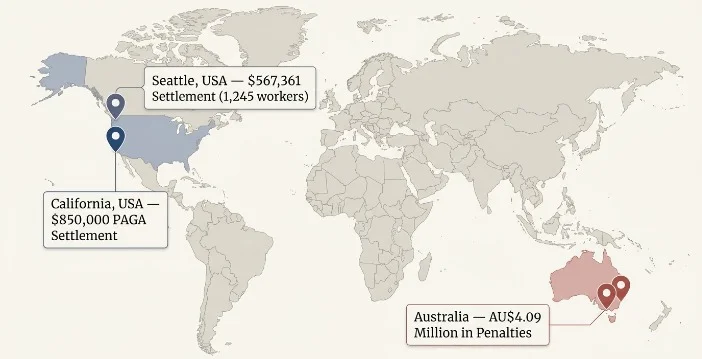
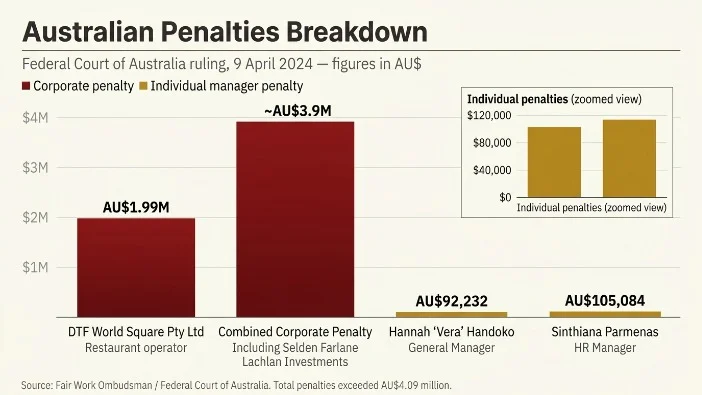
The famous Taiwanese dumplings chain Din Tai Fung has received a series of wage and hour cases which when combined altogether, give an impressive image of cross-border labour law enforcement. In Seattle, the Office of Labor Standards in the city settled a case worth 1,245 workers over sick-leave violations and break violations. The Federal Court of Australia labeled the practice as a calculated scheme to deprive employees of their hard-earned wages and fined it over AU$4.09 million, the second-largest penalty in the history of Fair Work Ombudsman at that time.
The state of California had an alternative case under the California Private Attorneys General Act which settled with a PAGA settlement of $850,000. Varying laws, varying forums, same subject: the underpaid vulnerable worker denied a break or discouraged to take a leave that he/she was legally entitled to take. This article takes a step-by-step look at each of the cases; how the legal frameworks involved interact; and what hospitality employers all over should be learning out of it all.
A Global Brand Caught in a Web of Local Labour Laws
Din Tai Fung is no secret restaurant. It is a globally recognised brand with branches around Asia, North America, Australia and Europe and is famous as being conscientious in it’s kitchen standards. When word spread that the chain had received the receiving end of considerable wage theft enforcement actions in three jurisdictions, it caught the interest of labour lawyers and regulators as well as hospitality industry watchers.
What makes the Din Tai Fung saga unusual is not any single case in isolation. It is the pattern. Roughly the same conduct — underpaying workers, denying breaks, suppressing legally protected leave — surfaced in cities thousands of kilometres apart, prosecuted under wildly different legal regimes. For students of comparative employment law, it is something of a real-time case study in how municipal ordinances, federal statutes and national workplace laws each tackle the same underlying problem.
We have a brief word before we turn to the cases, of a terminological nature. It does not always mean what most people would imagine a definition of wage theft. It goes beyond taking the pay packet of somebody. It can involve policies that silently deter the workers to utilize the benefits that they have already earned or to practice scheduling that deprives the workers of the mandated rest periods. The following cases represent a continuum of the abuses that regulators in the present-day view as wage theft.
Seattle, Washington: When a City’s Labour Laws Bite Back
The Legal Backdrop
During the past ten years, Seattle has established a reputation of having some of the most worker-protective municipal labour laws in the United States. Violation is enforced by the Seattle Office of Labor Standards (OLS), a city agency that has actual investigative teeth. The Din Tai Fung case featured two ordinances that were on the frontline:
- Paid Sick and Safe Time (PSST) Ordinance (Seattle Municipal Code 14.16) – obligates employers to respond with accrued paid leave in response to illness, medical appointments or situations related to domestic violence, sexual assault or stalking.
- Wage Theft Ordinance (SMC 14.20) — contains a requirement to pay all wages due on all hours worked and includes the mandated protection of rest and meal breaks.
These regulations are imposed over the state and federal protection, not to replace them. That is a significant aspect. A Seattle employer must meet the legal requirements of city law, the law in the state of Washington and the federal Fair Labor Standards Act simultaneously.
The Investigation and What Regulators Found
The three legal entities involved in the Din Tai Fung operations in Seattle area investigated in the OLS search include: Din Tai Fung (Pacific Place) Restaurant, LLC; Din Tai Fung (University Village) Restaurant, LLC; and Din Tai Fung Prep Seattle, LLC, the commissary kitchen of the chain. Investigators zeroed in on two practices:
- An attendance points policy that quietly punished sick leave. On paper, employees had access to paid sick and safe time. In practice, the company allegedly maintained a points-based attendance system that docked workers for absences — including those covered by the PSST ordinance. The effect, regulators said, was to deter people from using leave they had legally earned.
- A pattern of missed meal and rest breaks. The Wage Theft Ordinance requires employers to actually provide breaks, not merely permit them in theory. The investigation concluded that workers across the locations were not consistently receiving the breaks the law guaranteed.
The Settlement: 18 June 2025
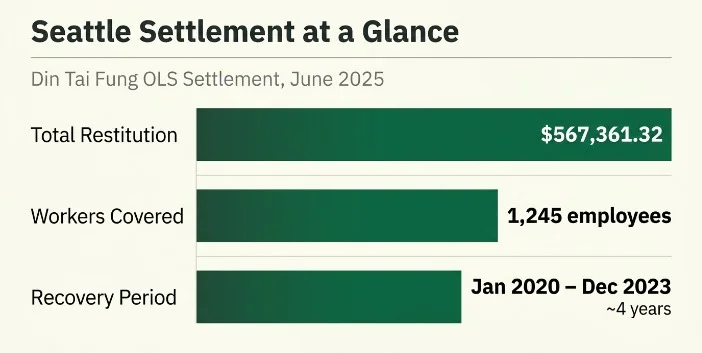
On 18 June 2025, OLS announced the resolution. Without admitting liability, Din Tai Fung agreed to:
- Pay $567,361.32 in restitution to 1,245 current and former employees, covering the period from 11 January 2020 to 6 December 2023.
- Eliminate the attendance points policy that had been found to discourage PSST use.
- Develop and implement written PSST and meal-and-rest-break policies that comply with Seattle law.
- Provide employees with notices of their employment information, as required by city ordinance.
The Technical Break Rules That Tripped Din Tai Fung Up
To readers who might wonder what are the granular requirements behind the headline, the ordinances of Seattle set out the details of which the employers of the hospitality business continually fall short:
- Rest breaks: Employees should be given a 10 minutes paid rest break after every four hours of work. It may be a single continuous break or rest intervals.
- Meal breaks: A majority of workers in shifts lasting more than five hours must be provided with a 30-minute unpaid meal break, except when it is voluntarily waived by the worker.
- PSST accrual: In the case of an employer as large as Din Tai Fung, the number of hours worked during a year is 30 hours per year, which workers earn one hour of paid sick and safe time each year, up to 72 hours of unused leave carried over annually.
All those commitments sound humble as individuals. You can just see how the financial exposure can be add up to more than half a million dollars in restitution over hundreds of employees and thousands of shifts over several years.
California: When Arbitration Clauses Reshape a Wage and Hour Fight
How the Case Began?
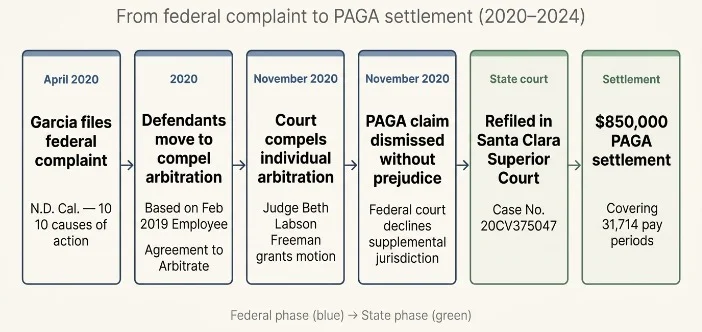
On 28 April 2020, a former full-time non-exempt employee named Juana Garcia, filed suit in the U.S. District Court of the Northern District of California. The case was filed on a case on behalf of Garcia and a proposed group of similarly situated workers. The defendants were Din Tai Fung Restaurant, Inc., Din Tai Fung (SF) Restaurant, LLC. and a person, Selena Soto.
The First Amended Complaint of Garcia was broad. It alleged ten causes of action, based upon federal law and California law:
- Violation of the Fair Labor Standards Act for unpaid overtime.
- Failure to pay all minimum wages owed.
- Failure to pay all overtime wages owed.
- Failure to pay reporting time pay.
- Failure to provide meal periods or pay additional wages.
- Failure to provide rest periods or pay additional wages.
- Failure to pay all wages earned at termination or resignation.
- Violation of California’s Unfair Competition Law.
- Enforcement of California’s Private Attorneys General Act (PAGA).
- Failure to timely produce records on request.
Garcia worked at a Santa Clara County location and alleged the violations occurred during her tenure there.
The Arbitration Clause That Changed Everything
This is where the case went and which any follower of the U.S. employment litigation would recognize. The defendants failed to include a substantive answer to the wage claims. They instead made a Motion to Compel Arbitration.
Their argument: In February 2019, Garcia signed an Employee Agreement to Arbitrate (EAA) as a condition of her continued employment. The company had a Mutual Arbitration Policy which was incorporated in the agreement. Garcia did not refute that he signed it. She admitted that she was informed that she would be fired in case she declined.
Judge Beth Labson Freeman on 20 November 2020 granted the motion. The personal employment-based claims of Garcia were arbitrated. The federal court denied any supplemental jurisdiction over the PAGA claim and dismissed it without prejudice to allow it to be refiled in state court.
This is, in many ways, a textbook outcome under contemporary U.S. arbitration jurisprudence. Mandatory arbitration clauses — particularly those signed under threat of termination — have repeatedly been upheld by the U.S. Supreme Court, most notably in Epic Systems Corp. v. Lewis in 2018. For employers, they remain one of the most effective tools for splintering would-be class actions into individual proceedings.
The PAGA Claim Resurfaces and Settles for $850,000
The PAGA piece, however, lived on. A separate state court action — Garcia v. Din Tai Fung Restaurant, Inc., et al., Case No. 20CV375047 — was filed in Santa Clara County Superior Court. PAGA is genuinely unusual as a legal mechanism. It allows an aggrieved employee to step into the shoes of the State of California and pursue civil penalties on the state’s behalf for California Labor Code violations. Because PAGA penalties are a public enforcement action rather than a private claim, courts have been more reluctant to force them into arbitration.
The state action ultimately resolved with a gross settlement of $850,000, covering 31,714 pay periods.
The pattern is one labour lawyers will recognise immediately. A class-style federal complaint gets carved up by an arbitration clause. The bulk of the workforce loses the leverage of collective action. PAGA — which the arbitration clause cannot easily reach — becomes the vehicle that delivers a meaningful recovery.
Australia: A “Calculated Scheme” and Record-Setting Penalties
The Fair Work Act and the Regulator Behind It
In a very different legal universe on the other side of the Pacific, the Australian case was played out. In that case, the statutory body that enforces the Fair Work Act 2009 (Cth) is the Fair Work Ombudsman (FWO), an independent statutory agency. The Act provides the National Employment Standards and a regime of modern awards – industry specific instruments which lay out minimum levels of pay, penalty rates on weekends and public holidays, overtime, allowances and casual loadings.
A comment on recent reform A recent reform in 2024 made intentional wage theft a federal criminal offense under the Commonwealth Criminal Code, punishable by a maximum sentence of 10 years imprisonment and a maximum fine of up to AU 7.8 million. The fact that criminalisation post-dates the Din Tai Fung conduct, but it provides the regulatory mood music to what followed.
What the Federal Court Found?
Actions of the previous operators of Din Tai Fung restaurants at Sydney, World Square and at Chatswood and at the Emporium in Melbourne were examined by the Federal Court of Australia. Justice Anna Katzmann was not shy in her language and termed the operation as a calculated scheme to rob employees of the hard-earned wages.
The discoveries of the court were not very pleasant:
- Deliberate, systematic underpayment. The underpayment of the seventeen employees, the majority of whom were young migrant workers on temporary visas, amounted to a collective underpayment of AU$157,025 between 2017 and 2018.
- Two sets of payroll records. To cover up the underpayments, the operators kept one set that reflected the actual wages and hours and a falsified set, which included fake pay slips, doctored timesheets, manipulated payroll journals. This dual-record system was operational at least since July 2016.
- Specific, repeated breaches of the modern award. Some of the findings were failure to comply with minimum award rates, penalty rates on weekend and public holidays, overtime, split shift allowances and casual loadings. The workers were asked to work at least 55 hours per week, exceeding the legal maximum of 38 hours per week.
- Targeting of vulnerable workers. As of June 2017, 338 of 382 employees were classified as “foreign employees,” with the vast majority on temporary visas. Evidence before the court suggested that hiring visa holders over Australian citizens or permanent residents was a deliberate strategy. A manager was quoted as saying they had to hire this way to avoid being reported to authorities by citizens.
The Penalties Handed Down on 9 April 2024
| Party | Penalty (AU$) |
| DTF World Square Pty Ltd (operator) | $1.99 million |
| Selden Farlane Lachlan Investments Pty Ltd | Part of combined corporate penalty (~$3.9 million combined) |
| Hannah “Vera” Handoko (General Manager) | $92,232 |
| Sinthiana Parmenas (HR Manager) | $105,084 |
| Total | > $4.09 million |
At the time, these were the second-highest penalties ever secured by the Fair Work Ombudsman. The court’s willingness to impose substantial individual penalties on the General Manager and HR Manager is particularly notable — it sends a signal that managers cannot hide behind the corporate veil when the conduct is found to be deliberate.
The Aftermath: Liquidation, Recovered Penalties and a 2025 Case
Several follow-on developments are worth noting:
- The FWO distributed AU$197,316 in recovered penalties to located underpaid employees during 2024.
- In July 2025, a former migrant worker, Guoyong Jet Liu, was awarded AU$50,588 in unpaid wages plus AU$12,116 in interest — a total of AU$62,704 — for deliberate underpayment that stretched across nearly four years.
- Crucially, the corporate entities that operated the restaurants went into liquidation before the case was heard. That raises the very real possibility that some affected employees will not recover the full amount of their unpaid wages, regardless of what the court ordered on paper.
Comparing the Three Jurisdictions Side by Side
For readers who want to see the cases in one frame, the table below lays out how each jurisdiction approached substantively similar conduct.
| Feature | Seattle, WA (Administrative) | California, USA (PAGA / Arbitration) | Australia (Judicial) |
| Enforcing body | Seattle Office of Labor Standards | Private plaintiff via PAGA; federal and state courts | Fair Work Ombudsman / Federal Court of Australia |
| Primary legal basis | City ordinances (PSST SMC 14.16, Wage Theft SMC 14.20) | FLSA, California Labor Code, PAGA | Fair Work Act 2009 (Cth) and modern awards |
| Conduct period | Jan 2020 – Dec 2023 | 2019 (allegations centred on Garcia’s tenure) | Roughly Jul 2014 – Jun 2018 |
| Monetary outcome | $567,361.32 in restitution to 1,245 workers | $850,000 PAGA settlement (31,714 pay periods) | > AU$4.09 million in penalties + back-pay |
| Headline violation | Attendance points policy deterring sick leave; missed breaks | Unpaid minimum wages, overtime, missed meal/rest periods | Deliberate underpayment, falsified records, systemic award breaches |
| Key remedial action | Eliminate attendance points policy; new written PSST and break policies | Arbitration of individual claims; PAGA settlement | Penalties on company and individual managers |
| Aggravating factor identified | Policy that suppressed protected leave use | Mandatory arbitration as condition of employment | Targeting of migrant workers on temporary visas |
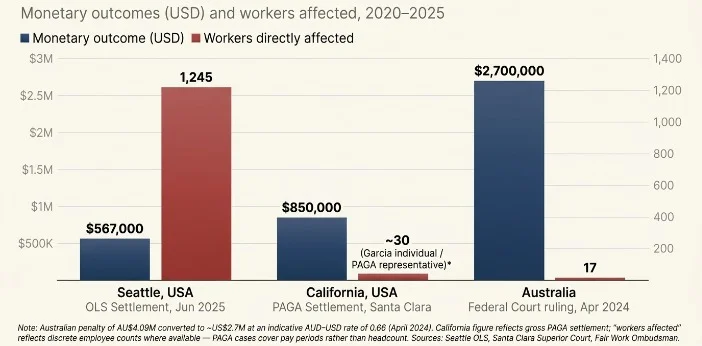
The contrast across the three rows tells a story. Seattle’s machinery is administrative and remediation-focused — the city wants the policy fixed and the workers paid back. California’s system, layered with federal arbitration doctrine, channels most individual disputes into private arbitration but leaves PAGA as a public enforcement valve. Australia, by contrast, hands the matter to a federal court that can both impose seven-figure corporate penalties and personally fine individual managers.
One thread runs through all three. In each jurisdiction, regulators and courts paid particular attention to whether vulnerable workers were being targeted. Seattle flagged a policy that suppressed sick leave for hourly workers. California’s PAGA framework exists precisely because legislators believed individual workers often lack the leverage to enforce their own rights. The Australian Federal Court explicitly tied the severity of it’s penalties to the fact that the underpaid employees were mostly young migrants on temporary visas.
What This Tells Us About “Wage Theft” as a Legal Concept
For non-specialists, the term “wage theft” can sound dramatic — almost rhetorical. The Din Tai Fung cases are a useful reminder that, as a legal matter, the concept is broader and more technical than the headline suggests. A few principles worth pulling out:
- Underpayment is only one form. Failing to pay overtime, denying mandated breaks, refusing to pay reporting time and withholding final wages on termination are all squarely within the modern legal definition of wage theft in many jurisdictions.
- Suppressing legally protected benefits counts too. Seattle’s enforcement made this point explicit. An attendance points system that punishes workers for using legally accrued sick leave is, in regulatory terms, a wage and hour violation — even if the leave technically exists on paper.
- Recordkeeping failures can amplify liability. The Australian case is the textbook illustration. Maintaining two sets of payroll records did not just hide the underpayment; it transformed the regulator’s characterisation of the conduct from negligent to “calculated.”
- Individual managers can be on the hook. The case of the decision of the Federal Court of Australia personally to fine the general manager and the HR manager serves as a reminder that the accountability of managers is becoming more of a characteristic feature of wage theft enforcement. The 2024 criminalisation of purposeful wage theft in Australia goes beyond this, with the potential of prison sentences.
When you are a worker and are attempting to determine whether something on your pay slip is a wage theft or not, the bottom-line lesson is this: wage theft is not all about the figure on your pay slip. It encompasses the form of policies, the functioning of time tabling and the purity of documentations.
Practical Lessons for Hospitality Employers
The Din Tai Fung saga is, among other things, a compliance roadmap written in red ink. A few lessons translate across borders:
- Audit attendance and leave policies for chilling effects. A policy can be technically lawful in it’s written form but unlawful in operation if it discourages workers from using protected leave. Seattle’s enforcement turned on exactly this point.
- Treat break compliance as a documented operational obligation. It is not enough to say breaks are “available.” Regulators in both Seattle and California examined whether breaks were actually provided and tracked. Many hospitality operators under-invest in time-and-attendance systems that can demonstrate compliance.
- Take recordkeeping seriously. The contrast between the U.S. and Australian outcomes is partly a contrast in how the conduct was characterised. Falsified records turned an underpayment case into a “calculated scheme.” Even unintentional recordkeeping gaps can shift the burden of proof against an employer in a wage and hour dispute.
- Recognise the heightened scrutiny on migrant and temporary visa workers. Multiple jurisdictions now treat the deliberate hiring of vulnerable workers to suppress reporting as an aggravating factor. The reputational and legal cost of being on the wrong side of that line is severe.
- Understand that arbitration clauses are not a complete shield. California’s PAGA framework and similar public enforcement mechanisms in other states, can sit outside the reach of arbitration clauses. Internationally, public regulators like the Fair Work Ombudsman do not need to honour any private dispute resolution agreement at all.
- Plan for cross-border consistency. A global brand operating with inconsistent payroll and HR practices in different markets is, almost by definition, exposed somewhere. The pattern in the Din Tai Fung cases — similar conduct in three jurisdictions — suggests a chain that did not have a globally coherent compliance posture.
In the case of workers who feel that they are not being paid or allowed to take a break, each of the regulators mentioned in this paper has a direct complaint option. Federal complaints in the U.S. are dealt with by the federally run Wage and Hour Division of the Department of Labor. Local violations are handled by city and state agencies. The Fair Work Ombudsman is a free complaint and information service in Australia. Debates about these matters are also alive in labour law-focused communities on Reddit (r/legaladvice and r/AusLegal) though those threads are by no means a substitute to advice given by a qualified labour lawyer.
This article is for general educational purposes and does not constitute legal advice. Workers who believe they are owed wages or have been denied breaks or leave should contact their local labour regulator or a qualified employment lawyer in their jurisdiction.