 Christopher Morgan (Bankruptcy & Finance)
The law of the American workplace is in a morass that is decades old. The Supreme Court is in 2024 quietly rewriting some of the rules that courts operate by in handling such cases, the federal agencies that enforce employment law have new leadership that is pulling them in different directions and a government shutdown last fall left a backlog that is still being cleared. And whether it’s something at work that has crossed a line either as an employee or as an employer attempting to keep abreast of what is actually being demanded of you at a given moment, the truth of the matter is that you are right there in that spot where the ground is moving.
The Federal Laws That Run the Show
Most of the workplace protections in this country come from just a handful of laws passed between the 1930s and the 1990s. They are the backbone of all. These are the basis of protection and though a state can add it’s own layer (more on that mess later), these are the starting point of what protections you in fact have at work.
Here’s what each one covers, and who would be responsible for enforcing it:
| Law | What it does | Who enforces it |
|---|---|---|
| Fair Labor Standards Act (FLSA) | Sets minimum wage, overtime rules, recordkeeping requirements and child labor standards | U.S. Department of Labor |
| Title VII of the Civil Rights Act | Prohibits employment discrimination based on race, color, religion, sex (including pregnancy, sexual orientation and gender identity) and national origin | EEOC |
| Americans with Disabilities Act (ADA) | Prohibits discrimination against those with disabilities, requires reasonable accommodation | EEOC |
| Age Discrimination in Employment Act (ADEA) | Prohibits age based discrimination against people who are 40 and older | EEOC |
| Family and Medical Leave Act (FMLA) | Entitles eligible employees to up to 12 weeks of unpaid, job-protected leave for family and medical reasons | DOL |
| National Labor Relations Act (NLRA) | Regulates union activities, right to organize and principles of collective bargaining in the private sector | NLRB |
| Occupational Safety and Health Act | Sets workplace safety standards and enforces compliance | OSHA |
| Equal Pay Act | Equal pay for equal work between men and women in the same workplace | EEOC |
There are a couple that are lesser but deserve to be mentioned. The WARN Act requiring mass lay-off or plant closing notice from large employers 60 days in advance is quite an important provision. Somehow people can overlook that until the moment they are laid off without warning. And the Immigration Reform and Control Act is the law that then leads to the I-9 form that everybody fills out on the first day of a new job.
If you want a plain-English explanation of any of this stuff, the Wikipedia article on U.S. labor law is not a bad place to start and the subreddit r/legaladvice has many examples of it in practice (with the standard disclaimer that anything you read online is not legal advice).
The Three Agencies Doing the Enforcing
Federal officials involved in enforcing employment law don’t work together as one unit, but are spread across three major offices with overlapping jurisdiction, each of which has a different political sensibility depending on which party controls the White House. That’s the typical aspect; the intensity of the changes over the last year is not.
The EEOC
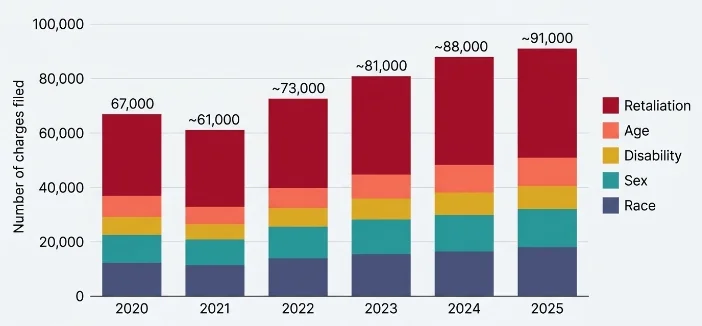
The EEOC has jurisdiction over discrimination, harassment and retaliation in the workplace, and has under the new commissioner indicated a renewed interest in investigating complaints regarding what it calls “anti-American bias” and antisemitism, as well as corporate DEI programs. That last one matters enormously for any employer running diversity initiatives, because the agency is now going out and looking for Title VII violations inside programs that were business as usual a year and a half ago. Even the EEOC’s own guidance page reflects the shift if you read between the lines.
The Department of Labor
The Department of Labor administers some 180 laws. Among them, the most common office that people encounter is the Wage and Hour Division, investigating unpaid overtime pay, improperly classified employees, and minimum wage violations by the employers it regulates. In addition to completing the audits that the DOL was unable to finish during the shutdown, the DOL is also working to publish new regulations defining overtime coverage and when a worker qualifies as an independent contractor (as opposed to an employee), which would apply directly to gig economy platforms that classify workers as 1099 contractors.
The NLRB
NLRB is the smallest of the three, but it is a board that punches above it’s weight due to union elections and unfair labor practice charges. The fact the board suffered a period of not having a quorum of members sounds like bureaucratic trivia until you realize nothing was decided during those months. With the new quorum established, the docket started clearing and the level of election activity became more pronounced.
A good way to think of what agency does what:
- Discrimination, harassment, accommodation: EEOC.
- Pay, hours, overtime, classification, and leave disputes: DOL.
- Collective action, organization, retaliation: NLRB.
- Job-related accident or safety risk: OSHA (which is technically a division of the DOL but is relatively independent).
What’s Changed in the Last Two Years
This is where things get interesting, and where much of the older legal advice you might find on the internet has started to go out of date in the wake of the 2024 Supreme Court term and its subsequent agency rule changes.
The biggest case of all came down in June 2024 when the Supreme Court overturned Chevron deference, a doctrine that had been in place for 40 years, in Loper Bright Enterprises v. Raimondo. Under Chevron deference, if Congress left a federal statute ambiguous, the agency was the one to tell what it meant. Chevron was killed by Loper Bright. Courts today make their own pronouncements about what the law means, and that is not a technicality. This means that all DOL rules, all EEOC orders, all NLRB decisions that rest on the interpretation of an ambiguous statute become much easier to test in a court. Since then the number of administrative challenges brought by employers and trade groups has been steady.
Other developments included three:
- In Muldrow v. City of St. Louis (April 2024), the Court held that a worker in a job transfer case no longer needed to show that they had suffered “significant” harm, but instead only some harmful change in a term or condition of employment. That sounds small. It’s not. It opens the door to a lot more lateral-transfer discrimination cases that previously would have been dismissed outright.
- Through Starbucks Corp. v. McKinney (2024), the Supreme Court limited the circumstances in which the NLRB can seek fast injunctive relief from lower courts against employers accused of firing union organizers. The ruling placed a more stringent four-factor test for courts to apply. A win for employers. The board faces an uphill climb.
- The DOL is in the process of revising the independent contractor rule. In February 2026, the DOL proposed a new rule repealing the Biden administration’s “totality of the circumstances” test and reinstating a test similar to the one in 2021, which focused on who controls the work and who has the opportunity for profit or loss. This change is far more employer friendly, and if you use contractors in your business, this is a change to watch through the rulemaking process.
Additionally, the federal government shutdown in late 2025 paused EEOC investigations. DOL audits were put on hold, and NLRB elections could not move forward. When the lights came back on, every agency had a backlog. That has created what employment lawyers call a “compliance crunch,” where cases that should have moved in winter are moving now, all at once, and employers are getting notices on matters they thought were dormant.
Where the Real Fights Are Happening Right Now
Outside of these cases and the rule changes, it comes down to four areas – the things employment lawyers spend their actual days on in 2026.
The DEI Fight
This one’s generating more litigation than anything else right now. We have the EEOC and the Department of Justice investigating diversity programs for Title VII violations, which is something that would have sounded absurd a few years ago. The 2023 college admissions case Students for Fair Admissions v. Harvard has also been invoked by several state attorneys general to challenge DEI programs in the private sector; employers running fellowship programs for underrepresented groups, tracking hiring goals based on employee demographics, or sponsoring certain kinds of mentoring and networking programs, are receiving letters they would not have received prior to 2022. In practical terms, there is not yet a bright-line rule for what survives and what does not. Most of the employment lawyers I’ve seen quoted on this are telling their clients to audit existing programs and document a business reason for anything that touches a protected characteristic. This isn’t a particularly satisfying answer, but there it is.
The Gig Economy Classification Question
This one will not die. The legal status of drivers, couriers and platform workers is being fought state by state, case by case, and the stakes are real money. Grubhub settled California’s misclassification lawsuit for $24.75 million, the kind of number that makes all the platforms look twice. The proposed federal “Empowering App-Based Workers Act” was supposed to create national standards. (It didn’t go anywhere.) The result is that a delivery driver in California has a meaningfully different legal status than one in Texas.
Remote Work as an ADA Accommodation
Here’s one that’s quietly interesting: during the pandemic, many workers came to believe remote work is a reasonable accommodation under the ADA. A more recent federal appeals court decision, which upheld the firing of a worker whose employer denied a request to work from home full-time because the job’s core duties required in-person work, implies that the post-pandemic expectation (that remote work is automatically a reasonable accommodation) is getting walked back by the courts. It still depends on the job, but employers now have legal avenues to require employees to be in the office that they did not two years ago.
The State-by-state Patchwork
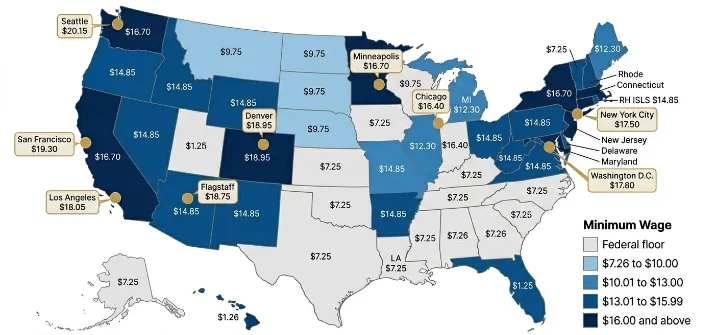
This truly is the headache that never goes away for any company that operates in multiple states: paid sick leave laws are patchwork, minimum wages vary from the statutory federal level of $7.25 to above $17 in parts of the country, and predictive scheduling laws have been enacted in some places but not others. Whether a non-compete is enforceable is a state-by-state coin flip at this point. Ohio passed its own mini-WARN Act in late 2025, requiring additional notice in the event of mass layoffs on top of what the federal WARN Act demands. There are dozens of these, and multi-state employers basically need a compliance calendar that updates quarterly and even then things slip through.
A functional breakdown of the four hot zones:
| Issue | What’s happening | Who should care most |
|---|---|---|
| DEI program scrutiny | Active EEOC and DOJ investigations into Title VII compliance | HR leaders at companies with formal diversity programs |
| Gig worker classification | State-by-state litigation, federal rule rewrite in progress | Anyone using 1099 contractors or running a platform business |
| Remote work accommodations | Courts pulling back on automatic ADA protection | Employees with disability accommodations, employers writing job descriptions |
| State law patchwork | Constantly changing laws (leave, pay, scheduling) | Multi-state businesses, small businesses near state lines |
For a low-stakes sense of what working people are actually facing, r/law and r/legaladvice on Reddit have threads where people walk through the particulars of their situation. This is not a substitute for talking to an actual lawyer.
A Quick Trip Backward, Because It Helps
You can’t really understand why American labor law looks the way it does without knowing where it came from. Two laws in particular shaped almost everything that followed.
The Wagner Act, formally known as the National Labor Relations Act of 1935, was a New Deal reaction to thirty years of ugly labor warfare. In the days before Wagner, it was possible to be dismissed, beaten or shot after forming a union and legal action was hardly an option. The Act ensured the right to organize, right to collectively bargain and the right to strike. The impact was theatrical. In the U.S., the number of union members increased to approximately 15 million by 1947 as compared to approximately 3 million in 1935. Five times more in twelve years.
Then followed the counter-reaction. Following the World War II, there was a series of strikes in large-scale industries (steel, coal, auto manufacturing) and the general public became hostile to what was viewed as the over-reaching of the unions. In 1947, the Congress enacted the Taft-Hartley Act over the veto of President Truman and it fundamentally changed the rules. Taft-Hartley:
Then came the backlash. After World War II, a wave of strikes hit major industries (steel, coal, auto manufacturing) and public opinion turned against what was seen as union overreach. Congress passed the Taft-Hartley Act in 1947 over President Truman’s veto and it fundamentally reshaped the rules. Taft-Hartley:
- Banned closed shops, where employers could only hire union members.
- Made unions subject to unfair labor practice charges (before this, only employers could be charged).
- Allow states to become right-to-work states and this is why the union membership in one state, like Michigan and the other one, like Texas, is so different.
- Allowed the President to apply to an 80-day injunction to stop a strike that was threatening national health or safety.
That balance between the protections of Wagner and the restrictions of Taft-Hartley remains the system of operation of labor relations in the private sector today. When you read about an NLRB decision or a union election, you’re watching that 1935-1947 framework in action, just with different facts and different industries.
The reason this matters in 2026: the Starbucks v. McKinney decision I mentioned earlier is, in a sense, another small tilt of that scale. Every generation seems to make some adjustment to the Wagner-Taft-Hartley balance and the recent Court has clearly tilted it toward employers. Whether that’s good or bad depends on where you sit, but it’s not new. It’s the latest move in a 90-year argument.