 Irma C. Dengler
- The country was still shaking off the paranoia of the Red Scare and state legislatures had passed a patchwork of “criminal anarchy” laws that, frankly, made lawyers like me nervous. New York’s version — Penal Law §§ 160–161 — criminalized advocating the violent overthrow of organized government. Broad language. Deliberately broad.
Benjamin Gitlow walked straight into it.
He was a socialist, a former state assemblyman and one of the managers of a newspaper called The Revolutionary Age. In 1919 right when the Bolshevik Revolution was still fresh news and American authorities were watching labor organizers like hawks, he published and distributed “The Left Wing Manifesto.” The document called for revolutionary mass action, class struggle, industrial revolts. It was not subtle.
He was arrested, tried under the New York statute, convicted and eventually ended up before the U.S. Supreme Court. The case was argued twice in 1923, with ACLU attorneys Walter H. Pollak and Walter Nelles handling the arguments — notably, Gitlow v. New York was the ACLU’s first major Supreme Court case.
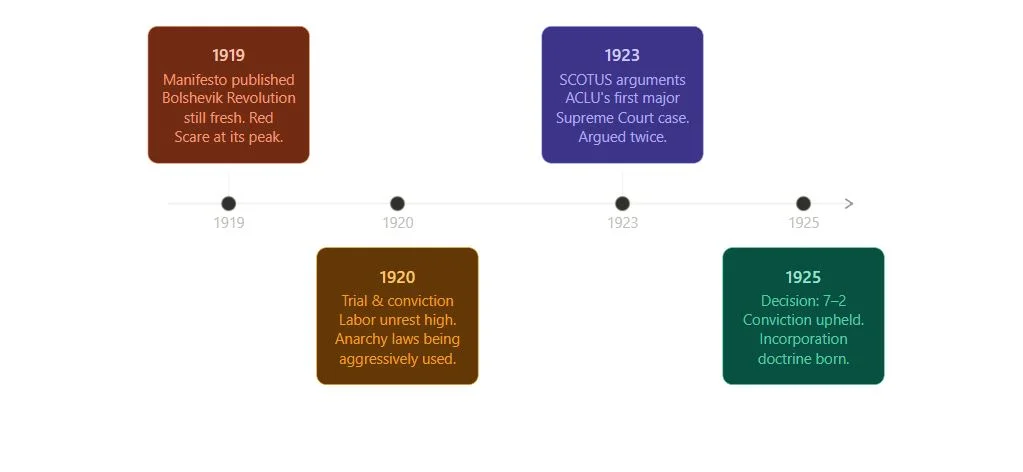
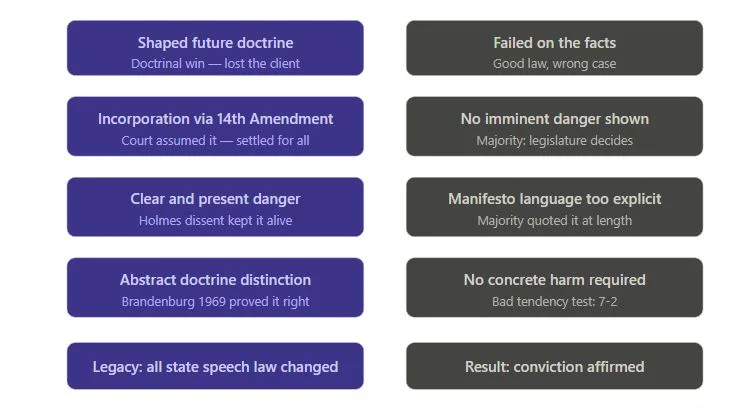
Here’s where it gets interesting, constitutionally speaking. Gitlow lost his case 7–2. Conviction upheld. But the opinion contained something that would reshape American constitutional law for decades: the Court’s assumption that the First Amendment’s speech and press protections apply to the states through the Fourteenth Amendment’s Due Process Clause. What we now call incorporation doctrine.
He lost the battle. Won the war. Sort of.
The Statute and the Charge
The New York Criminal Anarchy Law targeted anyone who:
- Advocated, advised or taught the duty or necessity of overthrowing government by force or violence.
- Published or distributed material containing such advocacy.
No requirement that actual violence followed. No requirement that anyone was actually incited. The words themselves, if they fit the statutory definition, were enough. That’s the legal tension at the heart of everything Gitlow’s lawyers were fighting.
Gitlow’s Arguments at the Trial Level
At trial in 1920, Gitlow’s defense wasn’t complicated — it was actually quite clean, as a matter of legal theory. The core argument: the manifesto caused nothing.
No strikes happened because of it. No riots. No attempted overthrow of anything. The prosecution couldn’t point to a single concrete result flowing from it’s publication. And Gitlow’s lawyers hammered that. Under what theory, they asked, do you criminalize words that produced no harm, no incitement, no action whatsoever?
The argument drew on a distinction courts had been wrestling with since Schenck v. United States (1919) — the difference between abstract political doctrine and direct incitement to illegal acts. From my perspective as counsel, this is actually a sophisticated trial-level move. You’re not defending the ideas in the manifesto. You’re attacking the category the prosecution put those ideas in.
The defense framed the manifesto as:
- Historical and political analysis — a prediction about socialist trends, not a call to arms.
- “Abstract doctrine” — the kind of theoretical writing that fills political journals without causing anyone to pick up a weapon.
- Essay-like commentary on where the labor movement was heading, not operational instructions for revolution.
Was that characterization entirely accurate? Gitlow himself, years later after breaking with communism, essentially said no — he wrote that his group “openly called for the violent overthrow of the United States Government.” But at trial, that candor wasn’t on the table. The legal strategy was framing and it was reasonable framing given the statutory language.
The Jury Instruction Problem
The trial judge did instruct the jury on the distinction between abstract doctrine and direct incitement. That matters. It means the jury was told to consider whether the manifesto actually crossed into unprotected advocacy — and convicted him anyway.
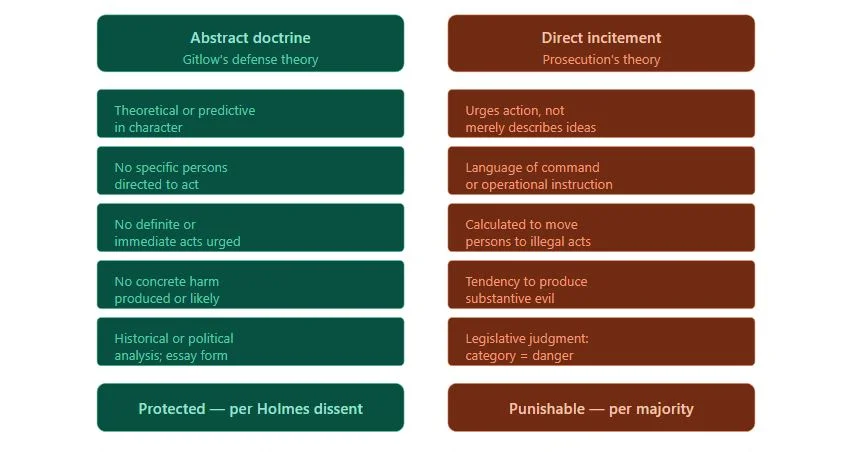
From a lawyer’s standpoint, a losing jury instruction is a gift on appeal. You’ve preserved the argument. The question of whether the manifesto was mere doctrine or actionable incitement becomes the central appellate issue and now you’re taking it to courts that can actually reshape the legal standard.
The New York appellate courts weren’t persuaded. They upheld the conviction. But Pollak and Nelles weren’t done.
What the Defense Strategically Avoided
Worth noting and this is something I point out to law students, Gitlow’s trial defense never really engaged with the content of the manifesto on the merits. They didn’t argue revolutionary socialism was good policy. They didn’t defend the Bolshevik Revolution. They stayed in the procedural and constitutional lane: even if you find these ideas repugnant, the law as applied here punishes speech that caused nothing and that’s constitutionally impermissible.
That restraint was tactically smart. Juries in 1920 weren’t going to be warmed up to defenses of revolutionary socialism. But they might respond to a clean argument about legal standards and the absence of harm. They didn’t, as it turned out but the argument was sound and it traveled well to the appellate level.
Gitlow’s Arguments on Appeal to the U.S. Supreme Court
By the time Pollak and Nelles got to Washington, the defense had sharpened considerably. Trial-level arguments about harm and incitement were still there but now they were wrapped in something bigger. Something that, if it landed, would change the constitutional architecture of the entire country.
The incorporation argument.
In 1923, this wasn’t settled law. It wasn’t even close to settled. The prevailing understanding since Barron v. Baltimore (1833) was that the Bill of Rights constrained the federal government, not the states. States had their own constitutions, their own courts, their own limits. The First Amendment said “Congress shall make no law” and courts had largely read that literally. Congress. Not Albany.
Gitlow’s lawyers said: look at the Fourteenth Amendment again. “No state shall deprive any person of life, liberty or property without due process of law.” Liberty. What does liberty mean if it doesn’t include the freedom to speak and publish? The argument was that First Amendment protections weren’t just federal, they were fundamental rights absorbed into “liberty” under the Fourteenth Amendment, binding on states just as firmly.
Bold. And at the time, genuinely uncertain as a matter of doctrine.
The Full Architecture of the Supreme Court Arguments
Breaking it down, because the appellate arguments were layered:
1. The Incorporation Argument The New York statute, as applied to Gitlow, deprived him of liberty without due process. “Liberty” in the Fourteenth Amendment encompasses freedom of speech and press, the same freedoms the First Amendment protects against federal interference. States aren’t exempt from those protections.
2. The Overbreadth Argument Even accepting some state power to regulate dangerous speech, this statute swept too broadly. It criminalized any advocacy of overthrow by unlawful means, regardless of circumstances, regardless of actual danger. No connection between the words and any real or imminent harm was required. That kind of categorical prohibition, untethered from actual threat, violated due process.
3. The Clear and Present Danger Argument Drawing directly from Holmes’s Schenck opinion, speech is only punishable where it creates a clear and present danger of substantive evil. Gitlow’s lawyers argued the state had to prove the manifesto posed that kind of danger. It hadn’t even tried. The prosecution rested entirely on the content of the document, not on any evidence of actual risk.
4. The Abstract Doctrine Argument (Carried Forward from Trial) The manifesto didn’t advocate “definite or immediate acts” of force. It didn’t tell specific people to do specific things. It was closer to a political essay, a prediction about historical forces, than an operational call to action. No incitement to concrete acts, no evidence anyone was actually incited.
What Made These Arguments Difficult
Here’s what I find genuinely interesting about the strategic position Pollak and Nelles were in, they were essentially asking the Court to do two hard things simultaneously.
First, announce a new constitutional principle (incorporation) that would significantly expand federal judicial oversight of state laws. That’s not a small ask in 1923. States’-rights sentiment was strong. The Court had been reluctant.
Second, apply that principle to this defendant, publishing this document, at this moment in history, when public and judicial anxiety about communist revolution was at something close to peak levels. The political optics were genuinely terrible.
| Argument | Legal Basis | Strength | Vulnerability |
| Incorporation via 14th Amendment | Due Process Clause, Barron v. Baltimore distinguished | Doctrinally innovative, ultimately persuasive | Novel — no prior clear holding |
| Overbreadth of statute | Due process, lack of harm requirement | Clean and logical | Legislature has police power to categorize dangers |
| Clear and present danger | Schenck v. United States (1919) | Strong precedent, Holmes authored it | Majority distinguished Schenck as fact-specific |
| Abstract doctrine / no incitement | Statutory interpretation, trial record | Preserved below, well-argued | Manifesto’s language undercut it |
The incorporation argument ultimately succeeded — doctrinally. The Court assumed it was correct. But the other three arguments collapsed under the majority’s reasoning. And that’s the painful irony of Gitlow: the lawyers won the constitutional principle they needed most for the future, while losing every argument that would have actually freed their client.
Lawyer’s Professional Analysis — Strategic Strengths, Weaknesses and Tactical Choices
Let me step back from the doctrine for a moment and just talk about the lawyering.
Pollak and Nelles were working with a genuinely difficult hand. Their client had published something that, in plain English, called for revolutionary overthrow. The political climate was hostile. The lower courts had already ruled against them twice. And they were asking a conservative Supreme Court to expand constitutional protections in a case involving a socialist manifesto. Timing couldn’t have been worse, realistically.
And yet — the strategic choices they made were sound. More than sound, actually.
What They Got Right
Staying out of the merits was the right call. Never defending revolutionary socialism on it’s substance. Never arguing the manifesto was good policy. They kept the entire defense in the constitutional lane: even dangerous ideas deserve protection unless they produce actual danger. That framing made the argument portable, it wasn’t about Gitlow’s politics, it was about legal standards that would apply to everyone’s speech.
The incorporation argument was visionary. It wasn’t going to win in 1925, the political moment wasn’t right but they planted it. The Court assumed it was correct, which in legal terms is nearly as good as holding it. Every First Amendment case against a state law for the next century traced back to that assumption becoming doctrine.
Preserving the clear and present danger argument was also tactically important. Holmes had written Schenck. Getting Holmes engaged and they did, he dissented powerfully, gave the losing position credibility and doctrinal staying power.
Where the Arguments Were Vulnerable
The manifesto’s actual language was a problem they couldn’t fully escape. The majority quoted it at length — “revolutionary mass action,” destruction of the parliamentary state, “revolutionary dictatorship of the proletariat.” Arguing that was “abstract doctrine” required the Court to ignore what the words plainly said. The majority wasn’t going to do that.
The clear and present danger argument ran into a majority that simply didn’t want to apply it that way. The Court distinguished Schenck as a case involving specific wartime circumstances, not a general rule limiting state police power. Once the legislature categorically determined certain advocacy was dangerous, courts didn’t need to second-guess it case by case. That’s a significant narrowing and it held for years.
The Holmes Dissent as Vindication
What stands out to me as counsel is how Holmes’s dissent essentially validated the defense’s strongest arguments, just not in time to help Gitlow. The manifesto had “no chance of starting a present conflagration.” It reached a small audience. It produced nothing. Every idea is technically an incitement if someone believes it strongly enough, that can’t be the standard or free speech means nothing.
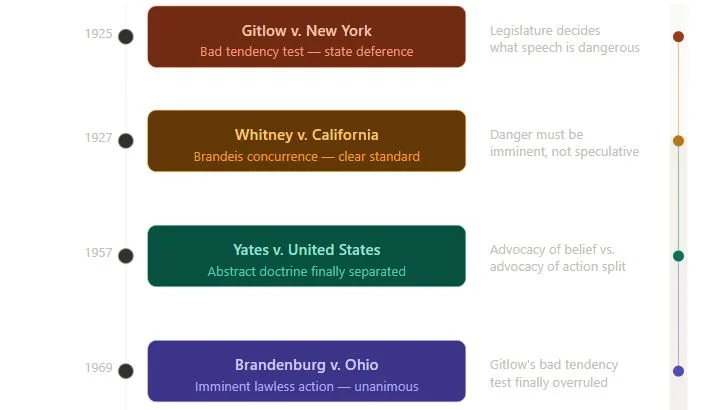
Holmes and Brandeis dissenting together carried weight. Not legal weight in 1925, but intellectual and historical weight that would eventually shift doctrine in the direction Gitlow’s lawyers had been arguing all along. Brandenburg v. Ohio in 1969, which finally required proof of imminent lawless action before speech could be criminalized is essentially the vindication of arguments Pollak and Nelles made in 1923.
They were just about forty-five years early.
The Dissent, Long-Term Legacy and Contemporary Relevance
Holmes didn’t mince words.
“There was no present danger of an attempt to overthrow the government by force on the part of the admittedly small minority who shared the defendant’s views.” That was his position, stripped down. The manifesto was addressed to a fringe. It ignited nothing. And punishing it anyway, based purely on it’s ideological content was, in his view, a fundamental misuse of state power.
Brandeis signed on. Two of the most respected legal minds on that Court, both dissenting. That’s not a footnote, that’s a fault line.
Why the Dissent Mattered More Than the Majority (Eventually)
Here’s the thing about landmark dissents: they’re arguments waiting for their moment. Holmes wasn’t writing for 1925. He was writing for whenever the Court was ready to listen and he knew it.
The majority in Gitlow adopted what scholars call the “bad tendency” test speech could be punished if it had a tendency to produce harmful results, even without proof of imminent danger. Legislative judgment about what categories of speech were dangerous was essentially unreviewable. That’s enormous deference. And it held for a while.
But the Holmes-Brandeis position kept resurfacing. Whitney v. California (1927), Brandeis wrote a concurrence so detailed and philosophically rigorous about the conditions required before speech could be suppressed that it reads almost like a treatise. It wasn’t the holding. Didn’t matter. Law professors were assigning it within years.
Then Terminiello v. Chicago (1949). Yates v. United States (1957), where the Court finally drew a harder line between abstract doctrine and advocacy of action. Each case chipped away at the bad tendency framework.
And then Brandenburg v. Ohio (1969).
Brandenburg: Where Gitlow’s Lawyers Were Proved Right
Brandenburg involved an Ohio Ku Klux Klan leader convicted under a criminal syndicalism statute, structurally similar to the New York law that got Gitlow. The Court struck it down unanimously. The new standard: government cannot punish advocacy of illegal action unless it is directed to producing imminent lawless action and is likely to produce such action.
That’s essentially what Pollak and Nelles argued in 1923. Imminence. Likelihood. Actual connection between the words and real-world harm.
Gitlow lost that argument by seven votes. It took forty-four years, but it became constitutional law anyway.
The Incorporation Legacy — Arguably Bigger Than the Speech Question
Doctrinal impact of Gitlow on incorporation is hard to overstate. Before 1925, states operated with significant freedom from First Amendment constraints. After Gitlow, even though the Court only “assumed” incorporation rather than formally holding it, the door was open.
Cases came through quickly:
- Stromberg v. California (1931) — First Amendment applied to strike down a state red flag law.
- Near v. Minnesota (1931) — Prior restraint doctrine applied against states.
- DeJonge v. Oregon (1937) — Assembly and petition incorporated.
- Eventually, almost the entire Bill of Rights applied to states through the same Due Process Clause logic Gitlow introduced.
Every time you read about a state law being challenged on First Amendment grounds, a state university punishing student speech, a municipality restricting protests, a state criminal statute targeting online expression, that case exists in a constitutional framework Gitlow helped build. The man who lost became the foundation for protections that affect hundreds of millions of people.
That’s not nothing.
Contemporary Relevance: The Arguments Haven’t Aged Out
Spend any time with current First Amendment litigation and you’ll find Gitlow‘s core tensions alive and loud.
Social media platform regulation. State laws targeting “harmful” online speech. Campus speech codes. Prosecutions under material support statutes that critics argue punish association and advocacy rather than action. The question Gitlow’s lawyers posed in 1923 at what point does the state’s interest in preventing dangerous ideas justify suppressing them? is asked constantly, just in different factual contexts.
The bad tendency test is formally dead after Brandenburg. But the impulse behind it legislative deference, categorical suppression of disfavored speech, treating ideological advocacy as inherently dangerous that impulse keeps finding new expressions. Courts keep having to redraw the line.
Gitlow Himself: A Strange Coda
Worth mentioning because it’s genuinely strange. Benjamin Gitlow eventually broke with communism, became vocally anti-communist and later cooperated with congressional investigations into communist activity in America. He wrote in his memoir that he and his comrades had openly called for violent overthrow essentially conceding what the majority said about the manifesto.
The man whose conviction produced landmark speech protections later took positions that, had they been held by others, those same protections might have shielded. History has a dark sense of humor sometimes.
Conclusion and Practical Takeaways for Modern First Amendment Practice
So what do you actually take from Gitlow if you’re practicing today?
Quite a bit, as it turns out.
The Case Teaches Doctrinal Patience
Gitlow’s lawyers lost in 1925. Every substantive argument they made clear and present danger, no incitement, abstract doctrine was rejected. And yet, within decades, those arguments became the controlling framework. Brandenburg is their argument. The incorporation doctrine they pioneered restructured American constitutional law.
For practitioners: losing cases at the Supreme Court level doesn’t mean the arguments are wrong. It sometimes means they’re early. The dissent you write today, the brief argument that gets two votes instead of nine, that’s sometimes where doctrine goes next. Holmes knew it. Brandeis knew it. Write for the future, not just the current bench.
Preserve Everything at the Trial Level
Gitlow’s trial attorneys preserved the abstract doctrine argument. That preservation made the appellate arguments possible. In First Amendment cases especially, where facts about context, audience, actual harm and likelihood of danger all matter, a clean trial record is everything.
If you’re defending a speech case at trial, document:
- Evidence (or absence of evidence) of actual harm flowing from the speech.
- The specific audience reached and their response.
- The context in which the speech occurred.
- Any expert testimony on the distinction between advocacy and incitement.
These aren’t just trial arguments. They’re the foundation for every appellate argument you’ll make.
Know Which Battle You’re Actually Fighting
Pollak and Nelles were simultaneously fighting for Gitlow’s freedom and for a constitutional principle larger than any single client. Those goals weren’t always aligned. The incorporation argument was their best long-term move but their weakest immediate one asking a conservative Court to expand federal oversight of states while defending a socialist manifesto was always going to be difficult.
Modern practitioners face similar tensions constantly. The case that makes bad law is sometimes the one with the most sympathetic facts for a broad ruling but you might win on narrower grounds that don’t advance the doctrine. Knowing when to push for the broader principle and when to take the narrow win is genuinely hard. Gitlow is a useful case study in what happens when you push for the principle and lose the client.
The Incorporation Doctrine Is Your Foundation — Use It
Every state-level First Amendment challenge you bring rests on Gitlow‘s assumption, later confirmed through decades of doctrine. Understanding why the Fourteenth Amendment incorporates First Amendment protections not just that it does makes you a better advocate. You can argue about the scope of liberty, about fundamental rights, about why certain protections are so essential to ordered liberty that states can’t abridge them any more than Congress can.
That’s not just constitutional history. That’s the theoretical foundation for arguments you’ll make in briefs and oral arguments throughout your career.
Final Thought
Gitlow v. New York is one of those cases where the headline result conviction affirmed, defendant loses completely misrepresents it’s significance. The man went to prison. The doctrine he generated protected speech for generations.
Benjamin Gitlow published a manifesto calling for revolutionary overthrow and ended up as the vehicle through which American courts built some of their most important free speech protections. His lawyers lost on every argument that would have helped him and won on the argument that helped everyone else.
If that’s not worth teaching, I don’t know what is.