 Nicholas J. Rego Accident Lawyer
You rear-end someone at a stoplight, it’s annoying. A semi rear-ends you? That’s a whole different nightmare. The physics alone should scare you – an 80,000-pound truck versus your 4,000-pound sedan isn’t a fair fight. But the legal mess that follows makes the physical damage look simple.
According to the Benton Accident & Injury Lawyers, around 13 million accidents occurred in the USA in 2023. Despite an annual decline in road accidents, it remains an ongoing issue.
The Weight Problem
Federal law limits the weight of commercial trucks to 80,000 pounds (49 CFR 658.17), though states can issue permits for heavier loads. Your average car? Maybe 4,000 pounds if you’re driving something big. That weight difference? It makes all the difference when it comes to crashes.
The stopping distance tells the real story. A semi-truck carrying a full load at 65 mph needs about 525 feet to come to a full stop — nearly two football fields. Your car? It needs maybe 300 feet. Truckers are well aware of this, and yet some still tailgate. And when things go wrong, the car always loses.
Insurance companies are all too familiar with this weight issue. That’s why the Federal Motor Carrier Safety Regulations (FMCSR) require trucking companies to carry liability coverage of at least $750,000 to $5 million, depending on what they’re hauling (49 CFR 387.9). Meanwhile, your state likely only requires you to carry $25,000. See the difference?
Multiple Defendants Make Everything Complicated
Hours of Service – The One Rule Everyone Breaks
The FMCSR restricts drivers to driving for 11 hours following at least ten consecutive hours off duty (49 C.F.R. sec 395.3). This makes sense until you realize that driver pay is by the mile, not by time. Sitting in traffic doesn’t pay. Waiting for loading doesn’t pay. So they fudge the logs.
Electronic Logging Devices (ELDs) were supposed to correct this once they became required in 2017. It’s harder to cheat a computer than a paper logbook, right? Except drivers found workarounds. They’ll log off duty while stuck in traffic. Go into “personal conveyance” mode when they are, in fact, driving to get loads. The creativity is impressive, honestly.
When these violations lead to accidents, it’s the best thing since sliced bread for plaintiff lawyers. Jury learns the driver was in hour 14 of a shift that was supposed to last 11 hours? That’s punitive damages territory. Trucking companies know that and will often quickly settle these cases when logs look bad.
The Black Box Most People Don’t Know About
Car accident?
- You file a lawsuit against the other driver, maybe their employer if they were on the clock.
Truck accident?
- Now you’re possibly looking at multiple defendants:
- The driver.
- The trucking company.
- The shipper or cargo loader.
- Potentially a maintenance company.
- In cases involving product liability, the truck manufacturer.
- I’ve had cases with up to eight defendants before we were allowed to do discovery.
The trucking company will often quickly claim that its driver was an “independent contractor” and is therefore not liable. However, courts can often see through that tactic if the company:
- Controls the routes.
- Sets the delivery times.
- Slaps its logo on the truck.
The legal test varies by state, but the key issue is control, not who holds the paperwork.
Then there’s the concept of “vicarious liability” under respondeat superior — Latin for “the boss pays for what the employee did.”
- Trucking companies sometimes get creative by:
- Leasing the truck to the driver.
- Claiming no responsibility for what happens.
Some courts accept this, others don’t. It depends on your state and how well you can afford a lawyer who can connect the dots.
Pre-Trip Inspections That Never Happened
Federal law requires pre-trip inspections (49 CFR 396.13). Drivers must check brakes, tires, lights, cargo securement – takes about 15 minutes if done right. Most drivers pencil-whip these forms in 30 seconds while their coffee brews.
Post-accident investigations reveal the truth. Brake shoes worn to nothing. Tires with cords showing. Cargo that shifted because nobody checked the straps. Each violation is evidence of negligence, and systematic violations show the company’s culture of cutting corners.
The Federal Motor Carrier Safety Administration (FMCSA) maintains safety scores for every carrier through the Compliance, Safety, Accountability (CSA) program. Public information, anyone can look it up. When a company with terrible scores hurts someone, juries tend to award big numbers.
Discovery Fights You’ll Avoid in Car Cases
- Trucking companies keep defense firms on retainer who specialize in overwhelming plaintiffs with paperwork:
- They’ll object to everything.
- Assert privilege on routine documents.
- “Lose” important files, like the driver’s qualification records.
- It’s a strategy of attrition.
- The driver’s personnel file can be a battleground:
- Previous accidents? They’ll claim they’re irrelevant.
- Failed drug tests? “Too prejudicial.”
- Cell phone records showing texting? “Invasion of privacy.”
- You’ll have to file a motion to compel for every single piece of evidence.
- Meanwhile, they’ll demand access to every medical record you’ve ever had:
- Did you have back pain 10 years ago? They’ll argue your current issues stem from that, not the truckload of bricks they dropped on you.
- They’ll ask for your social media, work files, and pretty much everything else.
- It’s a game of asymmetric warfare.
Settlement Pressure and Nuclear Verdicts
- Trucking companies used to fight every case to the bitter end.
- But then came nuclear verdicts — jury awards of $50 million, $100 million.
- Now, if liability is clear and damages are substantial, they often settle rather than face a jury.
- Expect them to pull out all the stops to minimize the payout:
- Surveillance showing you unloading groceries even though you allegedly can’t lift a thing.
- Biomechanical experts arguing the crash couldn’t have caused the injuries you’re complaining about.
- Economists claiming you would’ve been unemployed anyway.
- Real leverage comes from knowing which companies have been burned before:
- A carrier that’s already paid out $50 million in another state will settle quicker than one that hasn’t faced a huge verdict.
- Their insurance companies are constantly monitoring this.
Insurance Games and Layered Coverage
One million dollar policy sounds like a lot until you realize a traumatic brain injury can run $3 million in medical bills alone. Trucking insurers know this math. They’re going to be making quick settlements hoping the victims don’t lawyer up.
The true coverage is often buried in layers. Primary policy for $1 million, excess coverage for another $5 million, umbrella on top of that. But insurance companies do not give this information freely. They’ll behave as if that first million is all there is.
Trucking companies are playing games with their policies. They will purchase coverage from offshore insurers that vanish when claims arrive. Or they’ll self-insure in complex captive insurance deals. It is difficult to appreciate the actual coverage while the statute of limitations runs out.
Use Event Data Recorder (EDR)
- Your car likely has an Event Data Recorder (EDR), but commercial trucks come with Electronic Control Modules (ECMs) that track everything:
- Speed
- Brake application
- RPMs
- Clutch position
- And much more, with data that can go back months, not just a few seconds before impact like car EDRs.
- Getting this data requires acting fast:
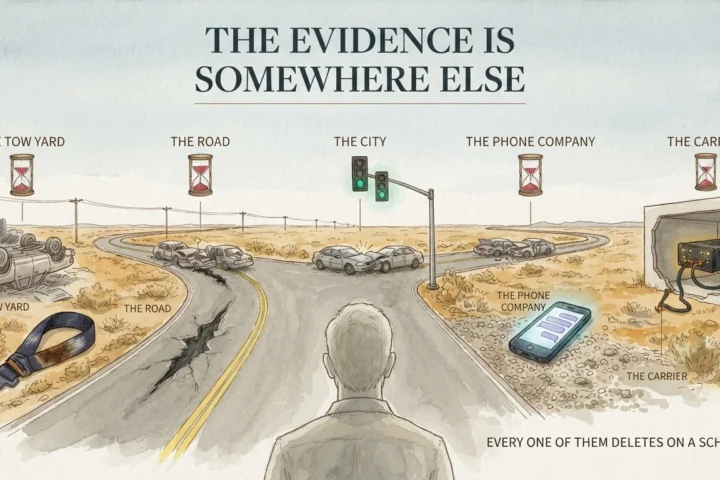
- No federal law requires the data to be preserved.
- Companies “accidentally” overwrite it all the time.
- Smart lawyers send preservation letters right away.
- Some states have spoliation laws that penalize companies for destroying evidence — but first, you have to prove they were notified to preserve it.
- ECM data can destroy a trucker’s story in an instant:
- Truck driver says they were going 55 mph? ECM shows 73 mph.
- Driver claims they hit the brakes? ECM shows no brake application at all.
- I’ve seen defense attorneys literally shut their briefcases mid-deposition when confronted with ECM readouts.
State Laws That Change Everything
There are different commercial truck laws in Texas than in California. The no-fault auto insurance in Florida plays weirdly with trucking policies. Georgia permits direct actions upon insurers that other states do not presume.
A cap on the amount of damages, some states have it, and others don’t. Some require punitives to be based on gross negligence; others, ordinary negligence. The identical accident could be worth $500,000 in one state and $5 million across the border.
Forum shopping is not the exclusive province of big corporations. Depending on where the accident occurred, where the trucking company is located and where it does a significant amount of business — each could be an option for filing a lawsuit. Choose wrong and you’ve reduced your case value by 90 percent.
The Timeline Problem
Car wreck cases are likely to resolve within a year. Trucking cases? Three years, at a minimum, if they’re serious. The discovery process alone can last a year and a half. Depositions across multiple states. Expert witnesses sparred over issues ranging from brake temperatures to the impact of sleep deprivation.
Meanwhile, medical bills pile up. Lost wages accumulate. Their target: the vulture-like litigation funding companies that dangle piles of cash now in exchange for a cut of your settlement later. Trucking defendants feel this pressure and they use it.
Some companies can’t afford the cost. Trucking cases could require $100,000 in expenses before trial — accident reconstructionists, medical experts, economists, trucking safety experts. Smaller outfits either get “tapped out” or they bring in co-counsel, thus eating into the client’s recovery.
References
- Federal Motor Carrier Safety Regulations (FMCSR) – 49 CFR Parts 300-399
- Hours of Service Regulations – 49 CFR 395.3
- Minimum Insurance Requirements – 49 CFR 387.9
- Vehicle Weight Limits – 49 CFR 658.17
- Inspection and Maintenance Requirements – 49 CFR 396.13
- CSA Safety Measurement System – FMCSA publicly available database
- Electronic Logging Device Mandate – 49 CFR 395