 James Mcleod NZ (AU NZ Immigration Lawyer)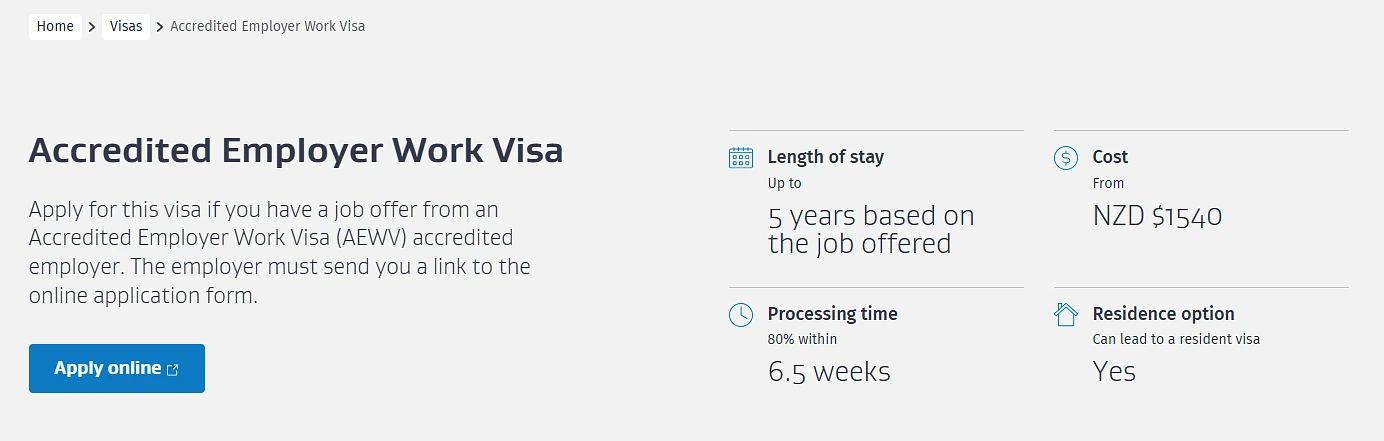
Key Takeaways:
- In July 2022, the AEWV replaced six other work visa streams and is currently New Zealand’s main employer-sponsored work visa.
- It involves the employer first being accredited, followed by an assessment of the job, before the worker can apply for a visa.
- The government rolled out major reforms across 2025 in phases: removing the median wage threshold, simplifying the job check, and lengthening the visa period for lower-skilled roles.
- You can stay for up to 5 years in an ANZSCO skill level 1 to 3 role, or 3 years in a skill level 4 to 5 role. After that, you need to leave New Zealand for 12 months before applying for another AEWV.
- In practice, the AEWV functions as a step towards a Skilled Migrant Category residence visa. It is not meant to be a dead end.
- From August 2025, wage thresholds update to reflect the June 2024 median wage of $33.56/hour. From March 2026, the immigration median wage rises to $35.00 per hour.
How the Three Steps Actually Work
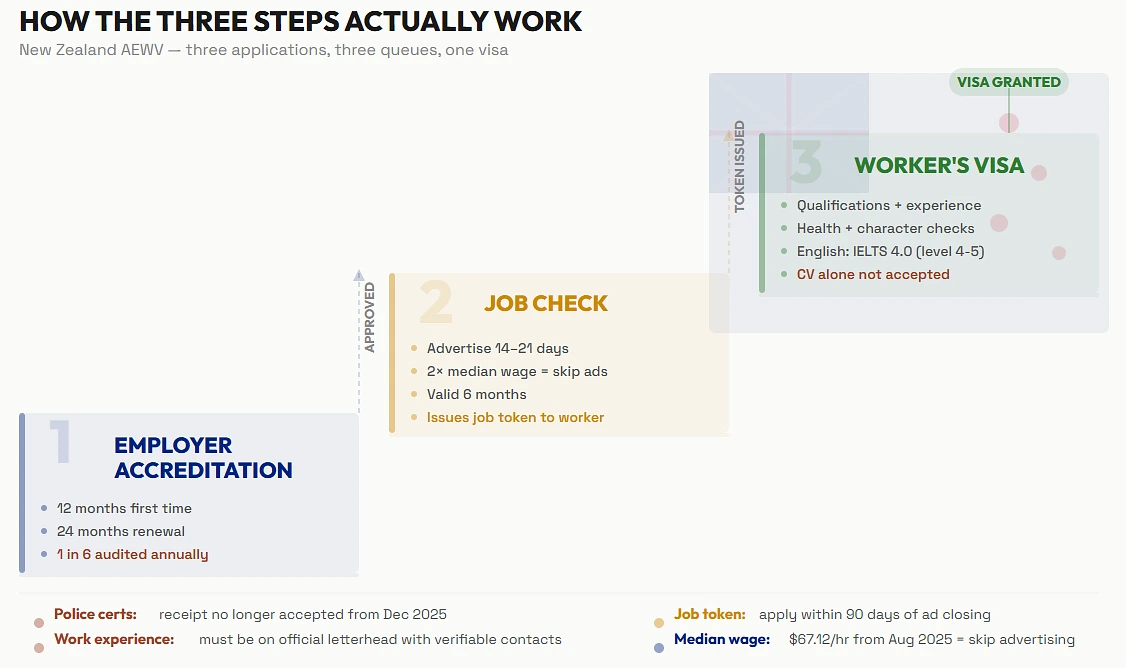
The fundamental construct of the AEWV system is an idea that sounds fine in theory and gets messy in practice. It is this: employers need to prove that they need a migrant worker before the migrant worker applies, and they have to do this in three separate applications to Immigration New Zealand, each with its own fees, evidence requirements and time frames.
Step 1 — Employer Accreditation
The first step is for the employer to be accredited, which is INZ’s way of checking that the business is genuine, financially sound, and compliant with New Zealand employment law. There are two main forms.
Standard accreditation applies to employers who wish to employ up to five migrants at any one time on AEWVs. High-volume accreditation applies to employers who wish to employ six or more. Additionally, there is a triangular employer accreditation for labour hire companies who place migrant workers with controlling third parties, and it carries extra requirements because the arrangement is more complex from a worker protection standpoint.
First accreditation lasts for 12 months. Each subsequent application will be approved for 24 months as long as the business meets all the requirements and its accreditation has not been expired for more than 12 months.
What INZ actually looks at is whether the business is financially viable, whether it has a compliance history with employment standards, no record of exploiting workers, and a genuine operating business in place. They’re now auditing roughly one in six accredited employers every year, so it’s not a one-off tick.
Step 2 — The Job Check
After accreditation is granted, the employer can apply for a Job Check for the specific role. This is INZ’s requirement to ensure that, before a job goes to a migrant worker, no suitable New Zealand citizen or resident is available for it.
The employer must advertise nationally on platforms such as Seek or Trade Me for at least 14 calendar days for roles on the National Occupation List, and 21 calendar days for skill level 4 or 5 ANZSCO roles. For skill level 4 or 5 roles the employer must also engage with Work and Income, and as of March 2025 that is declaration-based instead of the previous engagement check.
No advertising is needed if the role pays at least twice the median wage ($67.12/hour from August 2025) or the occupation is on the Green List.
One job check may be used to fill multiple positions where the ANZSCO/NOL code, occupation, pay, location and minimum requirements are the same. Different location or different pay means a separate job check. The approval is valid for 6 months, and the employer must apply within 90 days of the job advertisement closing.
If the job check is approved, the employer receives a job token, a unique code which gets passed to the migrant worker.
Step 3 — The Worker’s Visa Application
The worker then uses that token to apply online via Immigration Online, where the job details the employer provided during the job check are prefilled. The worker’s side focuses on the personal requirements: qualifications, work experience, health, and character. If the role is skill level 4 or 5, the English language requirement (IELTS 4.0 or equivalent) also applies.
One surprise is that a CV alone is not enough to prove previous employment; you will also need employment certificates on official headed paper showing job title, dates of employment and verifiable contact details for each employer. Immigration New Zealand is specific about this because fraudulent employment documents have been a persistent problem.
Police certificate rules changed in December 2025 too. You must upload the actual certificate. A receipt showing you’ve ordered one is no longer acceptable, and the exceptions for applicants from Fiji, Hong Kong and Israel are narrow.
What Changed in 2025 — and Why It Matters?
The government announced several AEWV reforms in December 2024, which were rolled out in a piecemeal fashion over the course of the year, aimed at making the system more responsive and easing the processing bottlenecks that had been causing grievance among employers and migrants alike. Whether that worked is a matter of which employer or migrant you ask, but the individual changes are significant.
Here’s the timeline:
| Date | Change | What It Replaced |
| January 2025 | Online employer modules removed | Employers were previously required to complete training modules online |
| March 2025 | Median wage threshold removed for AEWV roles | All AEWV roles previously had to pay at or above the NZ median wage |
| March 2025 | Job Check redesigned — declaration-based engagement with Work and Income | Old system required a formal engagement check for skill level 4/5 roles |
| March 2025 | Minimum work experience reduced to 2 years | Previous requirement for many roles was 3 years |
| April 2025 | Interim work rights for all AEWV applicants from any work or student visa | Previously limited to certain visa types |
| Mid-2025 | Skill level 4/5 visa duration extended from 2 years to 3 years | Workers previously got 2 years with an option to apply for 1 more |
| Mid-2025 | Construction domestic workforce threshold reduced from 35% to 15% | Certain construction employers needed 35% of workforce to be NZ citizens/residents |
| August 2025 | Wage thresholds adjusted to reflect the $33.56/hour median wage | Previous thresholds based on older Stats NZ data |
| December 2025 | Two new temporary seasonal visa pathways created (GWSV and PSV) | Existing temporary seasonal pathways |
| December 2025 | Police certificate receipts no longer accepted — actual certificates required | Receipts were accepted while certificates were being processed |
Removing the median wage threshold is probably the biggest single change. Until March 2025, all AEWV roles had to pay at least the NZ median wage. That locked out whole industries (hospitality, aged care, some agricultural work) where the genuine market rate for the job sat below the median. The new rule still requires paying the market rate for the job and at least the NZ minimum wage, but no longer imposes an artificial floor that was higher than what the job actually pays in the real economy.
The median wage threshold is only removed for the AEWV itself, though. Residence visa pathways, such as the Skilled Migrant Category, are still subject to median wage benchmarks. So a worker can now come into the country on an AEWV at a lower wage, but as soon as they look to move to residence they will be hit with the median wage requirement again. That gap is going to create some frustration for people who don’t plan ahead.
Additional form for the Accredited Employer Work Visa – This Is From 2024
Wage Thresholds and What They Actually Unlock
Despite the removal of the median wage threshold from the AEWV, what a migrant can and can’t do in New Zealand is still substantially determined by their wages. The brackets function as a series of progressively more open doors.
| Wage Level | Hourly Rate (from Aug 2025) | What It Gets You |
| NZ minimum wage | $23.50/hr (from April 2025), $23.95/hr (from April 2026) | Minimum required for any AEWV role |
| Partner support threshold | $28.00/hr (from March 2026) | Your partner qualifies for a Partner of a Worker Work Visa with open work rights. Below this, your partner can only get a visitor visa. |
| 1.5× median wage | $50.34/hr (from Aug 2025) | Eligible for the maximum 5-year continuous stay on an AEWV |
| 2× median wage | $67.12/hr (from Aug 2025) | Exempt from the labour market test (no advertising required) and the minimum skills threshold |
| SMC median wage | $35.00/hr (from March 2026) | The benchmark for Skilled Migrant Category residence visa points |
The partner support threshold at $28.00/hour is the one people miss. Under the AEWV, a migrant earning $26/hour, a common wage for many occupations, can have their partner visit New Zealand but not work. That $26 to $28 an hour gap represents the difference between one income and two, and it can be a very big difference when a family is deciding whether they can actually manage Auckland rents on a single salary.
How Long You Can Stay — and the 12-Month Stand-Down
The maximum duration you may remain on AEWVs is determined by the skill level of your occupation under the ANZSCO classification (being replaced by the National Occupation List, but the logic stays the same).
Skill level 1, 2 or 3: up to five years across one or more AEWVs.
Skill level 4 or 5: up to 3 years. This was extended from the old 2-year limit (with an option to apply for 1 additional year) as part of the 2025 changes.
If you’ve reached your maximum period of stay, you can’t apply for another AEWV until you have spent 12 consecutive months outside New Zealand. This can’t be waived. Doesn’t matter if your employer wants you back, doesn’t matter if you’re halfway through the Skilled Migrant Category process. If you’ve maxed out your AEWV time and you haven’t switched to a residence visa, you’re leaving.
The AEWV is explicitly temporary, but it has a path to residence built in, and the stand-down is what punishes ignoring it. If after three or five years on AEWVs you have not progressed towards the Skilled Migrant Category or a Green List pathway, you are effectively in the same position as starting again after the stand-down. Immigration timelines don’t forgive drift.
One upcoming change worth watching: while the details are yet to be released, Immigration New Zealand has signalled that workers who need up to 12 months of additional skilled work experience to meet SMC requirements will be able to apply for an AEWV extension from 2027. It is an acknowledgment by government that a gap exists between AEWV maximums and SMC qualification timelines.
From AEWV to Residence — The Skilled Migrant Category
The Skilled Migrant Category (SMC) is the most commonly used route to residence for migrants who entered the country on a work visa. It is points-based, and offers points for skilled employment, qualifications and New Zealand work experience.
Further changes to the SMC were announced by the government in September 2025 and take effect in August 2026. Among them:
Qualification points will favour NZ-obtained qualifications. A qualification from New Zealand is worth one point more than the equivalent qualification obtained overseas. Doctoral degrees are the exception, scoring equally regardless of where they were obtained, as do selected master’s degrees.
Two new pathways are being introduced:
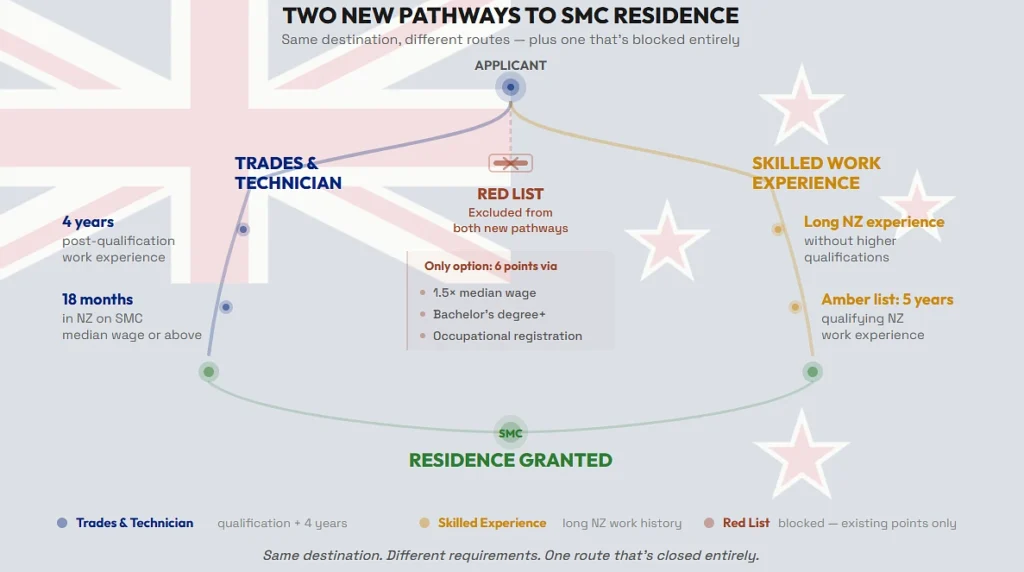
- A Trades and Technician pathway, which requires the applicant to have at least 4 years of relevant post-qualification work experience, 18 months of which has been spent in New Zealand on a wage no less than the SMC median.
- A Skilled Work Experience pathway, for workers with long work experience in New Zealand but without higher qualifications. Workers in “amber list” occupations must have at least 5 years of qualifying NZ work experience to use this pathway.
There is also a red list of occupations excluded from both new pathways entirely. Workers in these occupations can only apply for SMC residence if they can claim 6 points through the existing pathways: earning at least 1.5× the SMC median wage, holding a Bachelor’s degree or higher, or having recognised occupational registration plus the required NZ experience.
And, sitting alongside the SMC, is the Green List, a faster track to residence for occupations considered to be in critical shortage. Tier 1 Green List roles, senior doctors, certain engineers, some ICT occupations, are eligible to apply for residence directly without accumulating NZ work experience first. Tier 2 occupations require a period of work in New Zealand before qualifying.
The thing that ties the AEWV into these residence pathways is the whole strategic picture. The visa you’re working on today determines whether you can get residence in two years, three years or never. The right skill level, the right wage, the right occupation classification on the AEWV sets up, or weakens, the residence application before it’s even lodged.
Where Employers Get It Wrong
Because the AEWV is employer-led, workers suffer when employers make errors. Some common ones:
- Advertising for the wrong duration. Adverts run 14 days for NOL jobs and 21 days for skill level 4/5 jobs. If the employer has not advertised for the correct amount of time, the Job Check fails and they have to restart the process, re-advertise, wait, re-apply. Meanwhile the worker is still abroad waiting, or sitting on a visa about to expire.
- Paying less than the market rate. The median wage threshold is no longer a requirement, but INZ still checks that the salary offer matches the market rate for the role in that location. An employer offering a nurse in Auckland $24 per hour when the prevailing market rate is $35 or more will have the Job Check declined. INZ calculates the hourly rate as the salary divided by the maximum weekly hours in the employment agreement, and if the math doesn’t add up, that’s a decline too.
- Letting accreditation lapse. If the 12-month initial accreditation or the 24-month renewal period expires and the employer has not renewed, the accreditation is gone. They can reapply, but any pending Job Checks or AEWV applications attached to that accreditation are affected, and workers already employed on AEWVs under that employer face uncertainty about their visa conditions.
- Not completing settlement activities within the first month. Accredited employers must provide settlement support to their AEWV workers within one month of the employment start date. INZ checks compliance at accreditation renewal and during audits, so skipping it doesn’t hurt the worker immediately, but it puts the employer’s accreditation at risk, which circles back to hurting everyone on their AEWVs.
- Misclassifying the ANZSCO skill level. The skill level determines visa duration, English language requirements, Work and Income engagement, and critically, whether the position counts as “skilled employment” for SMC residence purposes. A role classified as skill level 3 that is really skill level 4 creates problems that surface months or years later, when the worker applies for residence and the occupation doesn’t qualify.
When You Actually Need an Immigration Lawyer
Most AEWV applications, on either side, are straightforward where the documentation is in order and the eligibility is clear. A licensed immigration adviser can handle these competently and cost-effectively.
The calculus changes when something goes wrong or the case has layers a standard application doesn’t cover. A Job Check declined because INZ wasn’t satisfied with the advertising evidence. An AEWV refused because a qualification assessment came back differently than expected. An employer accreditation declined over past employment law breaches the business believed had been resolved. A worker who has been in New Zealand on a series of visas trying to work out whether their total time allows another AEWV, or whether they’ve technically maxed out without realising it.
These are the situations where an immigration lawyer can act where an adviser cannot: making legal arguments before a tribunal, seeking judicial reviews, and representing clients in matters where the stakes go beyond a single application.
As most AEWV applications are processed in Auckland and most accredited employers are based there, a lawyer working in the same city carries a practical advantage: knowledge of the local labour market, current INZ processing priorities, and the quirks of how Auckland-based applications move through the system compared to other regions.
And where employer accreditation issues, occupation classification disputes or residence pathway planning sit alongside the AEWV, talking to an experienced immigration lawyer in Auckland before making the application, rather than after it has been declined, is the difference between a timeline that moves forward and one that stalls for months while avoidable errors get fixed.
The AEWV works. But it works best for people who understand it before they’re inside it.
References
- Immigration New Zealand, “Accredited Employer Work Visa” — https://www.immigration.govt.nz/visas/accredited-employer-work-visa/
- Immigration New Zealand, “Overview of AEWV employer accreditation and job check” — https://www.immigration.govt.nz/work/for-employers/getting-accreditation-or-approval-to-hire/employer-accreditation-for-the-aewv/aewv-employer-accreditation-and-job-check-process/
- Immigration New Zealand, “Changes to AEWV form questions for Green List occupations and wage thresholds” (July/August 2025) — https://www.immigration.govt.nz/about-us/news-centre/changes-to-accredited-employer-work-visa-aewv-form-questions-for-green-list-occupations-and-wage-thresholds/
- Immigration New Zealand, “Further changes to the Skilled Migrant Category to come into effect in August 2026” — https://www.immigration.govt.nz/about-us/news-centre/further-changes-to-the-skilled-migrant-category-to-come-into-effect-in-august-2026/
- Immigration New Zealand, “New seasonal visas open 8 December 2025” — https://www.immigration.govt.nz/about-us/news-centre/new-seasonal-visas-open-8-december-2025/
- KPMG GMS Flash Alert 2025-012, “New Zealand – Reforms to Accredited Employer Work Visa Announced” (January 2025).
- Lexology, “New Zealand: Changes to the Accredited Employer Work Visa and Post Study Work Visa” (January 2025).