 Christopher Morgan (Bankruptcy & Finance)
Summary: “OCGA § 9-11-34 governs document, ESI, and property discovery in Georgia civil litigation and it has more teeth than it looks. Plaintiffs have 30 days to respond to requests, defendants 45 and nonparty healthcare providers a strict 20-day window to object before automatic compliance kicks in. Georgia’s ESI rules trail federal practice — no proportionality mandate, no safe harbor for data loss — meaning litigators must be explicit about what they need and aggressive about preservation. Boilerplate objections are sanctionable, missed deadlines are unforgiving and the consequences of getting it wrong run from fee awards to adverse inference instructions. Know the rules, or pay for it.”
Let’s be honest — document discovery is where cases get won or lost. Not in the courtroom. Not during closing arguments. Right here, in the unglamorous grind of requests, responses, objections and follow-up motions. And if you’re litigating in Georgia, OCGA § 9-11-34 is the statute you need to know cold.
It’s one of those provisions that looks simple on the surface — you request documents, the other side produces them, everyone moves on. Except it never works that way. In my practice, I’ve watched cases derail because an attorney missed the 20-day objection window on a medical records subpoena. I’ve seen opposing counsel object to everything on ‘overbreadth’ grounds and get away with it for months. § 9-11-34 has teeth, but only if you know where the teeth are.
📷 INSERT IMAGE: Georgia courthouse exterior, representing state civil litigation context
What Does OCGA § 9-11-34 Actually Cover?
The statute sits inside Georgia’s Civil Practice Act and governs three things: requests to produce documents and tangible items, requests for electronically stored information (ESI) and requests for entry onto land or property. It applies between parties and, crucially, to nonparties too, which is where Georgia’s rules get genuinely interesting.
The scope language tracks OCGA § 9-11-26(b), meaning any request has to hit relevant, non-privileged matter. That’s a broad net. Documents, photographs, graphs, data compilations and since the 2006 amendment, ESI explicitly — all fall within reach, as long as they’re in the responding party’s “possession, custody or control.” That last phrase matters. It extends beyond what’s sitting on your client’s desk right now; it covers what their agents and representatives hold too.
One practical note: Georgia adopted ESI in 2006, bringing the statute in line with federal rules on that point. But it stopped well short of the 2015 FRCP amendments. There’s no explicit proportionality mandate, no detailed safe-harbor for inadvertent ESI loss. It’s leaner than federal practice, which cuts both ways.
The Mechanics: Deadlines, Objections and What Happens When Someone Doesn’t Play Ball
The procedure is straightforward, at least in theory.
📋 RESPONSE DEADLINES AT A GLANCE
| Party / Situation | Response Deadline |
| Plaintiff (after action commences) | 30 days from service of request |
| Defendant (newly served) | 45 days from service of summons & complaint |
| Nonparty (general) | Reasonable time per court or agreement |
| Nonparty Healthcare Provider | 20 days to object; prompt compliance if no objection |
| Motion to Compel (after failure) | File under OCGA § 9-11-37 — no fixed deadline but act promptly |
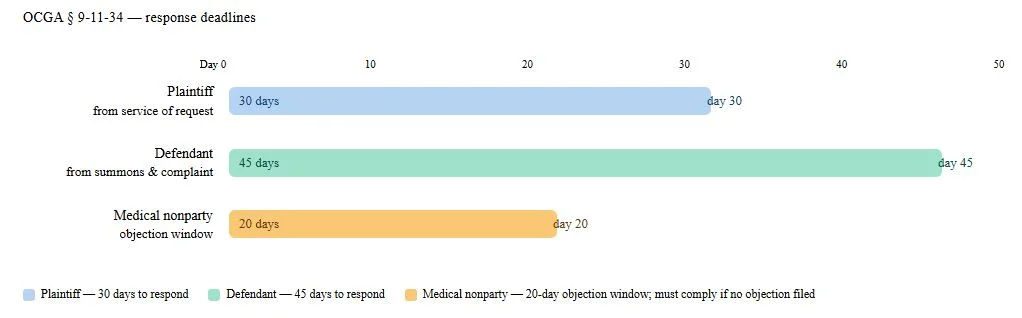
Thirty days for a plaintiff. Forty-five for a defendant freshly served with a complaint. The court can shorten or extend either window, but absent an order, those are your hard deadlines.
Objections have to be specific. You can’t just say “objection, overbroad” and call it a day — courts want reasons and if only part of a request is objectionable, you’re supposed to specify which part and produce the rest. Boilerplate objections are disfavored; judges have little patience for them and increasingly they’re sanctionable.
Miss a deadline or refuse without cause? The requesting party moves to compel under OCGA § 9-11-37. Sanctions under that section can include attorney’s fees and as the 2022 appellate decision in NRD Partners II, L.P. v. Quadre Investments, L.P. confirmed, those fee awards extend to nonparties on a successful compel motion.
Nonparty Discovery — Georgia’s Distinctive Rules
This is where § 9-11-34 diverges most sharply from federal practice. And it’s where I’ve seen the most traps.
Requesting documents from a nonparty? You’ve got two routes: serve a § 9-11-34(c) request (with a copy to all parties of record) or go the deposition route under § 9-11-30 or § 9-11-31. Either works. The nonparty or any party — can object. If you need to compel, you’re making a good-cause showing. That’s a higher bar than party discovery and courts take it seriously.
But medical records nonparty discovery? That’s a whole separate creature. Subsection (c)(2) lays out a precise procedure — certified mail or statutory overnight delivery notice to the patient (or their counsel), the same to all parties and a 20-day window for anyone to object.
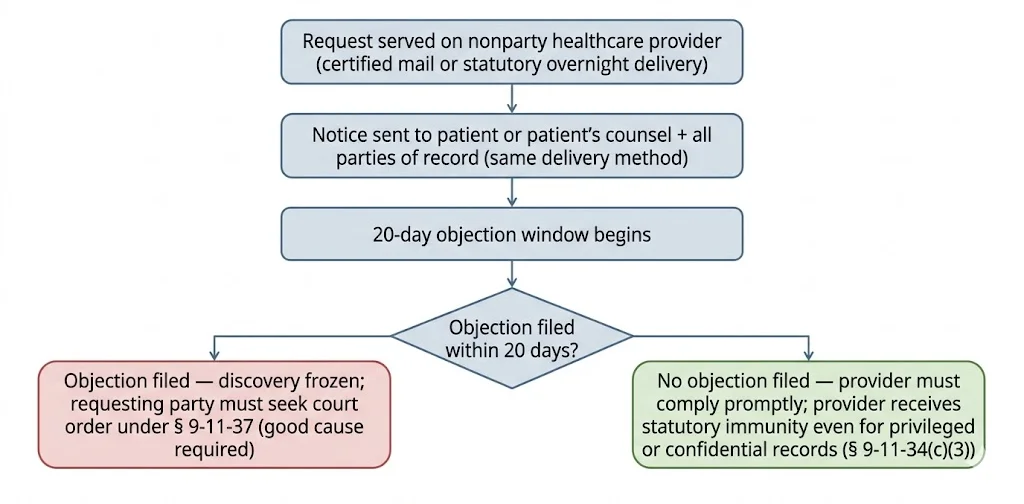
If no objection comes in within those 20 days? The provider must comply and this is worth knowing, the provider gets immunity even if the records contained confidential or privileged information. Subsection (c)(3) says so explicitly. That immunity provision is there to protect compliant nonparties from being caught in the middle and it works.
File the objection, though and the machinery stops. Discovery is frozen until the requesting party gets a court order. They’ll need to file under § 9-11-37 and show good cause. Courts in cases like Hopson v. Kennestone Hospital, Inc. have consistently held that strict compliance with the notice and timing rules is non-negotiable. Miss the certified mail requirement? The whole request is potentially vulnerable.
ESI in Georgia Practice: Useful, But Thinner Than Federal
Electronic discovery. Everyone talks about it; fewer people do it well in Georgia state court.
The good news: ESI is squarely within § 9-11-34’s reach. The 2006 amendment to the “data compilations” language settled that. You can request emails, metadata, native files, drive images, whatever’s relevant and within the responding party’s control.
The harder truth: Georgia has limited appellate guidance on e-discovery specifics. There’s no state equivalent to FRCP 37(e)’s safe harbor for good-faith ESI loss. Spoliation is handled under general § 9-11-37 principles and common-law adverse inference doctrine. Preservation duties kick in upon reasonable anticipation of litigation — that’s the standard but the consequences of blowing it can be severe.
Practical ESI Checklist for Georgia Litigators
| ESI Discovery Checklist — OCGA § 9-11-34 |
| ☐ Issue a litigation hold / non-spoliation letter immediately upon anticipating litigation |
| ☐ Draft requests identifying specific devices, custodians, date ranges and keywords |
| ☐ Request native format AND metadata explicitly — ‘reasonably usable form’ is the floor, not the ceiling |
| ☐ Ask for ‘mirror images’ of drives when critical data integrity is at issue |
| ☐ Retain a forensic expert early — before the motion to compel, not after |
| ☐ In divorce matters, assess pre-filing access rights to shared devices carefully |
| ☐ Build a keyword list into the request itself — don’t leave search scope ambiguous |
| ☐ If bad faith destruction is suspected, move for inspection; courts can compel it on that showing |
One thing worth flagging: the responding party controls how production happens. You can get a “reasonably usable form” production that strips metadata and loses native format entirely — perfectly defensible under the statute. If you need metadata and native files, ask for them specifically. Don’t assume.
Georgia vs. Federal: Side-by-Side Comparison
If you do any federal practice alongside state work and most Georgia litigators do — keeping these distinctions straight matters. The rules look similar. They’re not.
| Feature | OCGA § 9-11-34 | FRCP Rule 34 |
| ESI Coverage | Yes — ‘data compilations’ language | Yes — explicit ESI provisions |
| Nonparty Discovery | Robust — specific rules in (c) | Subpoena required (Rule 45) |
| Medical Record Rules | Strict: certified mail + 20-day window | No equivalent specific provision |
| Proportionality Mandate | Not explicit — relevance-based | Yes — built into Rule 26(b)(1) |
| ESI Safe Harbor | No equivalent provision | Yes — Rule 37(e) protects good faith loss |
| Response Time (Plaintiff) | 30 days | 30 days |
| Response Time (Defendant) | 45 days from service | 30 days (no extension for defendants) |
| Form of Production Rules | “Reasonably usable form” only | Detailed — native, metadata specified |
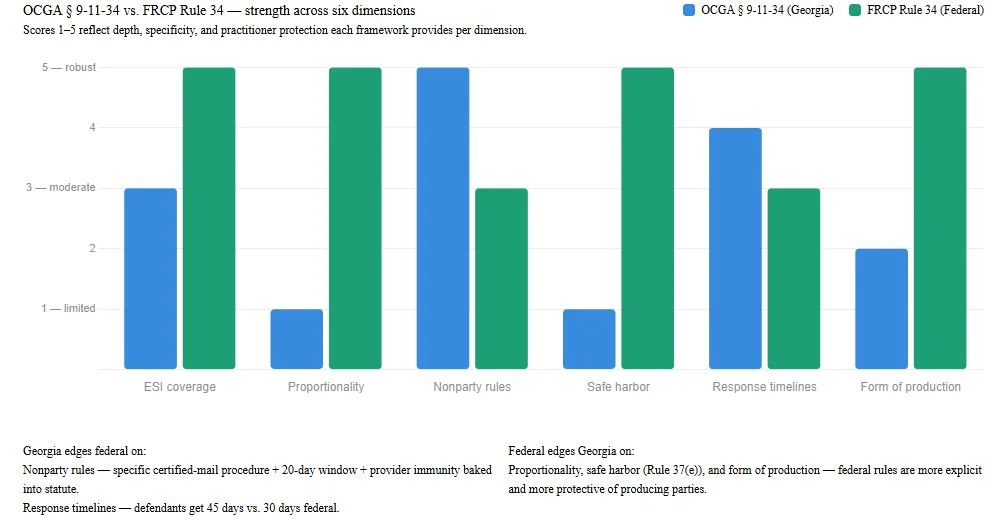
The gap on proportionality is the practical one. Federal courts run a proportionality analysis on every disputed request — burden, benefit, case complexity, the works. Georgia courts don’t have that explicit framework. Relevance is still the primary test. That means overbreadth objections in state court can be harder to win, but it also means defendants can face broader discovery obligations than they might in federal practice.
How to Draft Requests That Actually Hold Up
Vague requests invite valid objections. That’s just the reality. “All documents relating to the incident” is going to draw fire and sometimes it deserves to. Here’s how requests that survive look:
- Start with a definitions section. Define ‘document,’ ‘ESI,’ ‘communications,’ ‘relating to’ — mirror the statute’s language, then expand it to capture modern formats.
- Specify ESI parameters: custodians by name, date ranges, file types, email domains and requested format (native + full metadata is the standard ask).
- Use categories with sub-items rather than catch-all language. ‘All communications between John Smith and Jane Doe between January 1 and December 31, 2023, regarding Project X’ is defensible. ‘All documents about the project’ is not.
- Include a ‘translate to reasonably usable form’ instruction, it’s statutory language and it puts the respondent on notice that a garbled output won’t cut it.
- For land entry requests: nail down the exact scope of the inspection, the purpose and any testing or sampling methodology you plan to use. The statute requires this.
Responding to Requests — What Good Looks Like
On the other side of the table, here’s the short version: timely, specific and in usable form. That’s the standard. Anything less opens you up to § 9-11-37 motions and potentially sanctions.
If you’re going to object, say why specifically. If you’re objecting to part of a category, produce the rest and flag the objected portion. Courts expect this. Judges who see a response that does nothing but object to everything are not impressed and they will tell you so in a fee award.
Protective orders exist for a reason. Voluminous ESI, trade secrets, patient records, if there’s a legitimate basis for limiting how produced materials are used or disseminated, seek a protective order rather than just withholding. It’s cleaner, it’s defensible and it keeps you out of the § 9-11-37 crossfire.
Confidentiality Carve-Outs: The Subsection (d) Protections
The statute doesn’t override certain statutory confidentiality protections. Mental illness treatment records (OCGA § 37-3-166), developmental disability treatment records (§ 37-4-125), alcohol and drug treatment records (§ 37-7-166) and AIDS information (§§ 24-12-20 and 24-12-21) all retain their existing protections.
There’s a significant caveat here, though. If a person fails to file a § 9-11-34(c)(2) objection within the 20-day window, they waive their right to damages against the nonparty for any disclosure, even if those records were confidential. It’s a strict deadline. Courts don’t bend it for inadvertence.
The Bottom Line
OCGA § 9-11-34 is a workhorse statute — broad enough to cover almost any document or data you’d want in litigation, with enough procedural specificity to create real traps for the unwary. The nonparty and medical records rules are Georgia’s most distinctive feature and they’re the ones most likely to bite if you’re not paying attention.
Draft with precision. Respond with specificity. Preserve ESI before you need to. And if you’re dealing with medical records from a nonparty healthcare provider, count your 20 days from service and don’t let that window slip.
Questions about how § 9-11-34 applies to your case? We’ve navigated these discovery disputes countless times from routine document requests to contested ESI forensic inspections. Reach out and let’s talk through your situation.
| ⚖️ Key Takeaways |
| ✔ OCGA § 9-11-34 governs all document, ESI and property entry discovery in Georgia civil cases |
| ✔ Response deadlines: 30 days for plaintiffs, 45 days for defendants from initial service |
| ✔ Nonparty medical/healthcare records require certified mail notice to the patient and a strict 20-day objection window |
| ✔ No objection filed within 20 days = automatic compliance + immunity for the nonparty provider |
| ✔ Georgia’s ESI rules are thinner than federal — no proportionality mandate, no Rule 37(e) safe harbor |
| ✔ Spoliation sanctions can be severe; issue litigation holds immediately upon reasonable anticipation of litigation |
| ✔ Request native format and metadata explicitly — ‘reasonably usable form’ is a floor, not a ceiling |
| ✔ Boilerplate objections are disfavored and increasingly sanctionable; specificity is required |
| ✔ Georgia has not amended § 9-11-34 since 2015; no proportionality or ESI updates as of March 2026 |
Disclaimer
This article is provided for general educational purposes and does not constitute legal advice. OCGA § 9-11-34 and related rules can vary in application depending on the specific facts and circumstances of your case. Always consult a licensed Georgia attorney for advice regarding your particular situation. This article reflects the law as of March 2026; no amendments to § 9-11-34 have been enacted since 2015.