 James Mcleod NZ (AU NZ Immigration Lawyer)
Case: Naik v. USCIS, No. 4:2021cv03242 (D. Neb.) | Doc. 36, Sept. 29, 2021 | March 2026
Here’s something that gets lost in immigration headlines: you can file a perfectly valid federal lawsuit, line up 196 co-plaintiffs, and still leave court having lost ground before anyone even hears your actual argument. That’s Naik v. USCIS, Document 36 — a September 2021 procedural ruling that handed the government a clean win on venue and severance while the merits question (was USCIS unreasonably slow?) never got touched.
Venu Naik and his co-plaintiffs were not just another petitioners. They were talented employees, primarily of Indian and Chinese origin, who had already overcome the most difficult challenge a successful Form I-140 petition. I-485 adjudications awaited them to make them lawful permanent residents. That wait was catastrophic as the end-of-year visa crunch of FY 2021 came in. and so they filed a suit In Maryland together. The response of the court was basically: not this and not both.
In this article, we dissect what occurred, why it is important in legal terms and what it portends to any person considering being able to sue immigration delays in federal court. None of it is legal advice, analysis and education. To get advice on your legal situation, refer to an experienced immigration lawyer.
Case Background & Parties
The initial complaint was in the U.S. District Court of the District of Maryland (Civil No. 21-1945 PJM). On the one hand: 196 foreign nationals, including Venu Naik, who had had I-140 based petitions granted but all of whom had their I-485 adjustment applications pending in different service centers of the USCIS nationwide.
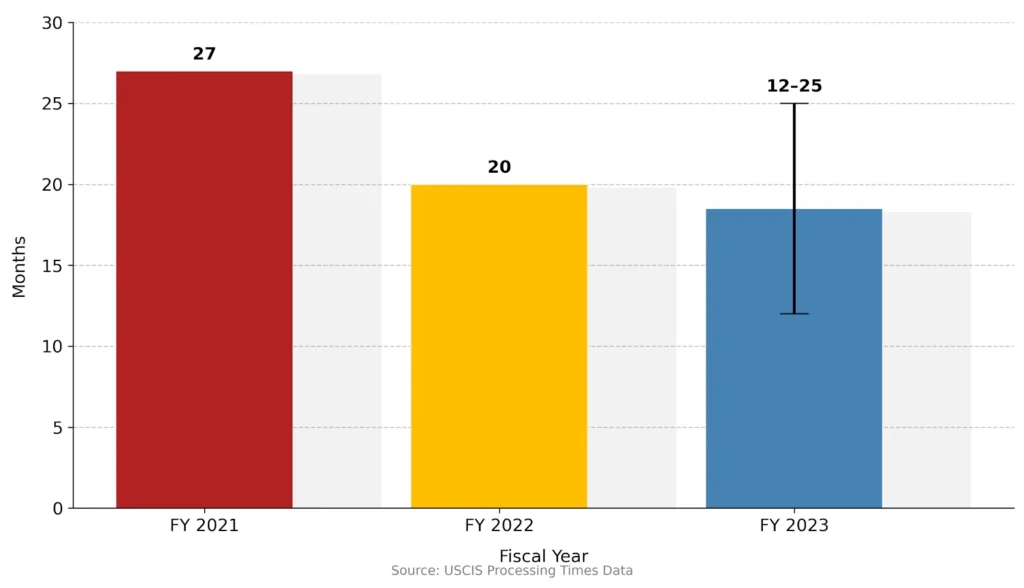
To the other: USCIS, the Director Ur M. Jaddou, and the corresponding federal officials. The agency was not merely safeguarding its rate of processing, it was working in an actual chaotic FY 2021 setting. Slows of the COVID-19, freezes in hiring and redistribution of staff in the work with Afghanistan refugees had formed a queue that put pressure on every part of the system. It is precisely this that was raised by GAO in its report on USCIS pending caseloads.
Fiscal year timing made everything more urgent. Under 8 U.S.C. § 1151 and § 1152(a)(2), employment-based visa numbers are capped annually with per-country limits — limits that disproportionately squeeze applicants from India and China. Unused family-based visas can roll over to employment-based categories, but only before September 30th. After that, they expire. The plaintiffs wanted expedited adjudication or a visa holdover into FY 2022. Neither happened.
Claims & Legal Basis
The plaintiffs leaned on the Administrative Procedure Act (APA), specifically 5 U.S.C. § 706(2)(A), which allows courts to set aside agency action that’s ‘arbitrary and capricious.’ Their core argument: USCIS’s failure to adjudicate in time wasn’t just slow — it was unreasonable, given the foreseeable FY 2021 visa crunch.
Two competing motions drove Document 36:
- Plaintiffs sought a preliminary injunction to keep all 196 claims consolidated in Maryland — efficiency and coordination being the obvious argument.
- USCIS moved to sever each plaintiff’s claim into separate actions and transfer them to whichever federal district covered their processing service center: Nebraska for Naik’s group, Texas for others.
The alleged harms were concrete and real. Career stagnation. Inability to change employers freely under AC21 protections. Family separation. For some, looming loss of green card eligibility tied to expiring visa numbers. But the court never weighed those harms — it decided the procedural questions first, and those questions ended the Maryland chapter entirely.
Court’s Analysis & Reasoning
Judge Peter J. Messitte’s analysis under 28 U.S.C. § 1404(a) (transfer for convenience) and FRCP Rule 21 (severance) covered four main grounds. None of them favored the plaintiffs.
1. Plaintiffs’ Choice of Venue — Reduced Deference
Courts normally give weight to where a plaintiff chose to file. Piper Aircraft Co. v. Reyno, 454 U.S. 235 (1981). But that deference drops when the chosen forum has little real connection to the claims. Most of the 196 plaintiffs didn’t live in Maryland. Their applications weren’t being processed there. The Maryland tie was basically: USCIS has its headquarters there. The court wasn’t buying it.
From the order itself: “The decision-making process for adjudicating visa applications occurs at USCIS’s service centers and field offices throughout the country, not at agency headquarters in Maryland.”
2. Witness Convenience & Administrative Records
In APA cases, the administrative record is everything — it’s what the court reviews. The witnesses and documents tied to processing Naik’s I-485 were at the Nebraska Service Center, not in Maryland. The court cited Melnattur v. USCIS, 2021 WL 3722732 (D.D.C.), and Aftab v. Gonzalez, 597 F. Supp. 2d 76 (D.D.C. 2009), for the principle that APA review should happen near the relevant agency action.
3. Convenience of Parties
Yes, consolidation in Maryland would’ve helped 196 plaintiffs coordinate. But the court saw another side of it — burdening one district with a massive, geographically dispersed case didn’t make sense when the underlying agency actions were scattered across the country. USCIS also documented genuine resource pressures, backed by the GAO backlog reporting.
4. Interest of Justice — The Equity Problem
This part of the ruling was pointed. If the court granted emergency relief specifically to these 196 plaintiffs, what about the approximately 250,000 others in the same queue? The court’s language was unambiguous:
“It is difficult to see how justice would be served if the Court were to grant relief to the eleventh hour request of these particular Plaintiffs, in preference to the thousands of others.”
Severance was also justified on practical grounds: 196 plaintiffs meant 196 different processing histories, service centers, and timelines. A single consolidated record was administratively unworkable. Equal Rights Center v. Equity Residential, 483 F. Supp. 2d 482 (D. Md. 2007) supported this reasoning.
Key Precedents Referenced
| Case | Citation | Relevance to Naik |
| Piper Aircraft Co. v. Reyno | 454 U.S. 235 (1981) | Baseline for plaintiff venue deference |
| Melnattur v. USCIS | 2021 WL 3722732 (D.D.C.) | APA record location drives venue |
| Aftab v. Gonzalez | 597 F. Supp. 2d 76 (D.D.C. 2009) | Transfer in immigration APA suits |
| Equal Rights Center v. Equity Residential | 483 F. Supp. 2d 482 (D. Md. 2007) | Severance for individualized claims |
| Stratagene v. Parsons Behle & Latimer | 315 F. Supp. 2d 765 (D. Md. 2004) | Local disputes resolved locally |
| TRAC v. FCC | 750 F.2d 70 (D.C. Cir. 1984) | Six-factor unreasonable delay test |
Ruling & Outcome
The court granted USCIS’s motion. All 196 plaintiff claims were severed and transferred to the districts covering their respective processing centers. Venu Naik’s case moved to the District of Nebraska — Case No. 4:21-cv-3242.
To be clear about what this wasn’t: it wasn’t a ruling that USCIS acted reasonably. It wasn’t a finding that the delays were acceptable. Those questions never came up. This was purely procedural — where and how the case gets heard, not whether the plaintiffs were right about the substance.
What happened next varied considerably. Some transferred cases were dismissed as moot once USCIS eventually adjudicated the underlying applications. Others faced motions to dismiss under APA unreasonable delay standards, evaluated using the six-factor TRAC v. FCC test:
- The time the agency has taken to act on the claim.
- Whether Congress set a timetable for the action.
- The nature and extent of interests being harmed by delay.
- Whether the agency has a higher-priority competing workload.
- The effect of expediting delay on other agency activities.
- Whether human health or welfare is directly at stake.
FY 2022 brought some systemic relief — USCIS adjudicated roughly 192,000 employment-based green cards that year, a record figure driven partly by visa rollover numbers. But for applicants who missed FY 2021’s window entirely, that record came too late.
Implications for Immigration Law & Practice
File Where the Action Happened
The biggest practical lesson from Document 36: in APA delay suits, file in the district where your application is actually being processed — not wherever feels strategically favorable. This isn’t just about winning the venue fight. It’s about not losing months of urgency to a transfer motion while your visa window closes.
Multi-Plaintiff Consolidation Carries Real Risk
Courts are skeptical of mass-plaintiff immigration suits unless there’s a truly uniform policy question at stake — not 196 individualized processing stories. If separate factual proof is needed per plaintiff, severance is a live threat. And once you’re severed, the coordinated leverage disappears.
APA Delay Claims Face a High Bar
The TRAC factors give courts significant room to defer to agency discretion — especially when the agency points to pandemic disruptions, a massive pending caseload, and documented resource constraints. Strong delay claims need specific, documented individual harm, not just long wait times.
The Per-Country Cap Problem Isn’t Going Away
Cases like Naik are symptoms of a structural issue: per-country caps under 8 U.S.C. § 1152(a)(2) create decade-long backlogs for Indian and Chinese applicants regardless of USCIS processing speed. Legislative fixes — versions of the EAGLE Act have been proposed multiple times — remain stalled. Until the cap structure changes, end-of-year visa crunches will keep happening. And so will lawsuits like this.
Practical Guidance at a Glance
| Situation | Recommended Action |
| I-485 pending with long delay | File USCIS e-Request inquiry; document all correspondence |
| Considering an APA lawsuit | File in service center’s district; build TRAC factor evidence |
| Multi-plaintiff coordination | Carefully assess individual case differences before consolidating |
| FY-end visa expiration risk | Consult an attorney immediately; mandamus under 28 U.S.C. § 1361 may apply |
| I-485 approved after filing suit | Case may be dismissed as moot; confirm with your attorney |
Conclusion
Naik v. USCIS never answered the question everyone wanted answered: was USCIS’s delay unreasonable? The case got stopped at the procedural gate — a venue and severance battle the government won cleanly. For Venu Naik and the other plaintiffs, a coordinated effort became 196 separate fights, each starting over in a new district, while FY 2021’s visa window shut permanently behind them.
The deeper lesson is about how immigration litigation actually works in federal court. Procedural strategy matters as much as the merits argument — sometimes more, in the early stages. Courts won’t bend their ordinary rules on venue and party structure just because the underlying injustice is real. And the injustice is real: a visa system where per-country caps trap skilled workers in multi-decade queues is genuinely broken. But the court itself noted that structural fix belongs to Congress, not the judiciary.
If you’re navigating an I-485 delay right now, start with USCIS’s own tools: check your case at uscis.gov/case-status-online, review typical processing times at egov.uscis.gov/processing-times/, and if things look unreasonable, talk to a licensed immigration attorney before the fiscal year clock runs out again.
Disclaimer: This article is for educational purposes only and does not constitute legal advice. Immigration law is fact-specific and highly time-sensitive. For guidance on your situation, please consult a licensed immigration attorney.