 Armand Avazian (US Immigration Lawyer)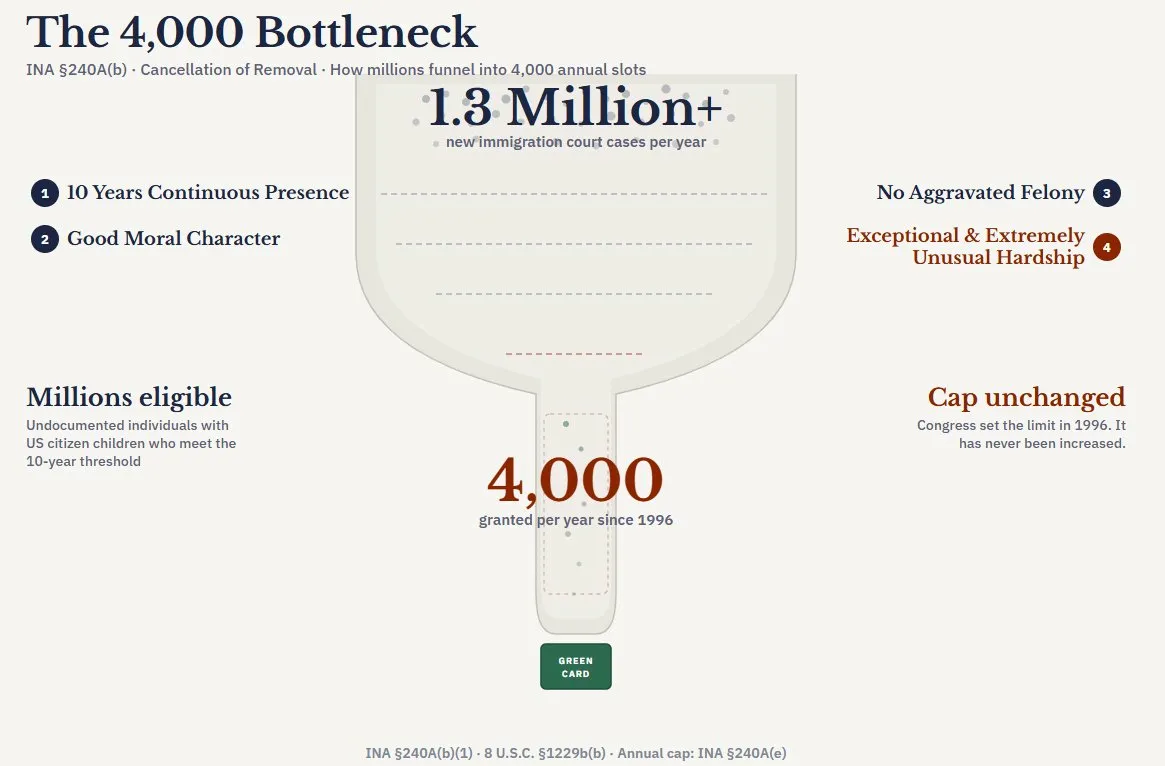
Rule: INA §240A(b) · Cancellation of Removal
There’s a provision buried inside the Immigration and Nationality Act that most people facing removal proceedings have never heard of. It doesn’t get talked about on the news. It doesn’t trend on social media. But it has quietly saved thousands of families from being torn apart — and it might be the most important piece of immigration law you’ll ever read.
It’s called Cancellation of Removal under INA §240A(b), and if you’ve been living in the United States for ten years or more without status, it could be the difference between a green card and a one-way flight back to a country your children have never seen.
The catch? Only 4,000 people per year can receive it. The legal standard is brutal. And the Board of Immigration Appeals has denied cases that would break your heart. But a handful of decisions have drawn the exact line between who qualifies and who doesn’t — and understanding that line could change everything.
What the Law Actually Says
Before we get into the cases, the statute itself. Section 240A(b)(1) of the INA — codified at 8 U.S.C. §1229b(b) — lays out four requirements. Miss even one and the door closes:
- Ten years of continuous physical presence in the United States.
- Good moral character maintained throughout that entire period.
- No conviction for an aggravated felony or certain other disqualifying offenses.
- Exceptional and extremely unusual hardship to a qualifying relative — meaning a US citizen or lawful permanent resident spouse, parent, or child.
As confirmed by Claudia Cedeño she is an Immigration lawyer from Rockville, MD, the last requirement is where everything gets complicated. And here’s the part that trips people up, every single time: the hardship isn’t about you. Congress wrote it that way on purpose. The immigration judge doesn’t care how hard it would be for the person facing deportation. The only thing that matters is the impact on your qualifying US citizen or LPR family member.
I’m reading that and thinking — wait, so even if I’ve been here twenty years, built a business, paid taxes, raised a family — none of that counts unless my child or spouse would suffer beyond what’s “normally expected” from deportation?
That’s exactly right. And the BIA has made it painfully clear just how high that bar sits.
Case 1: Matter of Monreal — The Father Who Lost Despite 20 Years in America
Matter of Monreal-Aguinaga, 23 I&N Dec. 56 (BIA 2001)
This was the first time the BIA formally interpreted the “exceptional and extremely unusual hardship” standard, and the result still stings to read.
Mr Monreal came to the United States from Mexico in 1980, when he was fourteen years old. By the time his case reached the Board, he’d been living in the country for roughly two decades. He had three US citizen children — ages 12, 8, and an infant. He’d worked at his uncle’s business for ten years straight. His parents were lawful permanent residents in the US. He had seven siblings living here legally.
On paper, this looks like a man who built an entire life. I’m looking at those facts and thinking — if this doesn’t qualify, what does?
The BIA said it wasn’t enough.
The Board acknowledged his children would face some hardship if they moved to Mexico with him. But it pointed to several factors working against the case. His wife had already voluntarily returned to Mexico with the infant before the hearing. He was in good health and could work in Mexico. His eldest children, while American, had some Spanish language ability. The economic hit, while real, was the kind of thing that “normally” comes with deportation.
That phrase — “normally expected to result from the person’s departure” — became the benchmark. If the hardship your family faces is the same kind of hardship any family would face when a parent gets removed, it doesn’t meet the standard. You need something more. Something beyond the ordinary pain of separation.
What went wrong: The evidence was thin. The record didn’t show that Mexico couldn’t provide schooling, that the children had special needs, or that the family would face conditions dramatically different from other deportation scenarios. The BIA practically invited future applicants to present their cases differently, noting that if the evidence had been stronger, the result “may well be different.”
Old proverb comes to mind here: “It’s not about having a good case — it’s about proving you have one.”
Case 2: Matter of Andazola — A Single Mother Denied, and Why It Matters
Matter of Andazola-Rivas, 23 I&N Dec. 319 (BIA 2002)
Ms Andazola was a 30-year-old single mother from Mexico. She’d entered the US around age 14 and had been living here for roughly 16 years. She had two US citizen children, ages 11 and 6. She owned her own home, had a 401(k) retirement plan, medical insurance through her employer, two cars, and $7,000 in savings.
She argued that as a single mother, returning to Mexico would devastate her children. She had no close family there. She said women in Mexico face discrimination — lower pay, fewer job opportunities — and that her status as a single mother would make things even harder.
The BIA acknowledged her situation was sympathetic. The Board even conceded that under the old “extreme hardship” standard from the former Suspension of Deportation law, she probably would have won.
But the new standard wasn’t “extreme hardship.” It was “exceptional and extremely unusual hardship.” Congress raised the bar in 1996 specifically to narrow the pool of people who could qualify. And the BIA found Ms Andazola fell short.
Why? A few critical details worked against her. The father of her children, while not married to her, still contributed financially and was a presence in the kids’ lives. He had authorization to remain in the US and could continue supporting them if they returned to Mexico. And while her siblings were in the US, they were undocumented — which the BIA weighed differently than if they’d been citizens or residents.
I’m sitting with two kids, a house I own, a retirement fund, sixteen years of paying into a system — and that’s still not enough. That’s a gut punch.
What went wrong: The father’s continued involvement blunted the single-mother argument. The children had some family support available in Mexico. And the BIA found that “diminished economic and educational opportunities” alone, without something more acute, couldn’t clear the bar.
Case 3: Matter of Recinas — The Case That Finally Drew the Line
Matter of Recinas, 23 I&N Dec. 467 (BIA 2002)
After Monreal and Andazola, immigration lawyers were genuinely scared. Two strong cases denied back-to-back. It looked like the “exceptional and extremely unusual hardship” standard was designed to be unwinnable without a qualifying relative who had a life-threatening medical condition.
Then Ariadna Recinas stepped up.
Ms Recinas was a 39-year-old single mother of six children. Four of them were US citizens, ages 12, 11, 8, and 5. The other two, ages 15 and 16, were Mexican nationals. She’d entered the US in 1988 and had been living here for over 14 years. She was divorced. She ran her own motor vehicle inspection business that employed two people.
Here’s what made her case different — and this is where the lesson lives.
She had no immediate family left in Mexico. Zero. Her parents were lawful permanent residents in the US. Her five siblings were all US citizens. Everyone she had was on this side of the border. If she got sent back, she’d be arriving in a country where she had nobody — with six children, four of whom had never set foot in Mexico and barely spoke Spanish.
The children’s father was out of the picture. He’d been paying $146.50 per month in child support at one point, but there was no indication he was still involved in their lives. He was undocumented himself and in removal proceedings in Denver.
And then the visa backlog issue sealed it. Because of the massive wait times for Mexican nationals in the family preference immigration categories, Ms Recinas had virtually no realistic path back to the United States if she were removed — even with US citizen siblings and LPR parents who could theoretically petition for her.
The BIA reversed the immigration judge and granted cancellation of removal. But even in winning, the Board was careful. It called her case “on the outer limit of the narrow spectrum of cases in which the exceptional and extremely unusual hardship standard will be met.”
Translation: she barely cleared the bar. And the Board wanted everyone to know it.
What Actually Made the Difference Between Winning and Losing
Place these three cases side by side and a pattern emerges. It’s not about checking boxes on a list. It’s about the cumulative weight of factors that, taken together, push the hardship beyond what’s “normal.”
The factors that tipped Recinas over the line where Monreal and Andazola fell short:
- Complete isolation in the home country. Recinas had zero family in Mexico. Monreal had a wife already there. Andazola’s children’s father could have helped. That absence of any safety net was decisive.
- Sole financial and emotional responsibility. There was no co-parent, no extended family, no backup. Every dollar those children needed came from her. Every school pickup, every doctor visit, every meal.
- Children deeply rooted in America. Four US citizen kids who’d never been to Mexico, who barely spoke Spanish, who would face what the BIA described as “complete upheaval” if transplanted to an entirely foreign environment.
- No realistic path to return. The Mexican visa backlog meant removal wasn’t temporary — it was essentially permanent. The door wouldn’t just close. It would lock.
- Economic vulnerability beyond the norm. Not just “lower standard of living in Mexico.” The reality that a single mother with six children and no family support would face conditions that made basic survival precarious.
What didn’t work in Monreal and Andazola:
- Having a spouse or co-parent available — even partially involved — weakened the isolation argument.
- Children who spoke some Spanish or had at least theoretical access to schooling in the home country.
- Family members in the US who lacked legal status themselves (the BIA weighed undocumented siblings differently than citizen or LPR family).
- Evidence that focused on the applicant’s own hardship rather than laser-focusing on the qualifying relative’s suffering.
The 4,000 Cap Nobody Talks About
Even if you meet every single requirement, there’s a number hovering over the entire system. Congress capped cancellation of removal grants at 4,000 per fiscal year under INA §240A(e). That number hasn’t changed since 1996.
To put that in context — as of 2024, over 1.3 million new cases were added to the immigration court backlog in a single year. Millions of undocumented individuals in the US have US citizen children. And only 4,000 people, across the entire country, can receive this form of relief annually.
I’m doing that maths. Millions eligible, 4,000 slots. Those aren’t odds. That’s a bottleneck.
This makes every detail of the application matter. Immigration judges aren’t just deciding whether you meet the standard — they’re exercising discretion about whether your case is compelling enough to warrant one of those 4,000 spots.
The Stop-Time Trap: When Your 10-Year Clock Gets Killed
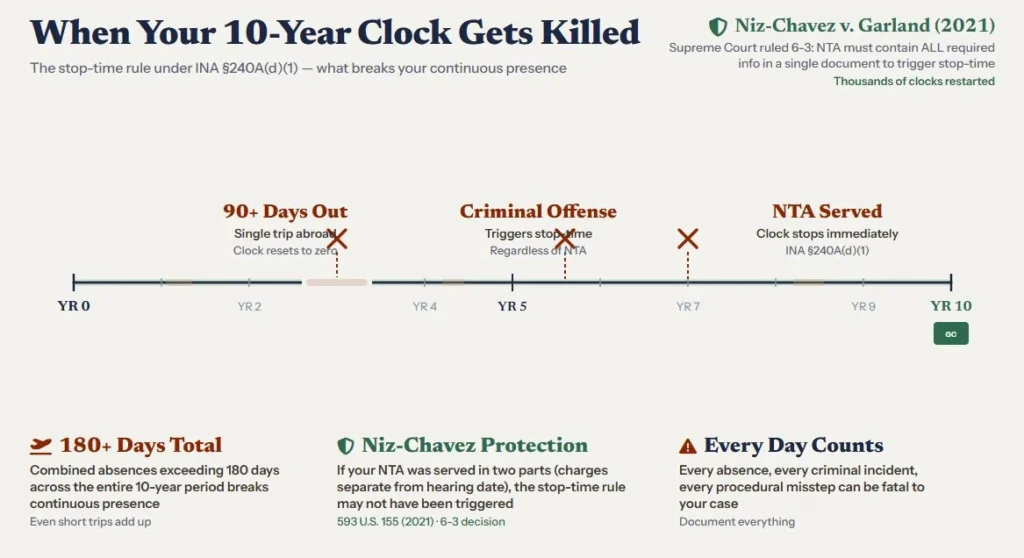
There’s another piece of this puzzle that catches people off guard. Under INA §240A(d)(1), your continuous physical presence clock stops the moment you’re served a Notice to Appear (NTA) — the document that formally starts removal proceedings against you.
For years, the government played a game with this. They’d serve NTAs in two pieces — one document with the charges, another with the hearing date and time. In Niz-Chavez v. Garland, 593 U.S. 155 (2021), the Supreme Court ruled 6-3 that the stop-time rule only kicks in when the NTA contains all required information in a single document, including the specific time and place of the hearing.
That ruling was enormous. It meant that thousands of people who thought their clock had stopped actually still had time running. Some who’d been told they were ineligible suddenly weren’t.
But here’s the thing — if you leave the US for more than 90 days at any single stretch, or your absences add up to more than 180 days total during the 10-year period, you break continuous presence. The clock doesn’t just stop. It resets. And certain criminal offenses trigger the stop-time rule independently, regardless of when the NTA arrives.
Every day counts. Every absence matters. Every mistake with the timeline can be fatal to the case.
What This Means if You’re Facing Removal Right Now
There’s no sugar-coating this. Cancellation of removal is hard. The BIA designed the standard to be hard. Congress wanted it that way.
But “hard” doesn’t mean “impossible.” Matter of Recinas proved that a case built on cumulative, well-documented hardship — not just emotion, not just sympathy, but real evidence of what happens to your US citizen family members when you’re gone — can clear the bar.
If you’re sitting here wondering whether your situation qualifies, the honest answer is: it depends on facts that only a thorough legal review can evaluate. The difference between Monreal’s denial and Recinas’s grant came down to documentation, evidence strategy, and how the hardship was framed.
As the saying goes — “A right without a remedy is no right at all.” The remedy exists. But it only works when the evidence is built to match the standard. Talking to a deportation defense attorney who understands how these BIA decisions operate isn’t optional. In a system that grants relief to only 4,000 people a year, the quality of legal representation isn’t a luxury. It’s the case itself.
More References
- Niz-Chavez v. Garland, 593 U.S. 155 (2021).
- CLINIC, “Why Cancellation of Removal Will Soon Become Even More Important” (2024).
- Cornell Law Institute, “Cancellation of Removal.”