 Giovanni ( software and services )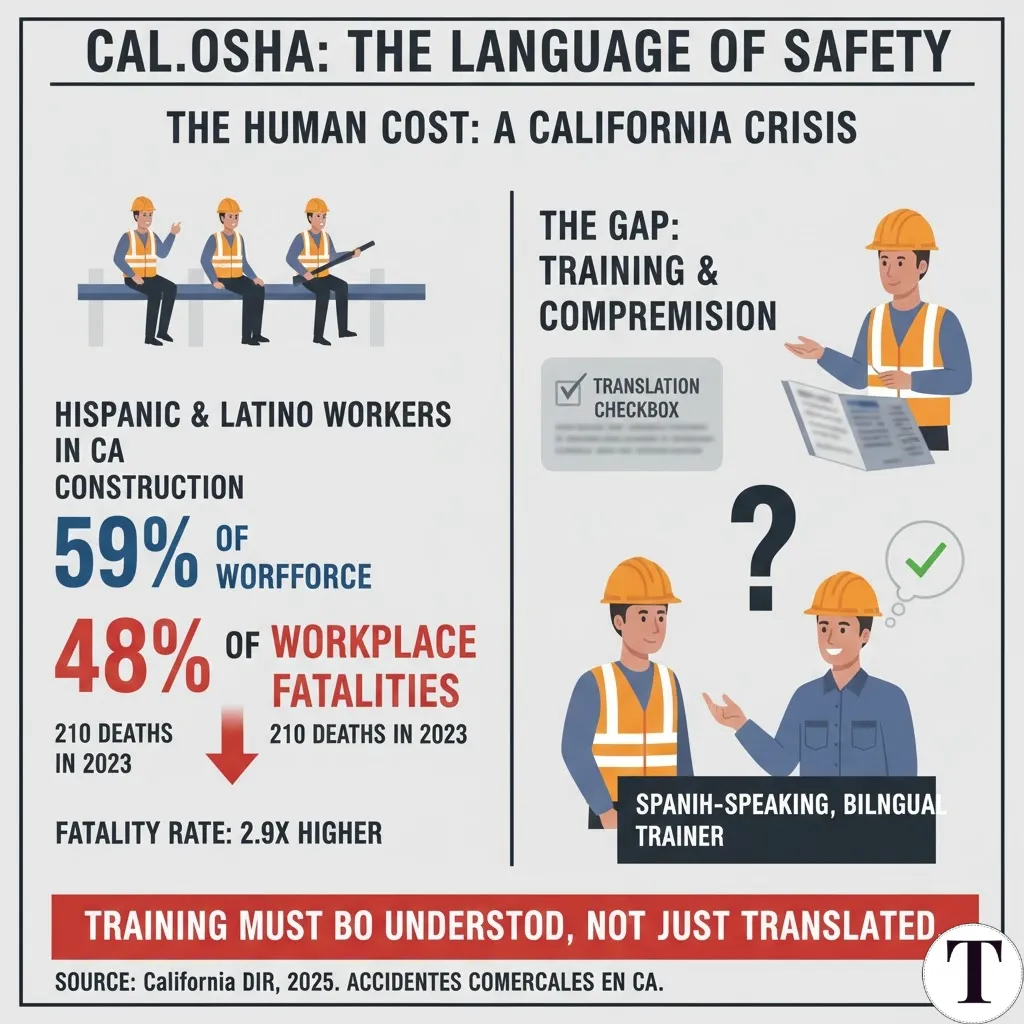
The Numbers That Should Keep Employers Awake
Hispanic and Latino workers make up 59% of California’s construction workforce. They also account for 48% of the state’s workplace fatalities—210 deaths in 2023 alone. Their fatality rate of 2.9 per 100,000 workers is more than double the rate for white non-Hispanic workers at 1.1 (California DIR, Fatal Occupational Injuries in California 2013-2023, April 2025).
These aren’t abstract statistics. They represent a gap between who’s doing the most dangerous work and who’s actually receiving safety training they can understand.
Cal/OSHA has been clear about what this means for employers: training that workers can’t comprehend isn’t training at all. And when investigators look into an accidente comercial en California involving a Spanish-speaking worker, one of the first questions they ask is whether safety training was genuinely accessible—or just a checkbox exercise.
| California Workplace Fatalities 2023 | Total Deaths | Fatality Rate (per 100,000) |
|---|---|---|
| Hispanic or Latino | 210 | 2.9 |
| White (non-Hispanic) | 146 | 1.1 |
| Black or African American | 28 | 2.4 |
| Asian | 52 | 1.6 |
| All Workers | 439 | 2.5 |
Source: California Department of Industrial Relations, Census of Fatal Occupational Injuries (CFOI), 2023
How Cal/OSHA Differs From Federal OSHA on Language
Federal OSHA’s Hazard Communication Standard requires chemical safety training “in a manner employees can understand.” That’s vague. It gives employers room to argue that posting English-language signs in a workplace where nobody reads English counts as communication.
California went further.
Title 8 of the California Code of Regulations, Section 3203 – the Injury and Illness Prevention Program (IIPP) requirement—mandates that employers establish systems for communicating safety and health information “in a form readily understandable by all affected employees.” The regulation doesn’t say “available” or “accessible.” It says understandable.
California Labor Code Section 6401.7 reinforces this by requiring that every employer establish, implement, and maintain an effective IIPP. Effectiveness gets measured by outcomes, not intentions.
What this means in practice:
- Training must occur when the IIPP is first established, for new hires, for new job assignments, when new hazards are introduced, and specifically for supervisors on hazards their teams face
- For construction, tailgate safety meetings are expected every 10 working days
- Small employers (fewer than 10 employees) can provide oral training, but it still must cover general workplace hazards and job-specific risks in a language workers actually understand
- Cal/OSHA publishes official training materials in Spanish, Chinese (Simplified and Traditional), Korean, Punjabi, Tagalog, Vietnamese, Arabic, and French—signaling their expectation that employers use appropriate languages
The difference between federal and California requirements isn’t subtle. Federal OSHA sets a floor. Cal/OSHA treats language accessibility as a core component of whether training happened at all.
What “Language Workers Understand” Actually Means Under California Law
The phrase “readily understandable” could theoretically mean a lot of things. Cal/OSHA’s Appeals Board settled the question in 2012.
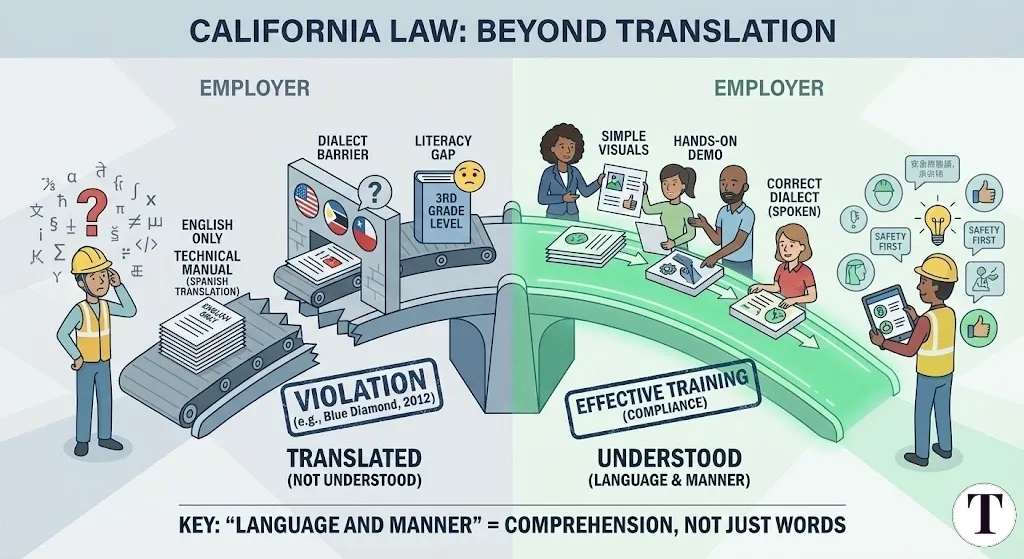
Blue Diamond Materials (Cal/OSHA App. 10-1282) established the precedent that California inspectors still cite today. The company provided safety training materials only in English to a workforce that included Spanish-speaking employees. The Appeals Board ruled this constituted a failure to provide “effective” training under Section 3203(a)(7)—a serious violation. The original inspection (No. 310243292) resulted in over $18,000 in penalties across multiple violations.
That decision created a clear standard: for training to be effective, it must be “given in a language and manner the employees understand.”
Not translated. Understood.
This distinction matters because translation alone doesn’t guarantee comprehension. A worker who speaks conversational Spanish but reads at a third-grade level won’t benefit from a technically translated safety manual. Someone who learned Spanish in Mexico may struggle with terminology common in Central American dialects. A Cantonese speaker handed Mandarin materials faces the same barrier as if they’d been given English.
Cal/OSHA’s published guidance reflects this. The agency’s fact sheet “Health and Safety Rights: Facts for California Workers” states explicitly that “training must be provided in a language that the employees can understand.” The “Basics of Cal/OSHA” guidance on hazard communication requires that employers “provide information and training on any chemicals used or stored at the workplace in a language and manner that are understandable to employees.”
When citations get contested, Administrative Law Judges have consistently applied this standard. In The Kroger Co. (Ralphs Grocery Company) case (Inspection No. 1486257, Decision January 2023), the ALJ affirmed a serious violation under Section 3203(a)(7) for failing to provide effective training—citing the Blue Diamond precedent on language accessibility. Penalty: $25,000.
Common Compliance Shortcuts That Create Liability
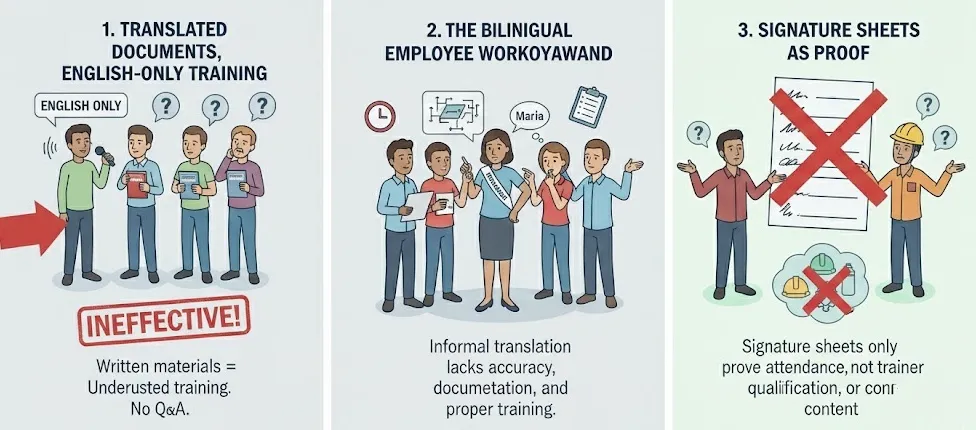
Employers facing multilingual workforces often reach for solutions that look like compliance but fail the effectiveness test. Three patterns show up repeatedly in Cal/OSHA citations.
Translated documents with English-only verbal instruction
Written materials in Spanish mean nothing if the trainer conducting the session speaks only English. Workers who can’t ask questions, can’t clarify what they don’t understand, and can’t engage with the material aren’t being trained. They’re being handed paper.
Cal/OSHA inspectors look at the full training process – who delivered it, in what language, whether questions were permitted and answered, whether comprehension was actually verified. Signature sheets prove attendance, not understanding.
The bilingual employee workaround
Relying on one Spanish-speaking worker to informally translate for coworkers shifts responsibility onto someone who may not know safety terminology, may not translate accurately, and probably isn’t being paid or trained to serve as an interpreter.
This approach fails for another reason: it creates no documentation. When an incident occurs and investigators ask how training was delivered, “Maria usually explains things” doesn’t satisfy Section 3203 requirements.
Signature sheets as proof of training
A signed acknowledgment shows someone held a pen. It doesn’t demonstrate:
- What was actually communicated
- Whether the worker understood the content
- Whether questions were asked or answered
- Whether the trainer was qualified to deliver the material
In contested cases, Cal/OSHA has looked past signature documentation to examine whether effective training actually occurred. KSBD, Inc. (Inspection No. 1675283, 2024) received citations for ineffective training of supervisors and employees, specifically in the context of heat illness prevention where language barriers prevented workers from understanding safety protocols. Proposed penalties totaled $276,425 across multiple willful-serious violations.
When Inadequate Training Becomes Serious and Willful Misconduct
Most workplace injuries in California get resolved through the workers’ compensation system, which limits employer exposure regardless of fault. But California recognizes an exception: when employer conduct rises to “serious and willful misconduct,” injured workers can pursue penalties beyond standard workers’ comp benefits.
The threshold requires more than negligence. Employers must have known about a dangerous condition, known it violated safety requirements, and failed to correct it anyway.
Language-related training failures can meet this standard when:
- The employer knew their workforce included non-English speakers
- The employer provided training only in English despite this knowledge
- A worker was injured performing a task they weren’t effectively trained to do safely
- Documentation shows the employer had been previously cited or warned about training deficiencies
The financial stakes are significant. According to the Workers’ Compensation Insurance Rating Bureau of California (WCIRB Quarterly Experience Report, December 2024), the average cost of a serious workers’ comp claim in California breaks down to approximately $30,753 in indemnity costs plus $36,488 in medical costs—roughly $67,241 total per claim. For employers found to have committed serious and willful misconduct, additional penalties apply on top of these base costs.
California’s workers’ comp claims also take substantially longer to resolve than the national average—7 years to close 90% of claims versus 3 years nationally. That extended timeline compounds costs and maintains liability exposure.
The pattern that creates maximum exposure: an employer who received a Cal/OSHA citation for training deficiencies, didn’t fix the problem, and then had a worker injured in circumstances directly related to inadequate training. At that point, the employer has documented knowledge, documented failure to correct, and documented harm. That combination transforms a workers’ comp case into something far more costly.
What Compliance Actually Looks Like
Cal/OSHA publishes ready-to-use materials in multiple languages precisely because they expect employers to use them. The “Injury & Illness Prevention Model Program for Non-High Hazard Employers” is available in Spanish, Armenian, Chinese, Korean, Punjabi, Tagalog, and Vietnamese. Heat illness prevention materials exist in 18+ languages. Hazard-specific alerts like the silica exposure warning for engineered stone countertop work are published in Spanish and Vietnamese.
Employers who use these resources, document their training programs, verify comprehension through methods beyond signature collection, and actually communicate in languages their workers understand aren’t just avoiding citations. They’re reducing the fatality gap that puts 210 Hispanic and Latino workers in California in the ground every year.
References
- California Department of Industrial Relations, Fatal Occupational Injuries in California 2013-2023 (April 2025)
- Cal/OSHA Title 8 CCR Section 3203 (IIPP Requirements)
- Blue Diamond Materials, Cal/OSHA App. 10-1282, Decision After Reconsideration (2012)
- The Kroger Co. (Ralphs Grocery Company), Inspection No. 1486257, ALJ Decision (January 2023)
- WCIRB Quarterly Experience Report (December 2024)
- US Census Bureau, 2023 American Community Survey; NAHB Analysis “Hispanics Comprise Nearly One-Third of the Construction Labor Force” (October 2024)
- Cal/OSHA Publications Catalog (Multilingual Resources)