 Sheila LaCivita
If you filed for Social Security Disability in the Simpsonville area and got denied, you’re not looking at some rare bad luck situation. The denial rate for initial applications sits at 62% nationally, and while South Carolina does slightly better than average with a 41.5% approval rate on first attempts, that still means more than half of everyone who applies gets a rejection letter.
What most people don’t realize is that getting denied initially doesn’t mean the claim is dead. The Greenville hearing office that handles Simpsonville cases approves about 53% of claims that make it to a hearing before an Administrative Law Judge. The math changes completely once you get past that first rejection.
The Numbers That Actually Matter for Simpsonville Residents
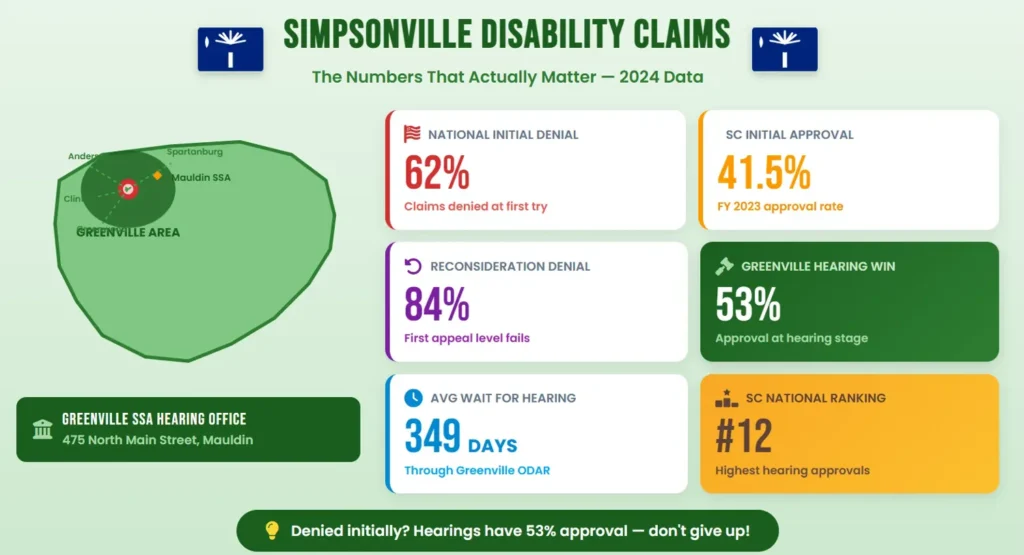
The Greenville SSA Office of Hearing Operations sits at 475 North Main Street in Mauldin and handles disability hearings for Anderson, Clinton, Greenwood, Greenville, and Spartanburg areas. Here’s what the data looks like as of 2024:
- 62% of disability claims denied at initial application nationwide
- 41.5% approval rate for initial claims in South Carolina (fiscal year 2023)
- 84% denial rate at reconsideration (first appeal level)
- 53% approval rate at hearings in the Greenville area offices
- 349 days average wait time to get a disability hearing scheduled through Greenville ODAR
- South Carolina ranks 12th in the nation for highest percentage of approvals at hearings
That reconsideration number is the one that surprises people. After the initial denial, most applicants file for reconsideration thinking the SSA will take another look and fix their mistake. But 84% of reconsideration appeals get denied too. The reconsideration stage is basically a speed bump on the way to a hearing, which is where claims actually get won.
The 349-day wait for a hearing is brutal though. That’s almost a full year of waiting after you’ve already been denied twice, probably while dealing with the medical condition that made you file in the first place. The average time for initial determinations has gotten worse too — it more than doubled from 3.7 months in 2017 to a peak of 7.7 months by August 2024.
Why Initial Applications Fail So Often
The 62% denial rate doesn’t happen because most applicants aren’t actually disabled. It happens because of how the system processes claims and what it looks for.
As many as 67% of first-time applications get denied due to missing information, incorrect details, or not enough medical evidence supporting the claim. The examiner reviewing an initial application has a stack of files to get through and limited time to spend on each one. If the medical records don’t clearly show why someone can’t work, the default answer is denial.
Common problems that sink initial applications:
- Medical records that describe symptoms but don’t explain functional limitations
- Gaps in treatment history that make it look like the condition isn’t serious
- Treating doctors who don’t provide detailed opinions about work capacity
- Subjective symptoms like pain or fatigue without objective test results
- Missing records from specialists, hospitals, or mental health providers
The subjective symptoms issue kills a lot of legitimate claims. Conditions like fibromyalgia, chronic fatigue, depression, anxiety, and PTSD don’t always show up on an MRI or blood test. The pain is real, the limitations are real, but the medical evidence looks thin to an examiner who needs documentation to justify an approval.
What the Fourth Circuit Cases Show About Winning Appeals
The Fourth Circuit Court of Appeals covers South Carolina, and recent cases from this circuit show exactly what goes wrong at hearings and how those errors get corrected on appeal.
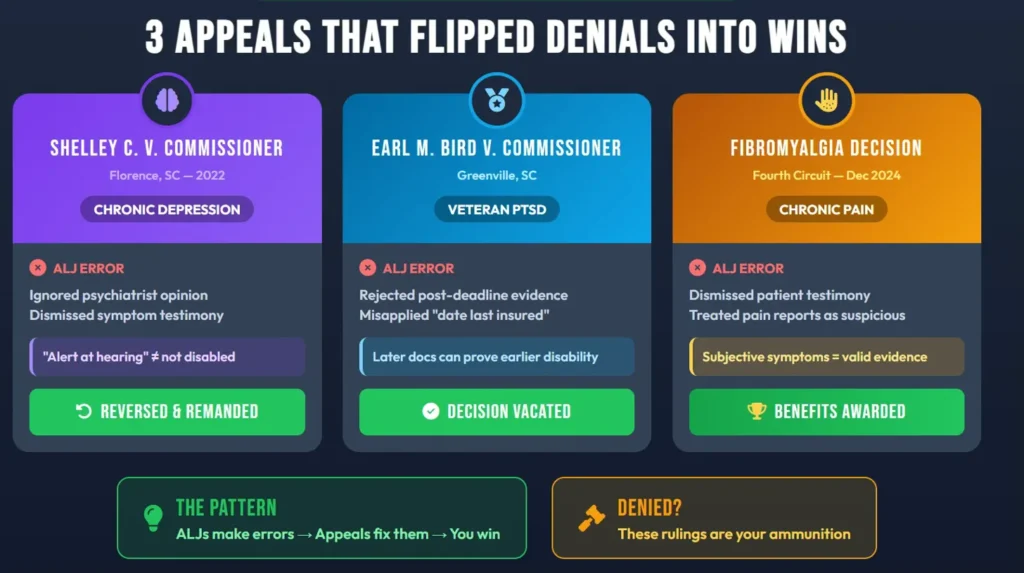
Shelley C. v. Commissioner (South Carolina, 2022)
This case went before Senior District Judge Terry L. Wooten in Florence. The claimant had chronic depression and a treating psychiatrist who provided opinions about her limitations.
The ALJ gave “little weight” to the treating psychiatrist’s opinion without properly explaining why. The ALJ also improperly disregarded the claimant’s own statements about her symptoms. The Fourth Circuit found that the ALJ’s analysis didn’t account for how mental health impairments actually work — depression doesn’t show up on an X-ray, and someone can have a devastating mental health condition while still appearing functional during a short hearing.
The court reversed and remanded the case.
This pattern happens constantly with mental health claims. A claimant describes crippling anxiety or depression, their psychiatrist supports the claim, and the ALJ decides the medical opinion doesn’t deserve much weight because the claimant “appeared alert and oriented” during the hearing. Having representation that knows how to challenge these decisions makes the difference between losing and getting the case sent back for proper consideration.
Earl M. Bird v. Commissioner (Greenville, SC)
This one came out of Greenville with representation from a local firm. The claimant was a veteran seeking benefits related to PTSD, and the central issue involved something called the “date last insured” — basically the deadline by which you have to prove you became disabled to qualify for benefits.
The ALJ denied the claim partly because some of the strongest evidence came from after the date last insured. The Fourth Circuit vacated that decision because post-date evidence can still be “reflective of a possible earlier and progressive degeneration” of a condition. Just because a diagnosis or detailed medical record comes later doesn’t mean the disability didn’t exist before that deadline.
Veterans dealing with PTSD often face this exact problem. They may not have sought treatment while in service or immediately after, and by the time they have solid documentation of their condition, years have passed. Knowing how to argue that later evidence reflects earlier disability is something that requires understanding how these cases get won on appeal.
Fourth Circuit Fibromyalgia Decision (December 2024)
This is recent — December 2024 — and it matters for anyone in the Simpsonville area dealing with chronic pain conditions.
The Fourth Circuit reversed a denial after finding that the ALJ failed to properly credit the claimant’s subjective evidence about fibromyalgia symptoms. The court didn’t just send it back for another hearing. They remanded for a calculation of benefits, meaning they determined the claimant should have been approved.
Fibromyalgia is one of those conditions where the main evidence is what the patient reports — widespread pain, fatigue, cognitive difficulties. There’s no definitive test that proves someone has it, and severity varies from person to person. ALJs sometimes treat subjective symptom testimony as inherently suspicious, but this case confirms that when properly presented, subjective evidence can carry a claim.
What Changes When You Have Representation
The gap between self-represented claimants and those with attorneys shows up clearly in the statistics. Around 50% of disability denials get remanded at the federal district court level when appealed, and the top reason federal courts send cases back is that a treating doctor’s opinion was rejected without good reason.
A Simpsonville NC SSD lawyers from Pilzer Law attorney or similar disability law firm understands what makes ALJs reject claims and how to build a record that prevents those rejections. They know that a treating physician’s opinion needs to be in a specific format with specific language about functional limitations. They know how to get doctors to provide that documentation. They know which medical evidence to emphasize and how to explain subjective symptoms in terms the SSA process actually credits.
The practical difference shows up in several ways:
- Medical evidence gets gathered before the hearing, not scrambled together at the last minute
- Treating doctors get asked the right questions and provide opinions in formats that carry weight
- The claimant’s testimony gets prepared so it addresses what ALJs actually look for
- If the ALJ makes errors, those errors get preserved for appeal
- Post-hearing briefs highlight the evidence and legal arguments the ALJ should follow
That 53% approval rate at Greenville hearings includes both represented and unrepresented claimants. The approval rate for claimants with experienced disability attorneys runs higher because the cases get presented differently from the start.
The Wait Is Real But the Odds Improve
Nobody wants to hear that they might wait 349 days for a hearing after already being denied twice. That’s a difficult reality for anyone dealing with a disabling condition and no income. Some conditions qualify for compassionate allowance processing which speeds things up considerably, but most claims go through the standard timeline.
The thing worth understanding is that the wait often ends with approval. South Carolina ranks 12th in the nation for highest percentage of approvals at hearings. The Greenville office approves 53% of claims at hearings. Those numbers mean that for people who stick with the appeals process and get their case properly prepared, the odds flip from mostly denial to roughly even or better.
Initial denial is where most claims are right now. It’s not where most claims have to end.