 John Veale Solicitor
There is no single “Isotonix lawsuit.” The phrase gets treated online as if one massive case exists, but what actually happened is three separate legal and regulatory issues involving Market America Inc., the North Carolina-based MLM company that manufactures and distributes Isotonix supplements.
One common one:
Product: Dietary Supplements
Recipient:
Marc Ashley
COO/PresidentMarket America Inc
1302 Pleasant Ridge Rd.Greensboro, NC 27407-9415United StatesIssuing Office:Office of Human and Animal Foods – East 3
United States
Key Issues from the FDA Warning Letter
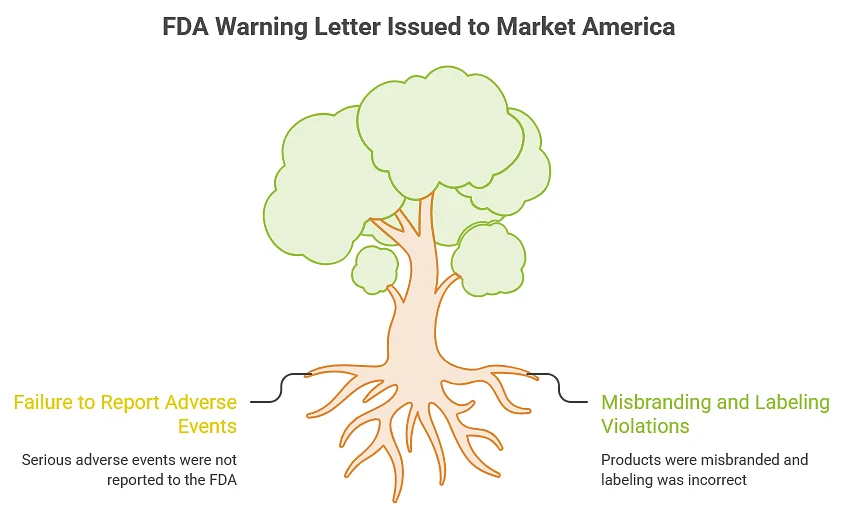
Lack of Reporting Serious Adverse Events
- To the FDA, Market America has not written up and submitted the Serious Adverse Event Reports (SAERs) as legally required, pertaining to dietary supplements, to be submitted within 15 business days.
- One (March 2018) reports involved the TLS Nutrition Shake and events that caused prolonged hospitalization, and vertigo, and required a 6-week physical therapy.
- The other one (January 2019), the TLS 21-Day Challenge Kit (Isotonix OPC-3 among other products), resulted in hospitalization and battles with abdominal pain, vomiting, and dizziness, coupled with weakness, shaking, and insomnia.
- This demonstrates that the company failed to report the adverse interactions with the regimen that included the Isotonix OPC-3, which moves the company further from compliance and closer to the safety and liability issues that would be of concern.
Violating Misbranding and Labeling
- Due to the following reasons, several Isotonix products that were cited as misbranded.
- The OPC-3 Isotonix (says 1 capful, but in the directions were recommend up to 2 capfuls at the start) and the serving size was not correct.
- Nutritional information was also likely presented improperly (example, the use of “vitamin B-3” instead of niacin, was a name given to a vitamin that should not have a value that was too small or be empty that was omitted, or declared to be zero or near zero).
- A 2020 FDA warning letter citing failure to report hospitalizations and misbranding of six products. This is a regulatory enforcement action, not a lawsuit, and it is publicly available on FDA.gov.
- A 2017 federal lawsuit filed by two former distributors alleging Market America operates as an illegal pyramid scheme. This is about the MLM business model, not supplement safety.
- Individual consumer complaints about adverse reactions to products like OPC-3, reported through various channels but not consolidated into any verified class action as of mid-2026.
Most articles online blend all three into one story. They are not one story.
Two categories of violations. explained:
Failure to Report Serious Adverse Events
Federal law under 21 U.S.C. § 379aa-1 requires dietary supplement manufacturers to submit Serious Adverse Event Reports (SAERs) to the FDA within 15 business days. Market America did not do this for two separate hospitalizations.
March 2018 incident: A consumer using the TLS Nutrition Shake experienced prolonged hospitalization, vertigo, and required six weeks of physical therapy.
January 2019 incident: A consumer using the TLS 21-Day Challenge Kit, which included Isotonix OPC-3 among other products, was hospitalized with abdominal pain, constipation, vomiting, dizziness, itching, weakness, shaking, insomnia, chills, headache, tingling and numbness, and cramps. All of this after one week on the regimen.
Neither incident was reported to the FDA within the required timeframe. The company later submitted revised procedures for assessing adverse event severity, but the FDA noted in its letter that Market America never addressed whether it would conduct a retrospective review of past adverse events to determine if others should have been reported too.
Misbranding of Six Products
The FDA found labeling violations across six specific products:
| Product | What the FDA Found Wrong |
|---|---|
| Isotonix OPC-3 | Instructions said take 2 capfuls but the Supplement Facts panel was calculated for 1 capful only, so consumers had no accurate information about actual nutrient amounts at the recommended dose. Also failed to identify the part of the plant from which botanical ingredients were derived. Referenced “Pycnogenol” (a trademarked ingredient) inside the Supplement Facts panel, which is not permitted. |
| Isotonix Multivitamin | Listed “Vitamin B-3” instead of the required name “Niacin.” Nutrient values that were too small to declare or were zero were either omitted or handled incorrectly. |
| Isotonix Multivitamin with Iron | Same naming and declaration issues as the standard Multivitamin. |
| Isotonix Activated B-Complex | Labeling deficiencies related to nutrient declarations. |
| Heart Health Essential Omega III | Labeling deficiencies related to nutrient declarations and serving size information. |
| TLS 21-Day Challenge Kit | Named in connection with the January 2019 hospitalization. Contained Isotonix OPC-3 among other products. |
The FDA’s letter explicitly stated these were “not meant to be an all-inclusive list of violations” and warned that failure to promptly correct them could result in enforcement action including product seizure or injunction.
The letter is publicly available at fda.gov/inspections-compliance-enforcement-and-criminal-investigations/warning-letters/market-america-inc-588959-02122020.
The Pyramid Scheme Lawsuit Is a Separate Case About the Business Model
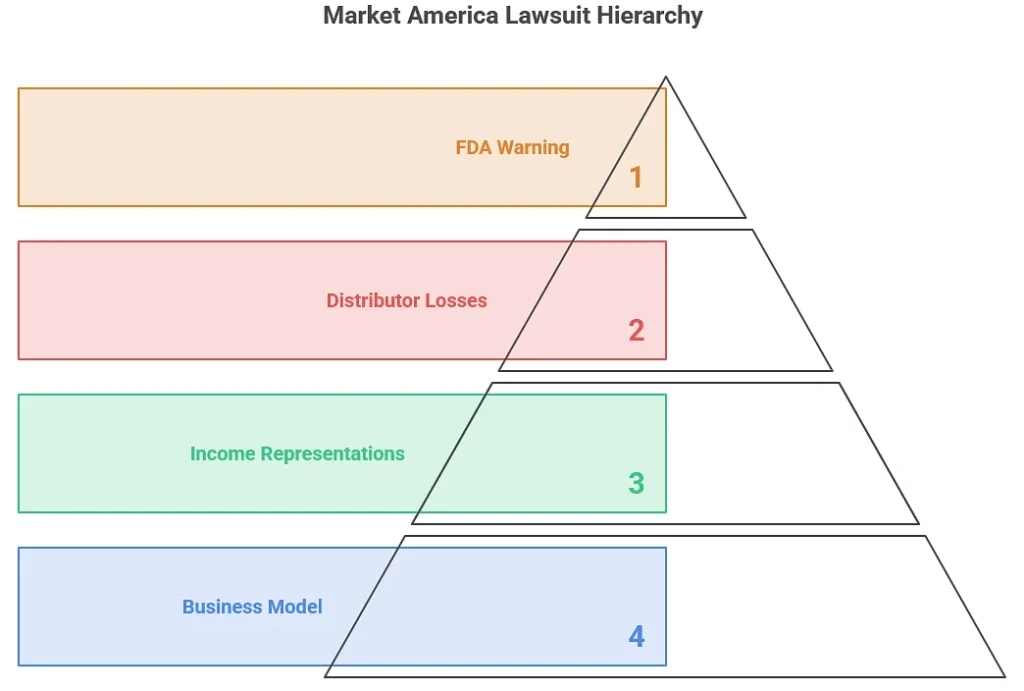
In 2017, two former Market America distributors, Chuanjie Yang and Ollie Lan, filed a federal lawsuit in California alleging the company operated as an illegal pyramid scheme. The case was later transferred to the Middle District of North Carolina.
This lawsuit had nothing to do with whether Isotonix supplements are safe or effective. The allegations centered on Market America’s MLM structure, specifically that the business model prioritized recruiting new distributors over selling products to actual retail consumers, that income representations made to prospective distributors were misleading, and that the majority of distributors lost money.
The distinction matters because dozens of articles online merge this lawsuit with the FDA warning letter and with consumer health complaints as if they are all part of the same legal action. They are not. The pyramid scheme case is about business practices and distributor economics. The FDA warning is about labeling violations and unreported hospitalizations. They involve the same company but they address completely different problems.
What About the “90% Absorption” Claim?
Isotonix products are marketed on the premise that their isotonic delivery system, a powder mixed into water that matches the body’s osmotic pressure, allows nutrients to be absorbed significantly faster than traditional pills or capsules. Some marketing materials have claimed absorption rates “up to 90% faster.”
Has this claim been independently verified?
The FDA’s 2020 warning letter did not specifically address the absorption claim. However, the Dietary Supplement Health and Education Act of 1994 (DSHEA) does not require supplement manufacturers to prove efficacy claims to the FDA before marketing. The manufacturer is responsible for ensuring claims are truthful and not misleading, but pre-market approval is not required the way it is for pharmaceutical drugs.
Several of the online “Isotonix lawsuit” articles describe litigation specifically challenging the 90% absorption claim. What actually exists in verified court records is the Yang/Lan pyramid scheme case, which touched on marketing practices broadly but was not structured as a product efficacy challenge. Individual consumers have raised the absorption claim in complaints, but no consolidated class action built specifically around that claim appears in federal court records accessible through mid-2026.
That does not mean the claim is validated. It means nobody has successfully brought it to trial as the central legal question yet.
Consumer Adverse Reaction Reports
Outside of the two hospitalizations documented in the FDA warning letter, individual consumers have reported various adverse reactions they attribute to Isotonix products, particularly OPC-3. These reports surface through FDA adverse event databases, consumer complaint forums, and legal intake websites. Reported symptoms across various sources include:
- Gastrointestinal distress, nausea, abdominal pain, and vomiting
- Cardiovascular symptoms including irregular heartbeat and blood pressure changes
- Dizziness, headaches, and neurological effects
- Allergic reactions
- Liver enzyme elevation in isolated reports
A critical distinction here. Individual adverse event reports, whether filed with the FDA or posted on consumer forums, do not by themselves establish that a product caused the reported symptoms. They document a temporal association, someone used the product and then experienced symptoms. Establishing causation requires clinical investigation, and for most of these individual reports that investigation has not occurred publicly.
The FDA adverse event reporting system (FAERS) is a signal detection tool. When enough reports accumulate around a specific product, the FDA may investigate further. The 2019 inspection and 2020 warning letter suggest the FDA was already paying attention to Market America’s reporting practices.
Is There an Active Class Action?
Several legal intake websites and blog articles reference an ongoing or potential class action lawsuit related to Isotonix product safety. As of mid-2026, no verified class action with a public docket specifically targeting Isotonix product injuries or the absorption efficacy claims appears in federal court records.
What does exist:
- The Yang/Lan pyramid scheme case (business model, not product safety)
- The FDA warning letter (regulatory enforcement, not a lawsuit)
- Individual consumer complaints and adverse event reports (not consolidated into a class action)
- Legal intake websites soliciting potential plaintiffs, which is standard practice for firms evaluating whether a class action is viable but does not mean one has been filed
The gap between what intake websites suggest and what court records show is wide. Someone reading online that an “Isotonix class action is underway” should check PACER or a federal court docket search before assuming a case exists with their name potentially attached to it.
What This Means If You Have Used Isotonix Products and Experienced Problems
If you experienced adverse health effects while using an Isotonix product, the FDA’s MedWatch system at fda.gov/safety/medwatch-fda-safety-information-and-adverse-event-reporting-program accepts voluntary adverse event reports from consumers. Filing one takes about 15 minutes and it contributes to the signal detection database that triggers FDA investigations.
If the adverse effects were serious enough to involve hospitalization, disability, or a life-threatening event, consulting a personal injury attorney who handles product liability and dietary supplement cases is the practical next step. Whether a viable individual claim exists depends on the specific product, the specific injury, the medical documentation connecting the two, and the applicable state’s statute of limitations.
What the FDA warning letter confirmed is that Market America was not reporting hospitalizations when it was legally required to. That failure does not prove the products caused the hospitalizations. But it does establish that the company was not following the reporting rules designed to surface exactly these kinds of safety signals.
References
- FDA Warning Letter to Market America Inc., February 12, 2020. Facility inspection May 21-28, 2019. Available at: fda.gov/inspections-compliance-enforcement-and-criminal-investigations/warning-letters/market-america-inc-588959-02122020
- 21 U.S.C. § 379aa-1 (Serious Adverse Event Reporting for dietary supplements, 15 business day reporting requirement).
- Dietary Supplement Health and Education Act of 1994 (DSHEA), 21 U.S.C. § 321 et seq.
- Yang and Lan v. Market America Inc., filed 2017, U.S. District Court, Central District of California, later transferred to Middle District of North Carolina. Pyramid scheme allegations.
- FDA MedWatch Adverse Event Reporting: fda.gov/safety/medwatch-fda-safety-information-and-adverse-event-reporting-program