 Kerry Splatt (AU Car Aciddent Lawyer)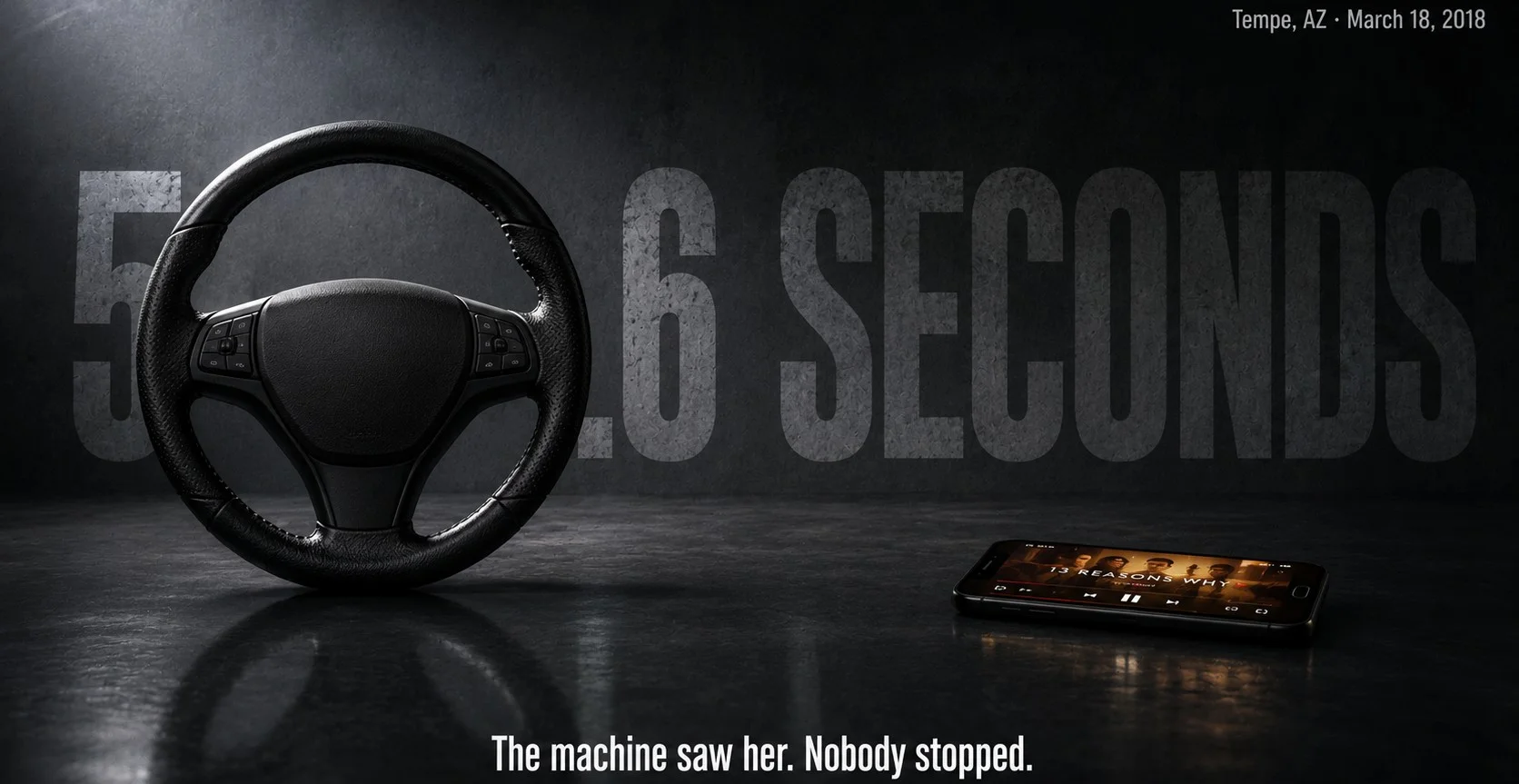
The car’s sensors picked up Elaine Herzberg 5.6 seconds before it hit her. Plenty of time. The trouble was that the software couldn’t decide what she was — a vehicle, then a bicycle, then “an unknown object” — and the human paid to watch the road was watching a TV show instead. The whole legal story lives in that gap: between what the machine saw and what nobody did about it.
The short answer, if you don’t want the long one. The driver paid. Rafaela Vasquez, the safety operator behind the wheel of Uber’s self-driving Volvo in Tempe on the night of March 18, 2018, was charged with negligent homicide. In July 2023 she pleaded guilty to a reduced charge of endangerment and got three years of supervised probation, a $500 fine and no jail time. Uber — the company that wrote the software, switched off the Volvo’s factory emergency braking, and had recently cut its safety crews from two people per car to one — was never criminally charged. It settled with Herzberg’s family inside ten days and never set foot in a courtroom. So when someone asks who is liable when autonomy fails, the answer this case actually gives you is uncomfortable: the person in the seat, not the company that built the seat.
Here’s how the law got there.
The Night of the Crash and the Driver’s One Job
It was just before 10 p.m. The Volvo XC90 had been running in autonomous mode for about 19 minutes, finishing a loop on a test route, when Herzberg started across the road outside a crosswalk, pushing a bicycle.
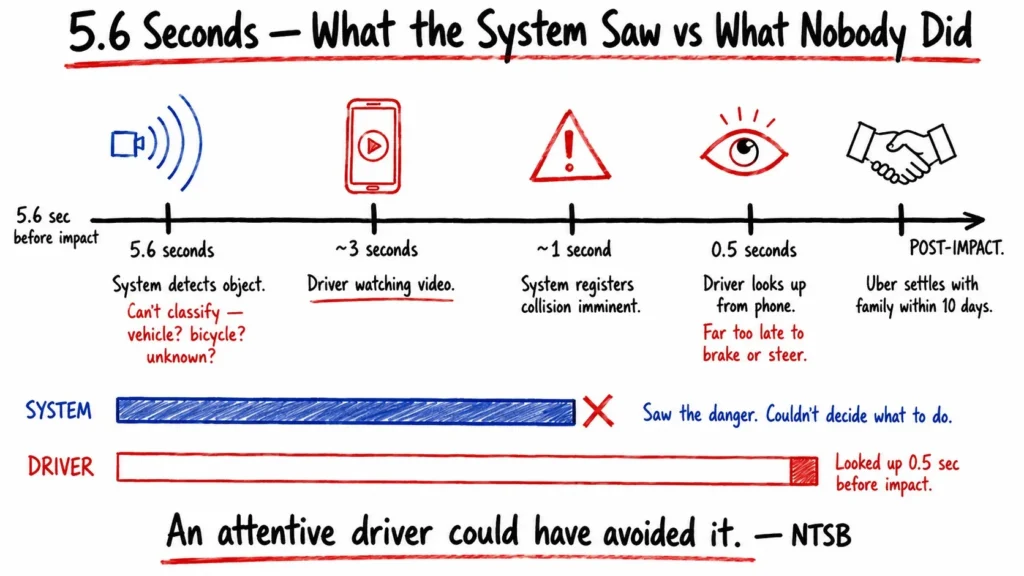
What matters legally is the word backup. Vasquez wasn’t a passenger. Under the testing model used here, the human operator is the last line of defense — the fallback the whole arrangement depends on. The NTSB’s investigation found she had been looking away from the road for a large share of the trip and looked up only half a second before the collision, far too late to brake or steer. The Board’s conclusion was blunt: an attentive driver could have avoided it. That single finding — that the danger was perceivable and she failed to perceive it — is what turned a tragedy into a criminal case. (For the underlying facts, the Wikipedia entry on the death of Elaine Herzberg is a solid starting point.)
Criminal Liability: From Negligent Homicide to an Endangerment Plea
A Maricopa County grand jury indicted Vasquez in September 2020 on one count of negligent homicide — a class 4 felony under Arizona Revised Statutes §13-1102. The theory was straightforward. Criminal negligence in Arizona means failing to perceive a substantial, unjustifiable risk that a reasonable person would have caught, where that failure is a gross deviation from ordinary care. Streaming entertainment during a safety-critical monitoring job clears that bar without much argument.
Then, in July 2023, the case ended not with a trial but a plea: guilty to endangerment, three years of supervised probation, a $500 fine plus restitution, no jail.
Why does the swap from homicide to endangerment matter? Because it quietly dodged the hardest fight in the whole case — causation. To convict on homicide, prosecutors would have had to persuade a jury that her inattention caused the death. But the car also failed: it misclassified Herzberg, and its automatic braking had been disabled. A defense lawyer would have hammered that the machine, not the human, was the real cause. Endangerment doesn’t require proving she alone caused anything — only that she recklessly created a substantial risk of death or injury. The plea captured her wrongdoing and let everyone avoid arguing, in front of a jury, exactly how much of the blame belonged to the robot.
One more thing the prosecutors did is easy to miss: they declined to charge Uber at all, stating there was no basis for corporate criminal liability under Arizona law. That left Vasquez as the only human the criminal system held responsible.
Civil Liability and the Ten-Day Settlement
The civil side closed almost before it opened. Within ten days of the crash, Uber settled with Herzberg’s family for an undisclosed sum. No lawsuit, no discovery, no public verdict.
That speed wasn’t an accident. Had the case gone forward, the family had several strong theories to throw at Uber:
- Vicarious liability (respondeat superior). Uber classified its Arizona test drivers as employees, not contractors. An employer is automatically on the hook for an employee’s negligence committed within the scope of the job — and monitoring the car was the job.
- Negligent training and supervision. Uber had recently cut its safety crews from two operators to one, and disabled the Volvo’s factory emergency braking without a reliable replacement. The NTSB tore into the company’s safety culture on exactly these points.
- Product / design defect. The system’s failure to correctly classify a pedestrian and decide to brake points straight at the software Uber built.
For Vasquez personally, Arizona’s comparative-negligence rule (A.R.S. §12-2505) would have split liability by percentage of fault — and Herzberg’s own decision to cross mid-block at night would have been weighed too. But because Uber settled and almost certainly indemnified its employee, Vasquez was unlikely to pay civil damages out of pocket. Her real exposure was always criminal.
The catch is what the settlement bought: silence. No jury ever apportioned fault in open court. The NTSB report became the only public accounting of who did what — which is a thin substitute for a verdict, and a pattern worth watching as more of these cases settle quietly.
The Legal Principles That Emerged (And What They Mean for You)
Strip the case down and three ideas survive.
First, the duty does not transfer to the machine. Put a human in the seat and the law treats that human as the driver, period — responsible for watching the road and intervening as if no software existed. This isn’t an Uber quirk. In a 2021 California case, a Tesla owner running “Full Self-Driving” was charged with vehicular manslaughter after a fatal crash, on identical reasoning: the system was engaged, but she was still legally the driver. If you ever sit behind the wheel of a test or semi-autonomous vehicle, that’s the line to keep in mind — the autonomy is yours to supervise, not yours to trust.
Second, charging a corporation with a homicide is genuinely hard in the United States. It usually demands proof that a senior manager authorized or recklessly tolerated the danger — a bar the Tempe prosecutors decided the evidence couldn’t clear. Several European systems make corporate manslaughter far easier to reach, which is exactly why this case would have played out differently across the Atlantic.
Third, and this is where the ground is shifting: newer statutes in states like Texas and Florida route liability toward the “automated driving system provider” when the system itself is at fault. Read the fine print, though. Those laws shield the human from the machine’s failures — not from their own failure to pay attention. The duty to watch outlives the reform.
Key Legal Takeaways
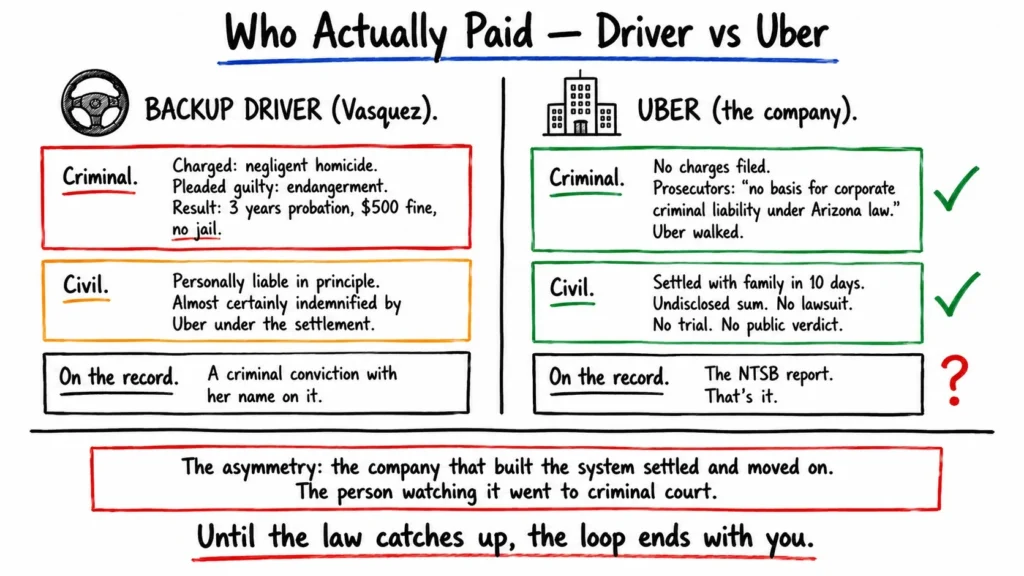
Here’s the whole case on a single grid:
| Backup driver (Rafaela Vasquez) | Uber (the company) | |
| Criminal liability | Charged with negligent homicide; pleaded guilty to endangerment. Three years’ supervised probation, $500 fine, no jail. | No charges filed. Prosecutors found no basis for corporate criminal liability under Arizona law. |
| Civil liability | Personally liable in principle, but almost certainly indemnified by Uber and covered under the family’s settlement. | Settled with Herzberg’s family within ten days for an undisclosed sum. No lawsuit, no trial, no public verdict. |
| What ended up on the public record | A criminal conviction with her name on it. | The NTSB report — the only public finding of fault that exists. |
The thing to carry out of Tempe is the asymmetry. When the autonomy failed, the company that built it settled and moved on, and the person watching it went to criminal court. Until the law catches up with the technology, that’s still the safest assumption to plan around — if you’re the human in the loop, the loop ends with you.