 Danielle R. Farahi (From California)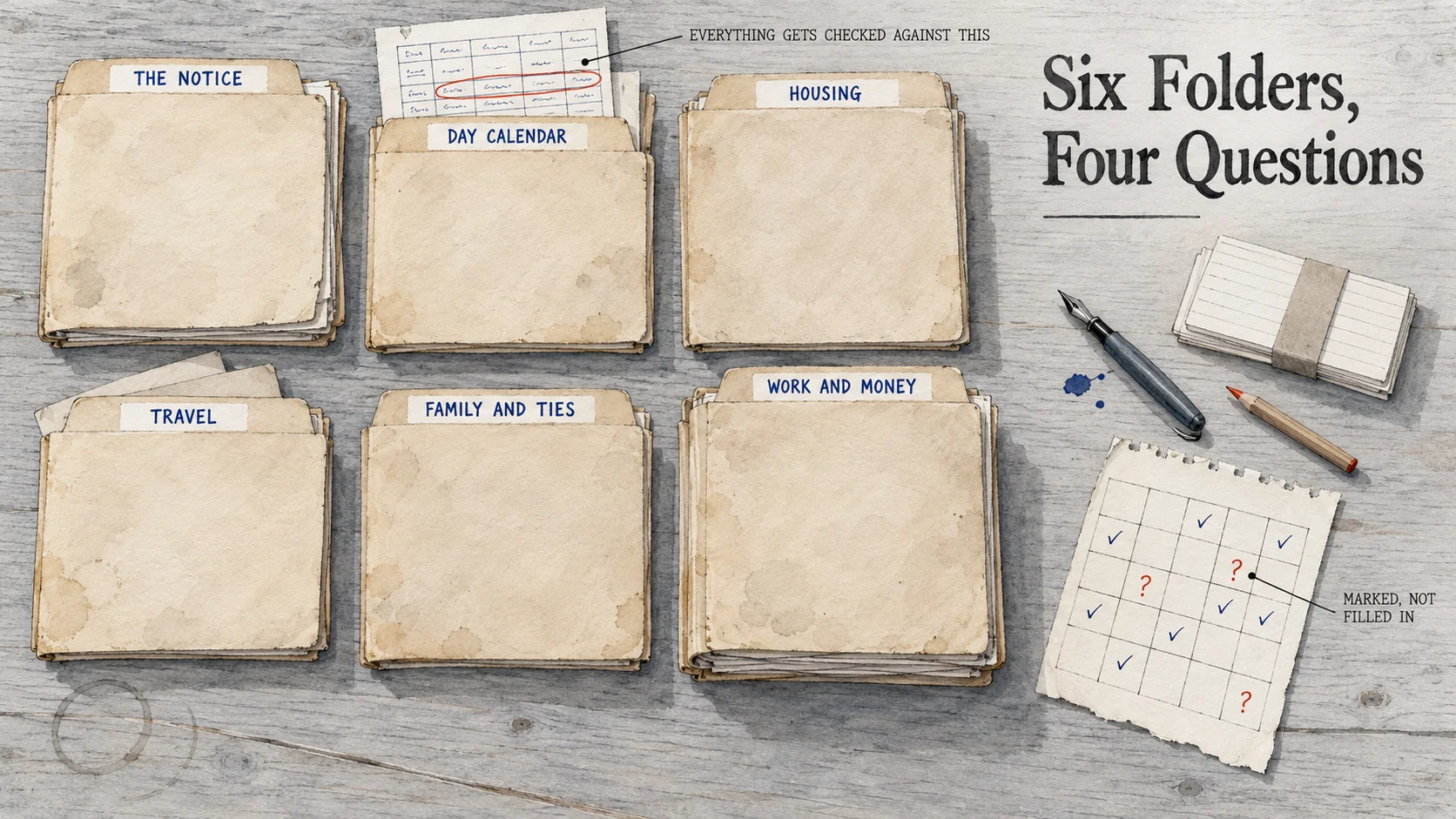
The FTB is testing four things, where your permanent home was, how many days you spent in California, where your closest ties were and whether all of that holds up for the exact period on the notice. Six folders answer those four questions. Please read the table first, because the last column is where people lose.
What The FTB Is Testing And Why A Box Of Receipts Does Not Answer It
California taxes residents on everything they earn anywhere in the world, so the whole fight is over whether you were a resident. The definition sits in Revenue and Taxation Code section 17014. A resident is anyone in California for other than a temporary or transitory purpose and anyone domiciled in California who is out of the state for a temporary or transitory purpose. Domicile is the place you mean to come back to, the permanent home and you only ever have one at a time.
Two more rules sit on top of that. If you spent more than nine months of the year in California, you are presumed a resident under section 17016 and it is on you to show otherwise. And where the day count does not settle it, the examiner goes to the closest connections test from the Appeal of Bragg, a 2003 decision that lists the ties the state weighs:
- where your spouse and children lived.
- where your home was and whether you owned or rented at each place.
- where you were registered to vote and where you actually voted.
- the state on your driver’s license and your car registrations.
- where your doctor, dentist, accountant and lawyer were.
- where your bank accounts and safe deposit box were.
- where your church, club and gym memberships were.
- the address on your tax returns and your business filings.
The examiner counts days and ties. Your documents are only there to put a date on each one.
Do you know the most famous man to lose years to this test was an inventor? Gilbert Hyatt sold his California house and moved to Las Vegas in 1991, a few months before the licensing money from his microcomputer patent started coming in. The FTB said he had not really left until April 1992 and it spent the next 26 years trying to prove it. Investigators interviewed 22 of his old neighbors and two agents went through the trash outside his Las Vegas house. The first bill was 13.3million.Withinterestithadgrowntoabout55 million by the time the Board of Equalization ruled in 2017 that he had become a Nevada resident on October 20, 1991, which left him owing about $1.9 million for the part of 1991 he had spent running his business from California. Granted, you are not Gilbert Hyatt, but the examiner runs the same list of ties on a schoolteacher who moved to Reno.
The Six Folders On One Page
| Folder | What goes in | What it proves | What it does not prove | The trap |
| 1. The notice and the period | The FTB letter, the years and dates it names, the deadline, the examiner’s contact | What you have to answer | Nothing about where you lived | Answering questions the notice did not ask |
| 2. The day calendar | One row per day with your location and one record per day | How many days you were in California | Why you were there | Guessing days and not marking them as guesses |
| 3. Housing | Leases, closing statements, property tax, utilities, insurance, repairs, sorted by property | Which homes were available to you and when | That you slept there | The second home that stayed furnished after you moved |
| 4. Travel | Flight confirmations, toll records, hotel folios, passport stamps, cell phone location history | Where you were on a given date | That a booking became a trip | Counting a cancelled reservation as a journey |
| 5. Family and community | School enrollment, doctor and dentist records, voter registration, driver’s license, memberships | Where your closest ties were | Residency on it’s own | Assuming more papers from one state wins |
| 6. Work and money | Employment contract, payroll by worksite, business filings, bank statements with address history | Where you worked and where the money sat | That the employer’s headquarters is where you worked | The bank address that never got updated |
Folder One: The Notice And The Period You Are Actually Answering For
Read the letter before you open a drawer. Write down the tax years it names, the exact residency period it questions, the response deadline and the examiner’s name and number. Those four things decide what goes in the other five folders. Anything outside the period goes in a box at the back, kept but not sent.
Admittedly the notice may read wider than the issue. An audit that names 2021 and 2022 may be about one question, whether you had left by the day the stock vested. Build the file around that question. Keep the rest, since the examiner can widen the scope later, but do not hand it over until asked.
Answer the period on the notice, keep everything else and send nothing the notice did not ask for.
Folder Two: The Day Calendar, Which Every Other Folder Gets Checked Against
This is the folder a lawyer asks for first. Any lawyer who takes on a california state tax audit and Segal, Cohen & Landis in Beverly Hills takes on plenty, wants the calendar before any lease or bank statement, because every other folder gets checked against it.
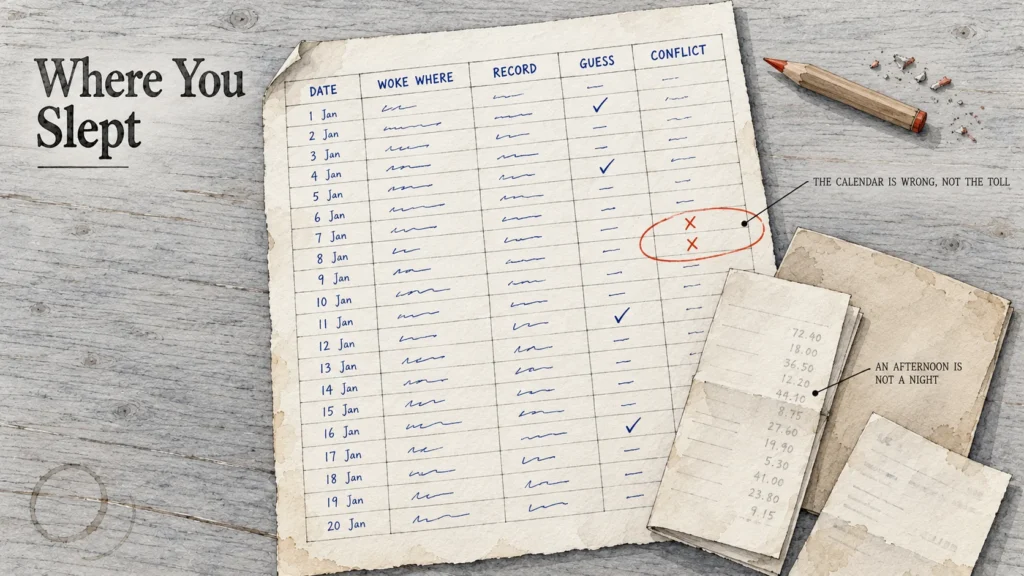
Make it a table with one row per day for the whole period. Columns:
- the date
- where you woke up that morning
- the record that proves it, named (toll charge, flight, hotel folio, card swipe)
- a mark for days that are a guess
- a mark for days where two records disagree
Around a move or a trip, do every day. In a quiet month at one address, a week per row will do, provided you can prove the week. Third party records made at the time carry the most weight, a toll record from the Bay Bridge, a hotel folio, a boarding pass scan. A card charge at a gas station in Reno proves you were near Reno that afternoon. It does not prove where you slept. True, the examiner will take an afternoon in Reno as a point in your favor, but he will not take it as a night.
Where you slept is the question for every day. If a record only shows where you spent the afternoon, mark the night unresolved and move on.
Are we really going to argue with a toll record? No. So neither should your calendar. If the toll record says you crossed into California on the 14th and your calendar says the 16th, the calendar is wrong and gets fixed now, before an examiner fixes it for you.
Folder Three: Housing, Sorted By Property And Not By Paper Type
One sub folder per property. Inside each, in date order: the lease or the closing statement, property tax bills, utility statements, homeowner or renter insurance, repair invoices. For each property write a one line note saying when it was available for you to use and when it was not.
The ifs and buts live in the second home. A house that stayed furnished and insured after you moved, with the power on and your clothes in the closet, is a house the examiner will say you never left. If it was rented to a tenant, the lease goes in and so does the tenant’s first rent payment. If your adult son lived there, write down who held the title, who paid the bills and the dates you could not have used it.
A home that stayed available to you counts against you on every day it stayed available, so prove the days it was not.
Folder Four: Travel, Matched Against The Calendar Line By Line
Flight confirmations, toll records, hotel folios, passport stamps, rental car agreements and cell phone location history, each one dated and each one matched to a row of the calendar. Where an arrival time matters, a flight that landed at 11:40 pm, write the time next to the date.
Unfortunately, a booking is not a trip. People book and cancel, change dates, miss flights. Label every cancellation and every changed reservation as what it was and keep the record of the trip that actually happened next to it. An examiner who finds a confirmation for a flight you never took, filed as if you took it, stops trusting the rest of the folder.
Keep the cancelled booking and the real trip side by side, labeled, because the examiner will find the cancellation anyway.
Folder Five: Family And Community, Where The Closest Connections Test Gets Decided
Spouse, partner, dependent children, in that order. School enrollment, pediatrician and dentist records, the youth soccer registration, all dated. Then your own ties: voter registration and the dates you actually voted, driver’s license, car registrations, where your doctor and dentist were, church or temple, gym, country club, the vet.
Indeed, this folder gets won or lost on dates rather than volume. Fifteen California memberships that lapsed in March do not outweigh four Nevada ones that began in March. Put a start date and an end date on every tie and let the examiner see the line move.
No single paper proves residency and no stack of papers does either. The dates on each tie are what the test reads.
Folder Six: Work And Money, Where The Headquarters Address Fools People
Employment contract, payroll records with the worksite for each pay period, work calendar, badge access records, business ownership documents, bank and brokerage statements with the address history on each account.
Two things fool people here. An employer headquartered in San Jose does not make you a San Jose worker if you did the job from a desk in Austin, so note the worksite for every pay period. And the bank that still mails to your old Pasadena address is a bank you forgot to update, which the examiner may read as a tie you kept. Update it now and keep the dated confirmation.
Where you did the work and where the money sat are two different questions. Answer both, by date.
How Far Back The FTB Can Reach And The Year It Can Reach Forever
For a year you filed a California return, the FTB has four years from the filing date to mail a notice of proposed assessment. That is section 19057. Leave out more than a quarter of your income and it stretches to six years under section 19058.
The trap is the year you filed nothing. Say you moved out in 2019 and filed no California return for 2020, because you were gone. If the FTB decides you were still a resident in 2020, there is no clock on that year at all. When no return was filed, the FTB can assess at any time, under section 19087. That is how Hyatt’s 1991 was still open in 2017.
For a year you filed no California return, the FTB can come back whenever it likes. Those are the years your folders have to be strongest.
A nonresident return, Form 540NR, filed for a year you had any California income at all, starts the four year clock on that year. Many people skip it to avoid attention and in doing so leave the year open for good.
Fix The Gaps And Conflicts Before You Send A Page

Three kinds of trouble turn up once the calendar is built and all three are better found by you than by the examiner.
- Missing stretches. A month with no records. Name it, then look for substitutes made at the time: archived statements, employer records, toll records, the landlord’s rent log, insurance letters. Label every reconstruction as a reconstruction.
- Unresolved nights. A day where the evidence stops at an afternoon arrival. Mark it unresolved. Do not assign it to the state you would prefer.
- Conflicts. Two papers that put you in two places, an overlapping lease, an old address on an account. Keep a separate conflict log with both entries, their sources and the explanation with the document that backs it. Do not delete the awkward lease. Deleting it turns a sloppy file into a fraudulent one.
Give every document a number, H001 and on, with it’s date range and the issue it goes to and keep the originals untouched. Send readable copies in the format the notice asked for, with the calendar and the index and send nothing beyond the request.
When To Stop Organizing And Let A Lawyer Send It
Two situations. The scope of the notice is unclear and you cannot tell whether a document is inside it or outside it. Or something in the file touches privilege, an email with your accountant about the move date, say. In both, stop and get advice before the envelope goes out, because an examiner keeps whatever you send and a well sorted file can go out in an afternoon once someone has checked it.
This article gives general information about California residency audits and is not legal or tax advice for any particular case.