 Attorney Kyle Persaud (Family Lawyer)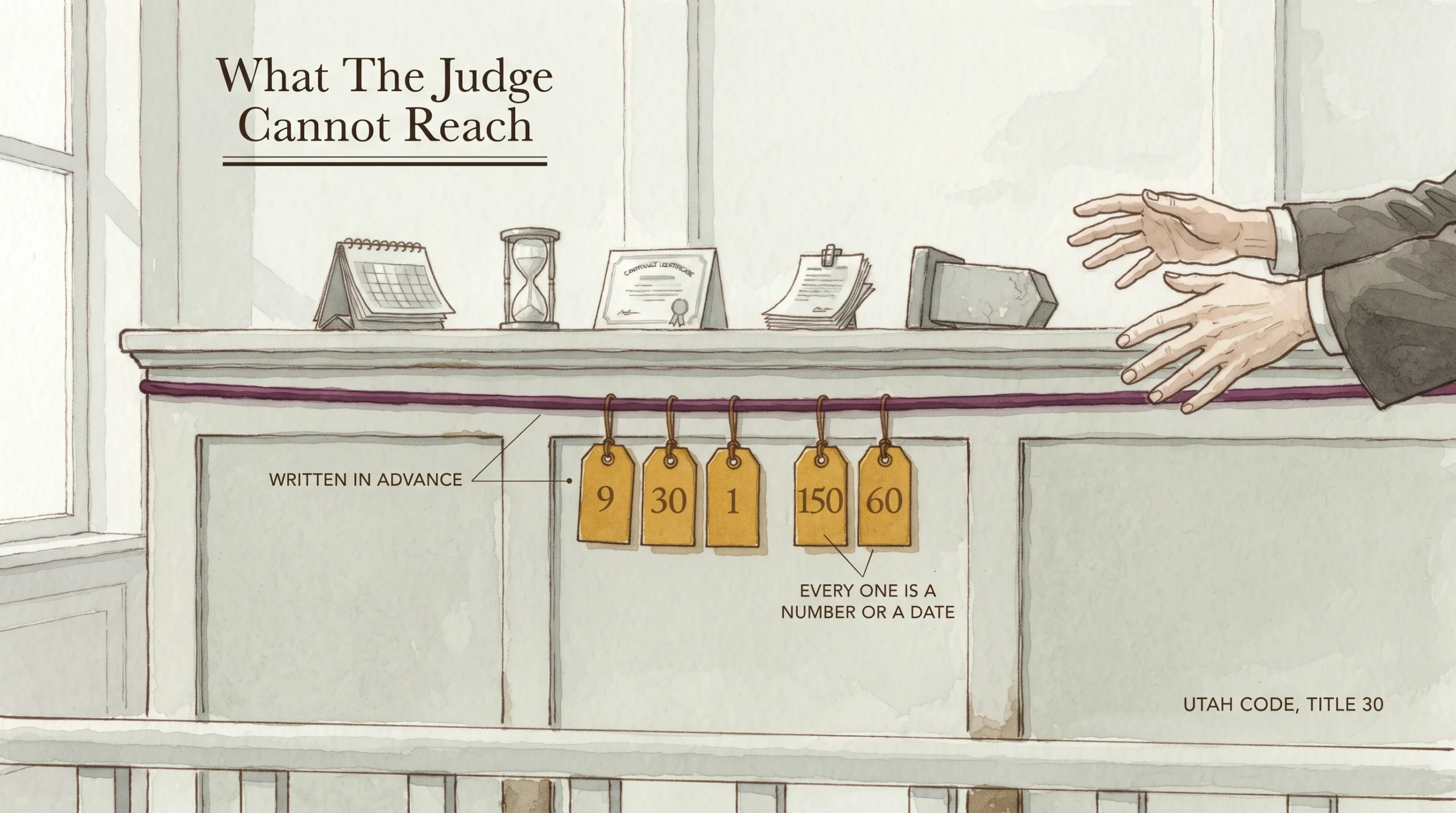
Family law is the part of the law that deals with marriage, divorce, children, alimony and the money and property that go with all of those. In Utah it lives in Title 30 and Title 78B of the Utah Code and it gets applied by district court judges and domestic relations commissioners, who see more of it in a week than most of us see in a lifetime.
What people ask less often is what limits it and I think it is the more useful question. A Utah family judge has a lot of power over your house, your kids and your paycheck, but there are things the Legislature and the Utah Supreme Court have told that judge he cannot do, however much the facts in front of him seem to call for it. These are nine of them and six of them have a number or a date in them that you would want to know before you walk into court.
Order Alimony For Longer Than The Marriage Lasted
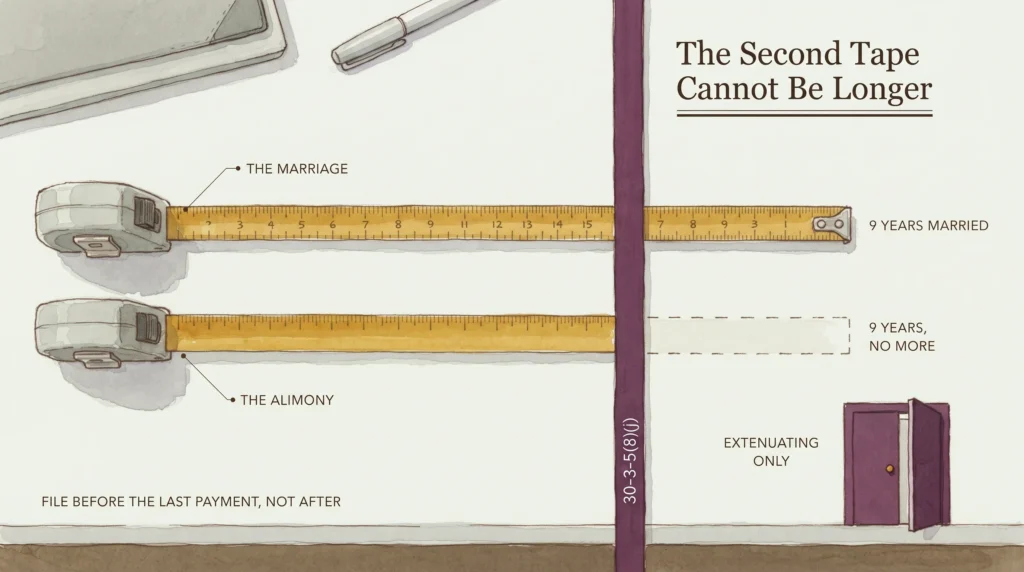
Utah Code 30-3-5(8)(j) says that alimony may not be ordered for more years than the marriage existed. Married nine years, nine years of alimony is the ceiling. The Legislature put that in by statute in 2002 and, unusually, made it reach back to orders that already existed.
Granted, there is a door in it. The judge can go longer if, before the alimony ends, he finds extenuating circumstances. In practice that means something unforeseen and serious, a disability that arrived during the alimony years, not “she still cannot find work”. And the motion to extend has to be filed before the last payment, not after.
The Judge Also Cannot Modify Alimony For A Need That Was Not There At The Decree
Same section. If a need did not exist at the time of the divorce, the court cannot later issue a new alimony order to cover it. We see people come back three years on saying rent went up and the job went away and the judge’s answer is that neither of those was in the decree, so neither can be added.
If you receive alimony in Utah, the term and the amount are decided at the divorce and the court’s power to improve them afterward is close to zero, so the time to fight over them is then.
Continue Alimony After The Recipient Remarries Or Moves In With Someone
Under 30-3-5(10) alimony ends by operation of law on the recipient’s remarriage, on cohabitation and on death. The judge does not have to order it stopped; it is already stopped. Cohabitation under the statute means living with someone you are not related to in a relationship that looks like a marriage.
One Year To Do Something About It
There is a catch for the payer. The statute gives the paying spouse one year from the day he knew or should have known, about the cohabitation to go to court and have the termination confirmed. Wait longer than that and the judge cannot help, even with the cohabitation proved. I have never understood why that limit is so short, but it is the rule.
If you pay alimony and your former spouse has moved someone in, the clock on your side started the day you found out and it is one year long.
Grant A Divorce In Under 30 Days
Utah Code 30-3-18. From the day the petition is filed, a judge cannot sign the decree for 30 days. He can waive it, but only on a showing of extraordinary circumstances and a wish to get it over with is not extraordinary. Admittedly most contested divorces take far longer than 30 days anyway, so this only bites the people who have already agreed on everything and want it done this week.
Enter A Decree For Parents Of Minor Children Who Have Not Taken The Course
30-3-11.3 and 30-3-11.4. If there are minor children, both parents have to complete the divorce education course and the divorce orientation course before the judge will enter the decree. It is not a box the judge can tick for you. People find this out when the paperwork is otherwise done and the clerk asks for the certificate.
The course takes an evening. Take it in the first month, not the last, because the decree waits for it.
Declare A Common Law Marriage More Than A Year After The Relationship Ended
Utah does recognize common law marriage, which surprises people, but only on a petition under 30-1-4.5 and that petition has to be filed while the relationship is still going or within one year after it ends. A year and a day later, no Utah court can declare that you were married, which means no marital property, no alimony, no inheritance as a spouse.
True, most people who were never formally married do not think of themselves as having a deadline. That is the problem. If you lived as husband and wife for fifteen years, held yourselves out that way and it has ended, the one year is running whether anyone has told you or not.
Change Child Support Backward
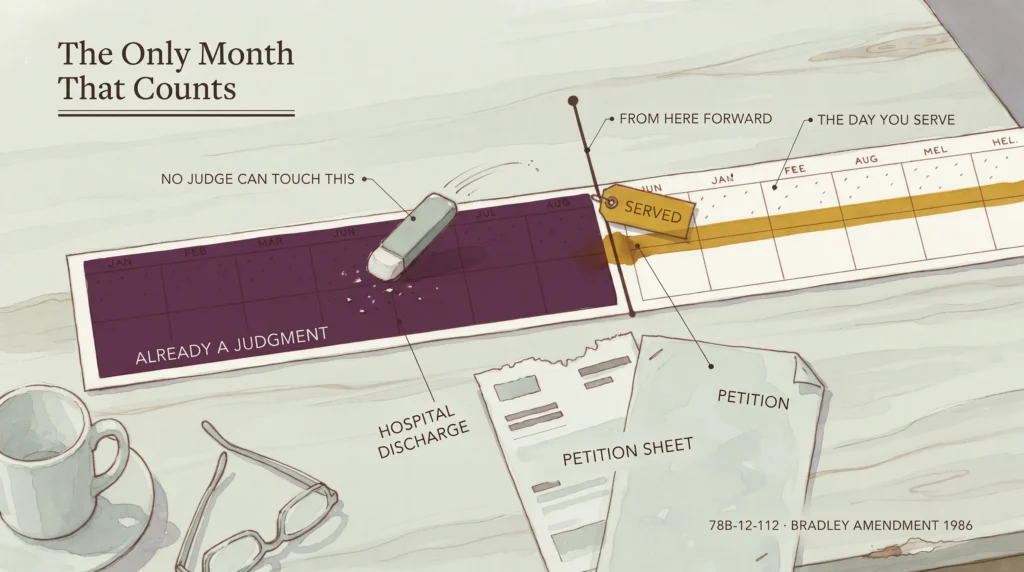
Two rules apply here, one state and one federal and together they are the hardest item on this list to accept.
Utah Code 78B-12-112 says a modification of child support can only reach back to the date the other parent was served with the petition to modify. Not the date you lost your job, the date you filed and served.
Then there is federal law on top. The Bradley Amendment, 42 U.S.C. 666(a)(9), has required every state since 1986 to treat child support that has already come due as a final judgment. Unfortunately that means no Utah judge, whatever he thinks of the facts, can reduce arrears. A father who was in the hospital for four months and never filed a motion owes every dollar of those four months, plus interest and the judge who finds that unjust has no power to change it.
Are we fools for thinking a judge can fix that? Most of us do think so, right up to the hearing. If your income drops, the only month that matters is the month you serve the modification papers and nothing before it can be touched.
Stop A Parent From Moving 150 Miles Away
30-3-37, the relocation statute. A parent who intends to move 150 miles or more from the other parent has to give 60 day’s written notice. What the judge can do with that notice is hold a hearing and rewrite parent time around the distance, long summer blocks, who pays for travel, that sort of thing. Forbidding the move is not among them. Parents ask for that order all the time and it does not exist, since the court decides custody and where a free adult lives is outside it.
If the other parent has given notice of a move, the fight you can win is over the schedule and the travel costs, not over whether they go.
Give Grandparents Visitation Over A Fit Parent’s Objection
Utah has a grandparent visitation statute, 30-5-2 and for years judges used it to order visits over a parent’s objection. The Utah Supreme Court narrowed that sharply in Jones v. Jones, 2015 UT 84. Where the parent is fit and the grandparent cannot show that cutting off contact would actually harm the child, the statute cannot constitutionally be applied against the parent. A grandparent who simply misses the children, however badly, does not get an order.
That item alone comes from the court rather than the Legislature and it follows Troxel v. Granville from the US Supreme Court in 2000, so it is not going to change.
What A Utah Judge Can Do That Most State’s Judges Cannot
One thing cuts the other way and it is worth knowing. Utah Code 30-3-5(8)(b) lets the judge consider the fault of the parties in setting alimony, including conduct that substantially contributed to the breakup. Most states took fault out of alimony decades ago. Utah kept it. So in this state, how the marriage ended can affect what gets paid, in a way it would not in Nevada or California next door.
Brad Carr, accomplished attorney at Carr Woodall, says that in family law there are always emotional issues and personal matters and that the law gives a structure so those do not turn into confusion and lasting conflict. The limits above are that structure, seen from the other side. Each one is a place where the Legislature decided in advance that the judge’s sympathy for one side would not be allowed to run the case.
The Nine, With The Number That Matters
Indeed, most of these come down to a number or a date, so here they are in one place.
| What people ask the judge for | Why the judge cannot | The number or date |
| Alimony for longer than the marriage | 30-3-5(8)(j) | The number of years married |
| Alimony to continue after remarriage or cohabitation | 30-3-5(10) | Ends by operation of law; payer has one year to act |
| More alimony for a new need | 30-3-5 | Only needs that existed at the decree |
| A divorce this week | 30-3-18 | 30 days from filing |
| A decree without the parenting courses | 30-3-11.3, 11.4 | Certificate before decree |
| A ruling that we were common law married | 30-1-4.5 | Within one year of the relationship ending |
| Child support reduced for last year | 78B-12-112, Bradley Amendment | Only from the date of service forward |
| An order stopping the other parent’s move | 30-3-37 | 150 miles, 60 day’s notice |
| Grandparent visits over a fit parent’s no | Jones v. Jones, 2015 UT 84 | Harm to the child must be shown |