 Mohammad Ahsan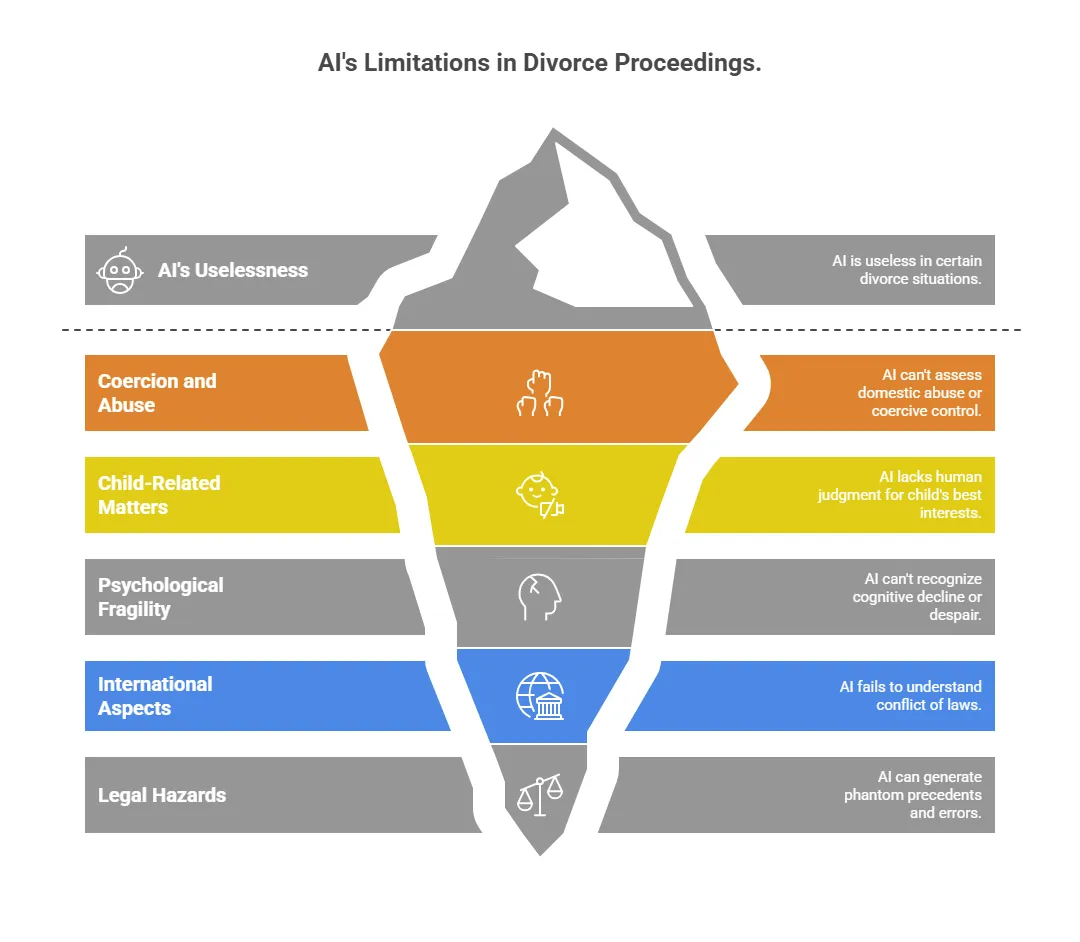
Haven’t you noticed that AI is almost everywhere? People are trying to integrate it into every sphere, blindly relying on its help. They even resort to it for divorce advice.
The informational hub Rev has published an article stating that approximately 65% of Americans have already used AI chatbots for legal purposes. This percentage is terrifying, given that nearly two-thirds of the population is at risk of being misled.
This article explains why using AI in legal matters, especially in divorce, is ill-advised. We have laid everything out clearly, point by point. Keep reading to see why family law is not an algorithm, where the limits of AI lie, and the 5 divorce cases where you should avoid consulting with AI.
Why Do People See AI as a Convenient Option in Divorce Today?
2026 is a continuation of the AI boom, a period where people are certain they can ask ChatGPT or Perplexityabout anything and get an expert answer. The same applies to the divorce process. People believe they can handle many procedural issues on their own, saving time and money without outside help.
On average, the cost of a divorce in the United States ranges from $15,000 to $30,000 per spouse. At the same time, AI platforms or AI-assisted mediation can resolve problems at substantially lower cost, ranging from $4,000 to $8,000, depending on the case complexity. This is a plausible explanation for why people view artificial intelligence as a convenient option in divorce today, but we cannot agree that this choice is entirely risk-free.
Family Law Is Not an Algorithm
Family Law is a complex and unpredictable branch of the judicial system in which legal professionals base their decisions not only on the law itself but also on psychological, financial, and human factors. It doesn’t have a single sample to follow.
Each case is unique, even when lawyers handle hundreds of cases involving two or three children and want to determine physical custody and the division of marital assets. There will always be something that stands out from the crowd: family dynamics, irrational conduct, or financial disputes.
Let’s dive deeper into why family law is not an algorithm.
- Absence of boilerplate solutions
- The role of judicial discretion
- Flexibility of the legal system
- Uncertainty of the results
- Dynamic nature
- Ethics and morality
AI: Its Uses and Limits Within the Divorce Process
Did you know that more than 75% of law firms have integrated AI into their workflows? This is connected with the necessity to streamline operations, the desire to manage high-volume routine tasks, and the need to stay competitive.
The use of artificial intelligence is justified when experts use it for document automation. It no longer requires spending 3 or more hours on work that can be completed in several minutes under a specialist’s supervision. AI is also invaluable for legal research, where it can sift through a vast body of case law to identify a crucial lead.
Finally, the implementation of legal AI tools for document review is pivotal now, as it helps navigate the paperwork required for a divorce case. Regarding client trust, more than 25% of clients are willing to entrust their divorce process to an AI-savvy attorney, while only 4% would trust pure AI without human intervention. The latter underlines the importance of the human element in family law.
Statistics indicate that the limit of artificial intelligence in the divorce process is its capacity to serve as a helper for legal representatives. Simply put, divorce is a human drama that demands the compassion, wisdom, and intuition of a real person, not an algorithm.
5 Divorce Situations AI Can’t Handle
Now that we’ve broken it all down, let’s dig deeper and clarify five divorce situations where AI is useless.
1. Presence of Сoercion and Abuse
“Unfortunately, artificial intelligence is incapable of providing a sound assessment or finding a solution for divorce proceedings involving domestic abuse and coercive control,” says Jill Kolodner, Founder of WGK Law. “We know that abuse isn’t always physical. That’s why AI is unable to notice when one of the spouses agrees to unfair conditions under a hidden threat or due to years of psychological suppression.
Such cases require the direct involvement of a lawyer and a psychologist to assess the vulnerable party’s well-being. It’s been shown that AI lacks tools to ensure victim safety and identify subtle manipulations.
2. The Case Concerns Child-Related Matters
Any case involving child-related matters is high-stakes and resource-intensive. AI is about statistics, not human judgment, operating on a set of dry facts and documentation based on historical data within its system. It can’t be seen that a seemingly “perfect” parent may veiledly suppress a child’s will and use their children as a weapon of revenge against the other spouse.
Only a living, breathing human, armed with a uniquely human skill set, can determine what serves the child’s best interests. Specifically, which parent is the child’s haven, or who is more attuned to their emotions? Whether for better or worse, AI sees a profile, not a child.
3. Psychological Fragility and Decline
Psychological fragility or decline is a condition in which a person’s inner core is in a vulnerable state on the verge of a breakdown. In court, a seasoned lawyer or judge will always show leniency. They may choose to call for a pause, de-escalate the pace of the proceedings, or change the tone of the discussion.
In these situations, the machine won’t recognize the other party’s cognitive decline, since technology cannot measure the true extent of human despair.
4. Divorce Involving International Aspects
The international aspect of the case has created serious legal implications. Here, AI can become a pitfall, as it is not enough to simply translate the law; one must also understand conflict of laws.
You should understand that an international divorce is not just a simple family dispute. It is more like a complex equation, with variables shifting at every turn. Thus, algorithms in such matters prove to be futile due to many reasons- be it a failure to resolve a jurisdictional conflict, or cultural and religious backgrounds.
5. Legal and Procedural Hazards
Legal and procedural hazards are submerged rocks that can sink a case if a person delegates it entirely to AI. The global legal community is already familiar with situations where ChatGPT’s hallucinations landed lawyers in hot water: the filings were found to contain citations to phantom precedents.
This is the main reason it’s better to rely on a qualified attorney who can maintain full control over the process.
Conclusion
Our article proves that artificial intelligence won’t supplant the keen mind of an expert who is attentive to nuances, inspires confidence, and creates a safe environment during a divorce. Not to mention their vast experience. AI is great, but only when it’s under strict oversight.