 Aarthy Venkat Head - Strategy at SignDesk
I’ve covered law enforcement litigation for a while and it’s rare to see one sheriff’s office absorb this many separate legal hits at once. Public records fights, retaliation claims from his own former opponent, jail-violence suits and a perjury referral sitting on the state Attorney General’s desk. Here’s what’s actually going on in Pima County, sorted out and stripped of the spin.
TL;DR
- The ACLU of Arizona sued Sheriff Chris Nanos in July 2025 over withheld public records about deputies contacting Border Patrol and court-ordered discovery has since produced incidents that cut against his “we don’t enforce immigration law” public stance.
- Two of his political adversaries inside the department, Sgt. Aaron Cross and Lt. Heather Lappin, have brought First Amendment retaliation claims; Lappin’s notice of claim runs to $2 million.
- Jail-conditions and excessive-force suits are stacking up, including a corrections officer criminally charged after knocking an inmate unconscious.
- In May 2026, the Pima County Board of Supervisors voted 4-0 (one abstention) to refer perjury allegations against Nanos to Arizona Attorney General Kris Mayes, after he testified under oath he’d never been suspended, contradicting El Paso records showing eight suspensions.
Fast Facts
| Active/recent legal matters | Roughly a dozen across six categories |
| Largest claim cited | $25 million (Fox jail-mistreatment suit, per available reporting) |
| Most significant issue | Whether PCSD’s immigration contacts violated the Fourth Amendment and state records law |
| Perjury investigation status | Referred to AZ Attorney General, May 12, 2026; no finding yet |
| Driving the scrutiny | The Nancy Guthrie disappearance case, a union no-confidence vote and a recall petition |
| Settlements already paid | $3.4M (Guerena), ~$3.2M (strip-search class action), $49,900 (EEOC ADA) |

The Public Records Fight: ACLU v. PCSD
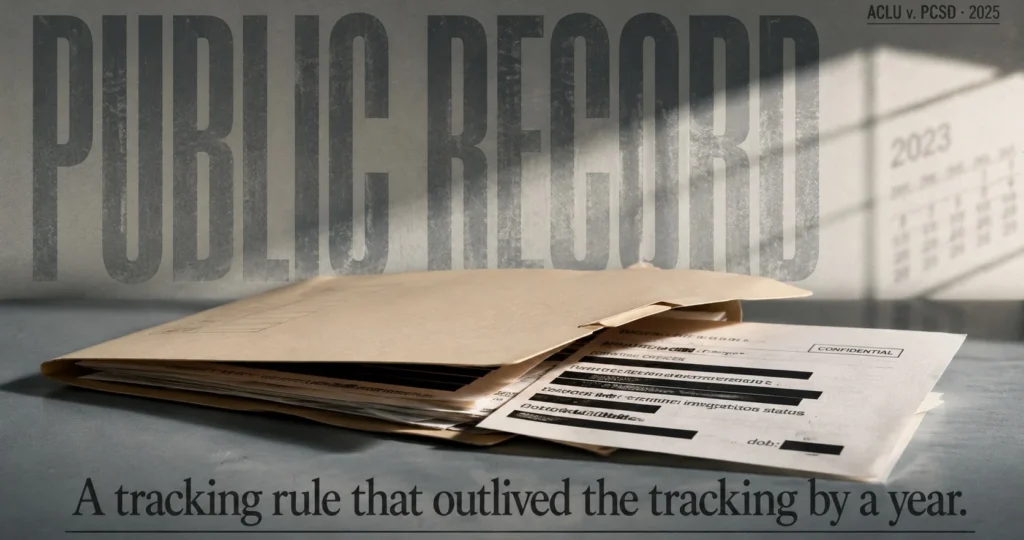
This is the case that cracked everything else open. In mid-May 2025, the ACLU of Arizona asked PCSD for records showing how often deputies called federal immigration officials during traffic stops, things like radio logs and incident reports. The department didn’t produce them. So on July 21, the ACLU sued in Pima County Superior Court under Arizona’s Public Records Law, A.R.S. § 39-121, which entitles the public to prompt disclosure of government records.
Then came the detail that made people pay attention. Before the requests landed, PCSD had a standing policy requiring the department to track every “request for assistance” made to federal immigration officials and compile it into a monthly report. According to records-request reporting, the department quietly stopped tracking those contacts in June 2024, even though the regulation itself stayed on the books until July 2025. The timing is the whole story here. Why does a tracking rule survive on paper for a year after the tracking stops?
Nanos has said this for years, on camera: his department doesn’t enforce federal immigration law. “Your immigration status is not a concern to us.” But court-ordered discovery told a more complicated story. The ACLU obtained records of deputy-Border Patrol contacts between 2021 and 2023 and a separate Arizona Luminaria investigation found that at least 16 people were turned over to Border Patrol by deputies between January 2022 and June 2023. The incidents involved Spanish-speaking people who weren’t suspected of any crime, which is exactly where the constitutional problem lives.
The ACLU argues these stops potentially violated the Fourth Amendment, which bars unreasonable search and seizure. Hold someone with no criminal suspicion just to hand them to federal agents and you’ve arguably crossed that line. An evidentiary hearing went forward in Pima County Superior Court and the ACLU is still chasing records the department calls too burdensome to produce.
When Political Opponents Sue: The First Amendment Cases
Two of the people suing Nanos worked under him and both ran straight at him politically. That’s what makes these retaliation claims sting.
Sgt. Aaron Cross is president of the Pima County Deputies Organization, the union that took a no-confidence vote against Nanos. In October 2024 he stood on a street corner holding a sign that read “Deputies Don’t Want Nanos.” He wasn’t in uniform, no badge, no insignia, just clothing the department later called too uniform-like. Days later he was on paid administrative leave and under what amounted to a gag order. He sued in federal court for First Amendment retaliation.
He didn’t win the early round. U.S. District Judge Raner Collins denied his request for a preliminary injunction, finding Cross “was certainly attempting to look like an on-duty deputy.” But the judge also ruled the department’s policy on protest attire was ambiguous and ordered PCSD to clarify it within 24 hours and he made a point of saying there was nothing wrong with the sign itself. So Cross lost the motion and still forced a policy change. That’s the kind of split result that tells you the underlying claim has teeth.
Lt. Heather Lappin was Nanos’s actual opponent, his 2024 Republican challenger. Her notice of claim runs over 100 pages and alleges PCSD hit her with five retaliatory investigations after she announced her run, including discipline for teaching an instructor course she’d taught seven times before. She’s seeking $2 million for First Amendment and due process violations. Here’s the part that matters most: an independent firm the county itself hired later investigated and found Nanos abused his authority for “political gain.” When the target’s employer pays for a probe and the probe lands on the target’s side, the claim stops looking like sour grapes.
To win these, both have to clear the standard for public-employee retaliation: they spoke on a matter of public concern, the speech motivated the adverse action and the government can’t show it would’ve acted anyway. A sheriff disciplining the union head and his own electoral rival, in the same week, days before an election? That’s a hard set of facts to explain as routine personnel management.
Inside the Jail: Force, Injury and a Guilty Plea
The case that’s hardest for the department to wave away is Garcia v. Nanos, because a jury didn’t decide the central fact, a guilty plea did.
On August 31, 2024, Joshua Garcia, 37, was in the booking area of the Pima County jail. Corrections Officer Ayden Escarrega, then 20, struck him six times in the face while other officers restrained him, knocking him unconscious. A use-of-force review found the last four punches unjustified. Garcia went to the hospital, then back to a cell. He’s now suing Nanos, Escarrega and four other officers for $300,000, alleging battery, false imprisonment, failure to intervene and negligent supervision and hiring.
Here’s why this one’s different. Escarrega didn’t just get accused, he pleaded guilty to aggravated assault, drew three years’ probation in March 2025 and was fired. In a § 1983 civil rights case, a criminal conviction on the underlying conduct is gold for the plaintiff. It removes the question of whether the force happened and shifts the fight to supervision and policy, exactly where Garcia’s complaint is aimed. His attorney put it plainly: calls like this come in from the jail often, not rarely.
Two more matters circulate in the reporting, a roughly $1.35 million COVID-protocols suit and a $25 million federal mistreatment claim against Nanos and the jail’s private medical provider. I’d treat the specific figures and party names on those as reported rather than confirmed until the dockets are pulled, but the pattern they point to, medical neglect and unsafe conditions, is consistent across the jail litigation.
These suits run on the Eighth Amendment and 42 U.S.C. § 1983, the federal statute that lets people sue government officials for constitutional violations. The Eighth Amendment’s bar on cruel and unusual punishment is what makes deliberate indifference to an inmate’s safety actionable.

For context, the county has paid out before. The $3.4 million Guerena settlement came after a 2011 SWAT raid killed Marine veteran Jose Guerena in his home, with Pima County covering $2.35 million of it. That was under former Sheriff Clarence Dupnik, not Nanos, but it sits in the institutional memory and it’s the kind of number taxpayers remember when the next big claim lands.
The Perjury Question: Credibility Under Oath
Strip away the politics and this comes down to one sentence Nanos said under oath.
During a December 11, 2025 deposition in the Cross case, Nanos testified he had never been suspended as a law enforcement officer. But internal-affairs records from the El Paso Police Department, where he worked in the early 1980s, show he was suspended eight times for a total of 34 days, including once for excessive force. He resigned from that department in 1982 and the characterization of that exit is itself contested: critics say it was in lieu of termination, while his attorney frames it as resigning rather than accept a proposed suspension after a dispute with a supervisor.
Nanos’s defense is that the question was about his Arizona career, where he genuinely was never suspended and that he didn’t understand it to reach a Texas job from four decades earlier governed by different rules. Maybe. But “have you ever been suspended as a law enforcement officer” is a broad question and that’s the crux of any perjury analysis: perjury requires a knowingly false statement about a material fact, so intent does the heavy lifting. An honest misunderstanding isn’t perjury. A deliberate dodge is.
On May 12, 2026, the Pima County Board of Supervisors voted 4-0, with Supervisor Steve Christy abstaining, to refer the perjury allegations to Arizona Attorney General Kris Mayes. Worth emphasizing: the board explicitly took no position on whether perjury occurred and a separate motion to declare the office vacant died for lack of a second. This isn’t a finding of guilt. It’s a referral, the legal equivalent of handing the question to someone with the authority to actually answer it.
None of this happened in a vacuum. The scrutiny intensified around the high-profile disappearance of 84-year-old Nancy Guthrie, mother of “Today” co-anchor Savannah Guthrie, alongside a union no-confidence vote and a recall petition against Nanos.
Employment, Wages and Disability Claims
The quieter category and the one that shows the litigation isn’t just about headline incidents.
PCSD has faced wage-and-hour claims under both Arizona overtime law and the federal Fair Labor Standards Act, including a 2018 matter where officers alleged retaliation after reporting payroll problems. FLSA cases against sheriffs often turn on a technical-sounding but decisive question, whether the sheriff even counts as the “employer” under the statute, which determines who’s on the hook.
On disability, the county reached a $49,900 EEOC settlement over ADA claims and agreed to provide anti-discrimination training. The Ninth Circuit has also handled PCSD accommodation cases, including disputes over how deputies handled a blood draw. And going back to 2009, a strip-search class action over jail booking procedures settled for nearly $3.2 million, one of the larger payouts in the department’s history.
The Statutes Behind the Lawsuits
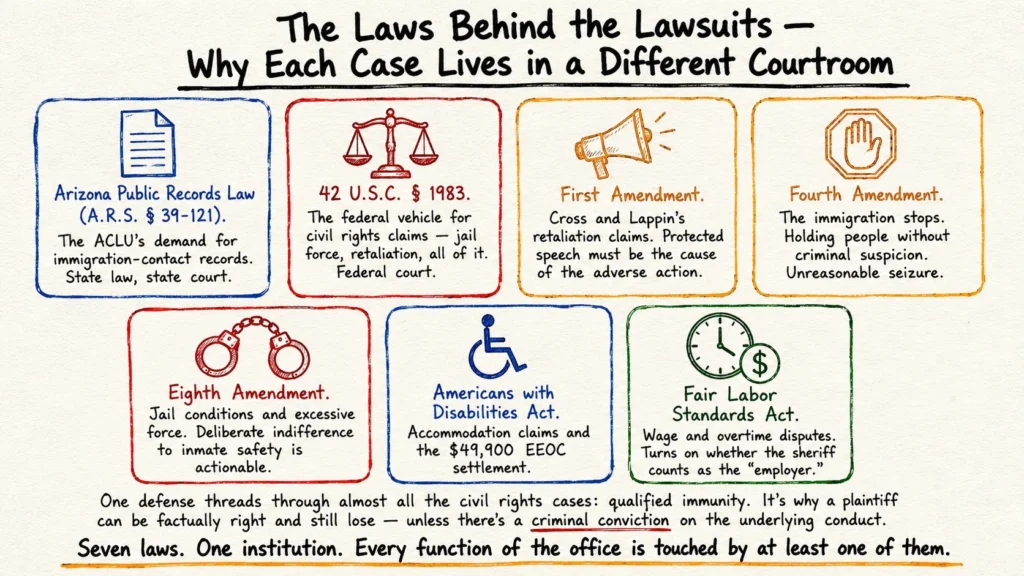
If you’re tracking why each suit lives in a different courtroom, it comes down to which law it’s built on. Here’s the map.
| Law / Provision | How it applies here |
| Arizona Public Records Law (A.R.S. § 39-121) | The ACLU’s demand for immigration-contact records |
| 42 U.S.C. § 1983 | The vehicle for the civil rights suits, from jail force to retaliation |
| First Amendment | Cross and Lappin’s retaliation claims |
| Fourth Amendment | The immigration stops, holding people without criminal suspicion |
| Eighth Amendment | Jail-conditions and excessive-force claims |
| Americans with Disabilities Act | The accommodation claims and EEOC settlement |
| Fair Labor Standards Act | The wage and overtime disputes |
One defense threads through nearly all of the civil rights cases: qualified immunity, the doctrine that shields officers unless they violated a “clearly established” right. It’s why a plaintiff can be factually right about what happened and still lose. The Garcia case is interesting precisely because a guilty plea makes that shield far harder to raise.
What This Means for Pima County Residents
Set aside the legal mechanics for a second. Who pays for all this?
You do. Settlements and judgments against the county come out of public funds, either directly or through insurance premiums that taxpayers ultimately cover. The Guerena settlement alone ran to $3.4 million. Stack up the pending claims here and the potential exposure is real money, the kind that competes with budgets for actual services.

But the cost isn’t only financial. The through-line in these cases is trust. A public-records fight is, at bottom, a question about whether residents can find out what their government is doing. The retaliation claims ask whether employees can criticize their boss without losing their livelihoods. The perjury referral asks whether the county’s top law enforcement officer told the truth under oath. Those aren’t separate stories. They’re the same story told from different angles and the question underneath all of them is whether the institution can be believed when it speaks.
That matters most for the people with the least leverage. The Spanish-speaking individuals handed to Border Patrol without suspicion. The inmate on a booking-room floor. They’re the ones who feel a transparency problem as something concrete.
The Road Ahead
So where does this leave Pima County?
The ACLU’s records case keeps grinding forward, with the department still resisting handing over documents. The Cross and Lappin retaliation suits are live and an independent investigation already concluded Nanos abused his authority for political gain, which is the kind of finding that shapes settlement math. Garcia’s civil case proceeds against the backdrop of a corrections officer who already pleaded guilty. And the perjury question now sits with the Arizona Attorney General, who will decide whether a referral becomes something more.
None of it is resolved. That’s the honest answer. What’s clear is that this isn’t one bad headline, it’s a sustained stretch of litigation hitting nearly every function of the office at once, from the jail to the records room to the sheriff’s own sworn testimony. How Pima County answers it, in court, at the ballot box through the recall effort and in whatever the AG decides, will say a lot about what accountability actually means for elected law enforcement. I’ll be watching how it lands.