 Adriana Campos ( Colorado )
ABOTA has over 7,600 members as of recent reporting, which is a large number, but relatively small compared to the total number of members of the American bar. The organization has affiliated state and local chapters in all 50 states and the District of Columbia through 95 chapters nationwide. Membership is conferred through a multi-step process in which a chapter nominates a candidate and the national board approves that candidate.
The organization is not open access. A candidate cannot simply submit credentials and wait for a decision.
How ABOTA Started and Why It Still Works This Way
ABOTA was founded in Los Angeles in 1958 by plaintiffs and defense counsel who had a common goal: to preserve the right to a civil jury trial guaranteed by the Seventh Amendment. Founders stated that membership requirements included experience with jury trials from the beginning, which set it apart from bar associations whose membership is voluntary and often divided between plaintiff and defense attorneys. Membership cuts across the traditional plaintiff-defense divide; both sides of the courtroom sit within the same chapter, bound by shared trial experience rather than client allegiance.
The founding principle continues to be the requirement that all ABOTA members have tried to verdict as lead counsel, in the civil context, a certain number of jury trials with no credit being issued for matters that were resolved prior to the jury verdict. The civil jury trial requirement applies only to cases tried by a jury and actually decided by it. A hung jury, resulting in a mistrial, is subject to the civil jury trial requirement, but not anything short of jury deliberation itself.
A lawyer cannot satisfy the requirement by being lead counsel in multi-year litigation even in a high-stakes, complex case that does not go to a jury verdict.
Todd Mensing: Well Past the Floor
For Todd Mensing, attorney and name partner at AZA Law in Houston, that floor was not a threshold. It was a baseline he had cleared many times over. Mensing has tried more than 60 cases across commercial and intellectual property disputes, energy litigation, and healthcare matters. His ABOTA election came in 2014.
A Credential Built on Verdicts
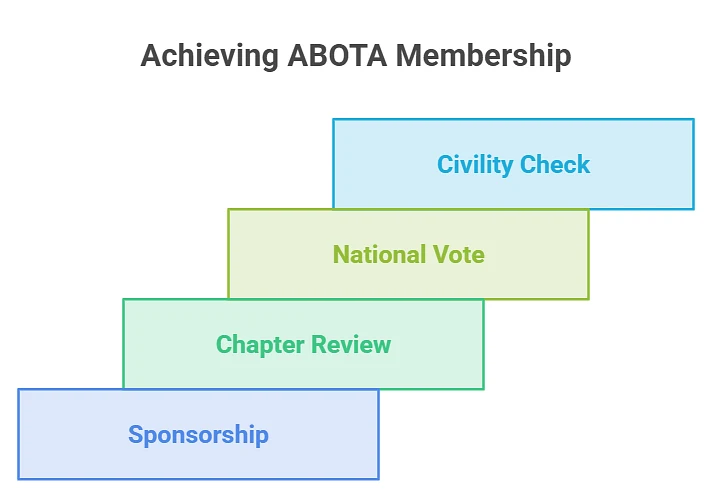
ABOTA membership moves through two stages.
At the chapter level, there must be sponsors (practicing attorneys or judges who are current members) recommending and evaluating a candidate for membership based on trial experience and conduct. After the sponsors have completed the candidate’s trial record, the chapter reviews the nomination papers and submits the nomination to ABOTA’s national board. The final step toward admission is an up-or-down vote by the national board, which requires a supermajority.
Local review does not guarantee election at the national level.
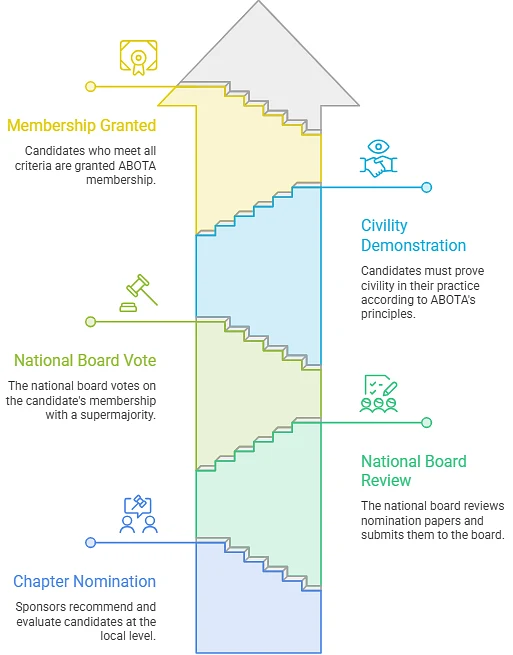
In addition to trial volume, candidates must also prove that they have demonstrated civility in their practice by complying with ABOTA’s Principles of Civility and Code of Professionalism. The guidelines apply to the strategy and tactics the attorney employs in litigation and not simply the outcome of their cases. Members found to violate the guidelines after having been elected are subject to internal disciplinary measures. With this focus on civility, the original rationale for ABOTA’s creation still applies: that although uncivil conduct was unnecessary in adversarial litigation, the plaintiff and defense lawyers have enough professional interests in common to form themselves into an organization.
Texas and Houston
Texas has one of the largest ABOTA footprints in the country. TEX-ABOTA, the state chapter, counts more than 1,200 members. Houston has the largest bar of the state’s legal markets and accounts for a substantial share of that membership, with attorneys practicing in the federal district courts and Harris County’s commercial dockets generating the kind of jury trial records ABOTA requires.
ABOTA membership remains a mark of distinction among a relatively small segment of the Houston bar.
From Nomination to National Election
Todd Mensing, attorney at AZA Law had been qualified well beyond the jury trial floor requirement before the city’s ABOTA chapter nominated him, having received Board Certification in Civil Trial Law from the Texas Board of Legal Specialization (which certifies an average of fewer than five lawyers per year statewide) in 2011. That certification requires:
- At least seven jury trials as lead counsel
- Passage of a comprehensive written examination
- Peer evaluation
The two credentials, ABOTA membership and Board Certification, operate independently. But an attorney who holds both has effectively double-passed a trial-volume threshold under two different evaluating bodies.
Well before the 2014 election, Chambers USA had already placed Mensing among the leading commercial litigation attorneys in Texas. Unlike some publications, Chambers bases its rankings on interviews with clients and peers, not on submissions from the firms themselves. Trial attorney Todd Mensing dealt with patent disputes, energy cases, and complex business litigation, the type of cases that only end up in court because there was no other way to resolve them.
What the Election Signals About Trial Readiness
ABOTA’s organizational work extends beyond credentialing. Its ongoing activities include:
- National Jury Trial Week, an annual observance
- Filing amicus briefs in cases touching on jury trial rights
- Civics education programming tied to the Seventh Amendment
Members are expected to participate in that mission; ABOTA frames membership not as a static credential but as an ongoing professional commitment. Chapter members take on roles in local programming, mock trial competitions, and bar outreach.
For a practicing trial lawyer, that participation carries value separate from the membership title. Meeting trial attorneys from the opposite side of cases in a chapter setting instead of a courtroom builds a professional network rooted in verdict experience. Since ABOTA’s founding choice was to include both plaintiff and defense lawyers in one organization, Houston chapter members may well have litigated against each other. The civility standards exist specifically to make that coexistence work.
Todd Mensing was recognized by Chambers USA, Super Lawyers, and Best Lawyers in America around the same period as his 2014 ABOTA election. Each system uses a different methodology, but the convergence across multiple evaluators during the same period reflects a trial practice that had built enough of a record to draw consistent recognition.
AZA Law’s Trial Footprint
AZA Law’s founding attorneys, John Zavitsanos and Joe Ahmad, started the firm in 1993 on a trial-first model. They took cases to verdict where other firms would have settled, building a reputation on courtroom results rather than managed resolution.
Todd Mensing, who joined AZA in 2001, added his trial record to a firm whose identity had been defined by jury work from the beginning. That move only makes sense if the goal is courtroom time rather than institutional career advancement. ABOTA membership, in that context, was less a departure from his practice than a formal recognition of a career already organized around the trial floor.
The credential cannot be bought, manufactured through volume submissions, or acquired through any path other than legitimate jury trial experience reviewed by sitting members. Todd Mensing’s standing in the Houston ABOTA chapter was earned case by case, in front of juries, over more than two decades of practice.