 Muhammad Usman
Summary: Google is facing a barrage of class-action cases that allege it is secretly eating user’s paid cellular data without their knowledge or permission in it’s Android OS. Three large cases have now been resolved (or close to it) and damages and settlement of over $875 million have been claimed in total. There’s a good possibility you are part of a settlement class if you are one of the approximately 100 million Android users in the United States. What happened, who it’s impacting and why the legal results are more significant than the dollars.
So What Did Google Actually Do?
This is the part that surprises most people when they first hear about it.
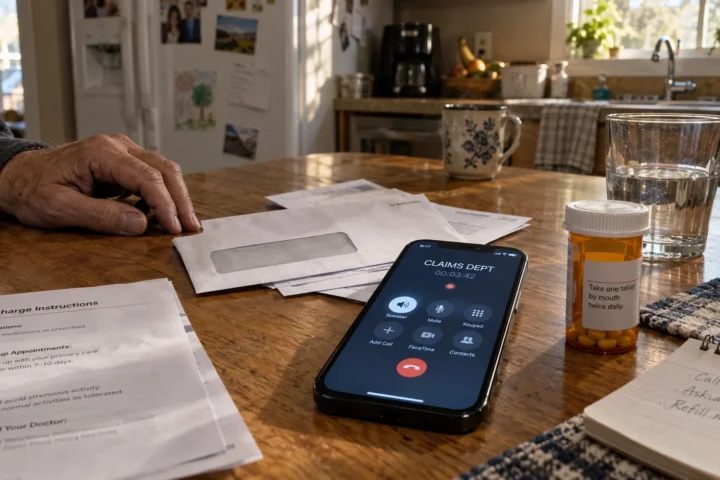
Your phone is sitting on your nightstand. Screen off. You’re asleep. And according to researchers — and eventually, federal courts — Google’s Android software was quietly sending and receiving data to Google’s servers. Hundreds of times a day. Using the cellular data you pay for every month.
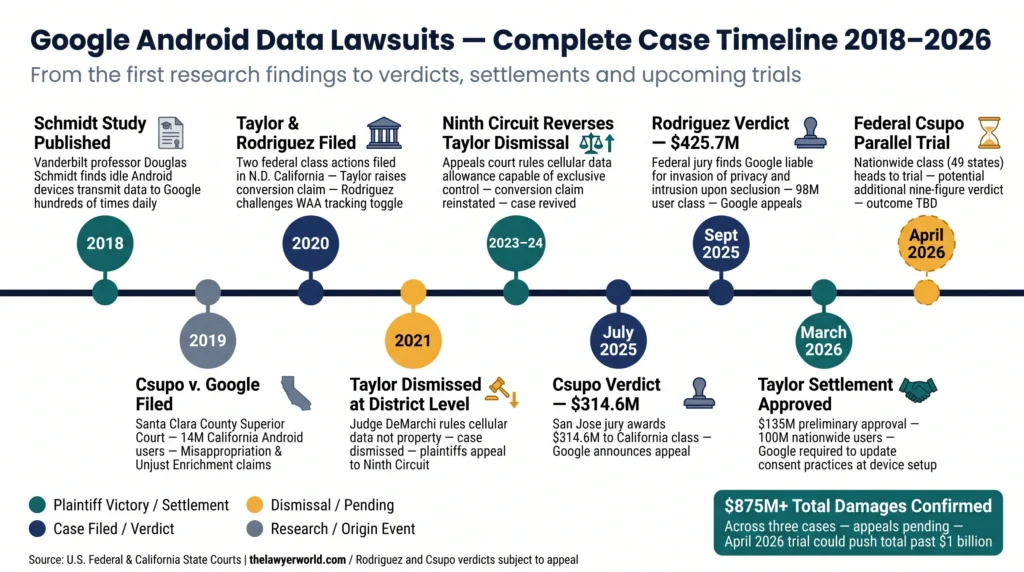
A 2018 study by Vanderbilt University professor Douglas Schmidt was the fuel that lit this fire. Schmidt found that an idle Android device — one just sitting there, not being actively used — was communicating with Google servers at a striking rate. That research became the backbone of the lawsuits that followed.
The core allegation isn’t complicated: Google was using something you bought and paid for — your data plan — for it’s own commercial benefit. Collecting usage patterns, behavioral signals, location data. The kind of information that makes targeted advertising work. And doing it quietly, tucked inside the operating system, in ways most users had no idea were happening.
What made this legally interesting — genuinely novel, actually — is how the plaintiffs chose to fight back.
The Three Cases You Need to Know
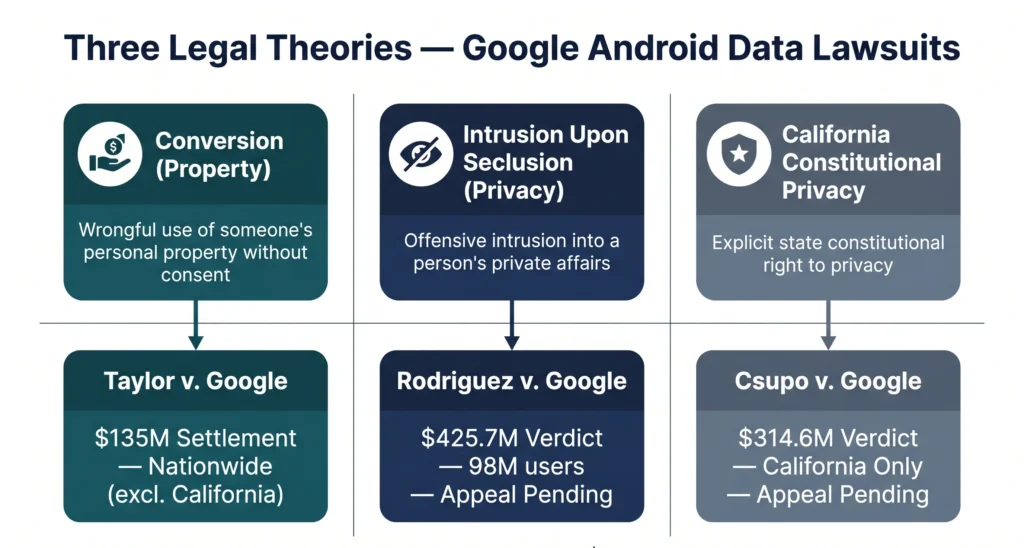
Three major lawsuits emerged from these allegations. Same general villain, same basic grievance, but each one attacked the problem from a different legal angle. That’s not accidental — it’s smart litigation strategy.
Here’s the breakdown:
| Case | Court | Filed | Main Claims | Result |
| Taylor v. Google LLC | U.S. District Court, N.D. California | 2020 | Conversion, Quantum Meruit | Settled — $135M (preliminary approval March 2026) |
| Rodriguez v. Google LLC | U.S. District Court, N.D. California | July 2020 | Invasion of Privacy, Intrusion Upon Seclusion | Jury verdict — $425.7M (September 2025; appeal pending) |
| Csupo v. Google LLC | Santa Clara County Superior Court | 2019 | Misappropriation, Unjust Enrichment | Jury verdict — $314.6M (July 2025; appeal pending) |
Three cases. Three different theories. Over $875 million on the board.
Taylor v. Google was the property case — the one that asked whether your cellular data is actually yours in a legal sense. Rodriguez was the privacy case — centered on Google collecting data even after users had switched off tracking in their account settings. Csupo was the California state case, focused on roughly 14 million California Android users specifically.
Each one deserves a closer look.
Taylor v. Google — Your Data Plan as Property
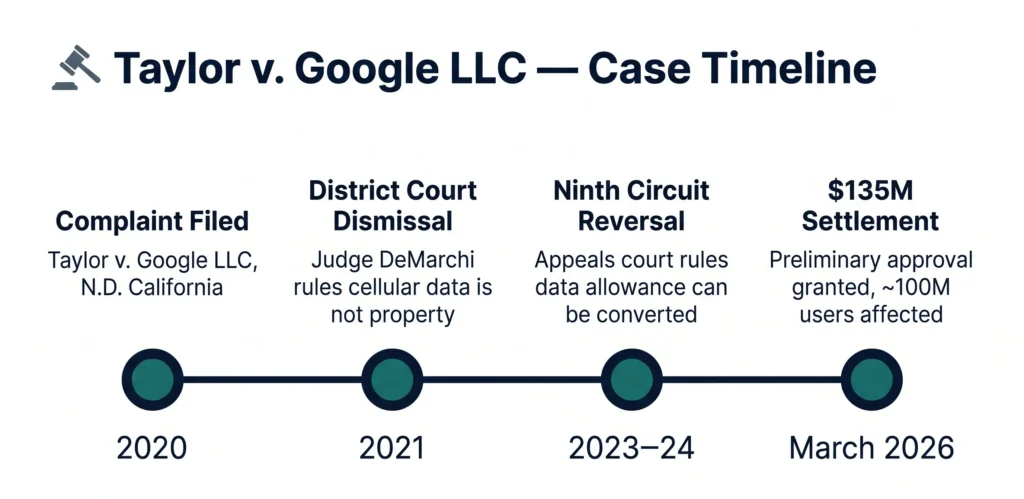
Filed in 2020, Taylor made a bet that not everyone thought would pay off: it argued that cellular data is personal property and Google was essentially stealing it.
The legal term for that is conversion — a tort that goes back centuries, usually applied to someone taking your car or your cash. Plaintiffs said the same logic applies when a company silently drains your data plan for it’s own benefit.
The district court wasn’t buying it initially. Judge Virginia DeMarchi dismissed the case, reasoning that data bandwidth isn’t like water or electricity — you don’t “consume” a discrete unit of it the way you’d use a gallon of gas.
Then the Ninth Circuit stepped in and reversed that.
The appeals court laid out a clean argument: cellular data “can be precisely limited by a user’s data plan; it can be measured when being used; and it can be attributed to a particular user.” That’s enough, the court said, to treat it as property capable of being converted.
That ruling is genuinely significant — it’s the first federal appellate decision to say a consumer’s data allowance can be property for conversion purposes. The door is now open for similar claims whenever a company uses your paid-for digital resources without permission.
After the Ninth Circuit’s decision, Google agreed to settle for $135 million. Preliminary approval came in March 2026. The class covers approximately 100 million U.S. Android users who used cellular data between November 12, 2017 and the date of final approval — excluding California residents, who are covered separately.
Rodriguez v. Google — “I Turned That Off”
Rodriguez hits differently because the harm here was more deliberate-feeling.
Google gives users a setting called Web & App Activity (WAA). Toggle it off and you’d reasonably assume Google stops tracking your app usage. The plaintiffs in Rodriguez alleged that Google kept collecting that data anyway — regardless of what the switch said.
This went to trial in August 2025. Eleven days of testimony before a federal jury in San Francisco.
The jury found Google liable on two counts:
- Invasion of privacy under the California Constitution
- Intrusion upon seclusion under common law (more on what that means below)
They rejected a third claim under California’s computer fraud statute — a decision that actually tells us something about how juries are thinking through these cases.
The award: $425.7 million for a class of approximately 98 million smartphone users. Google has said it will appeal, calling the verdict a misunderstanding of how it’s products work.
Csupo v. Google — California Fights Back
Csupo is the state court case, filed in Santa Clara County in 2019. Smaller class — about 14 million California Android users — but the jury still came back with $314.6 million after a June 2025 trial.
Google is appealing this one too.
There’s also a parallel federal case covering the other 49 states that’s scheduled for trial in April 2026. Depending on how that goes, the total damages picture could shift considerably.
The Legal Theories, Explained Without the Law School Jargon
Three different cases, several different legal theories. Here’s what each one actually means in plain English.
Conversion — Think of it as civil theft. If someone takes something that belongs to you and uses it for their own benefit, that’s conversion. The novel move in Taylor was arguing that your data allowance — the gigabytes you pay your carrier for each month — is “something that belongs to you” in the eyes of the law. The Ninth Circuit agreed.
Quantum Meruit — Latin for “what one has earned.” Essentially: if you benefited from something I own, you owe me fair compensation. This rode alongside the conversion claim in Taylor as a backup theory.
Intrusion Upon Seclusion — A privacy tort. It says that intentionally intruding into someone’s private affairs — in a way that would deeply offend a reasonable person — is legally actionable. The Rodriguez jury found that Google collecting app-usage data after users had disabled tracking met that standard.
California Constitutional Privacy — California’s state constitution actually has an explicit right to privacy, which gives plaintiffs there a stronger hook than the federal baseline. The Rodriguez verdict leaned on this.
One thing worth noting: the Rodriguez jury rejected the computer fraud claim (the CCDAFA). That suggests a meaningful line — juries seem willing to hold Google accountable for collecting data through it’s own apps beyond what users expected, but weren’t ready to call it “unauthorized access” in the criminal-law sense when it’s happening through pre-installed operating system functions.
The Consent Problem — Did You Actually Agree to This?
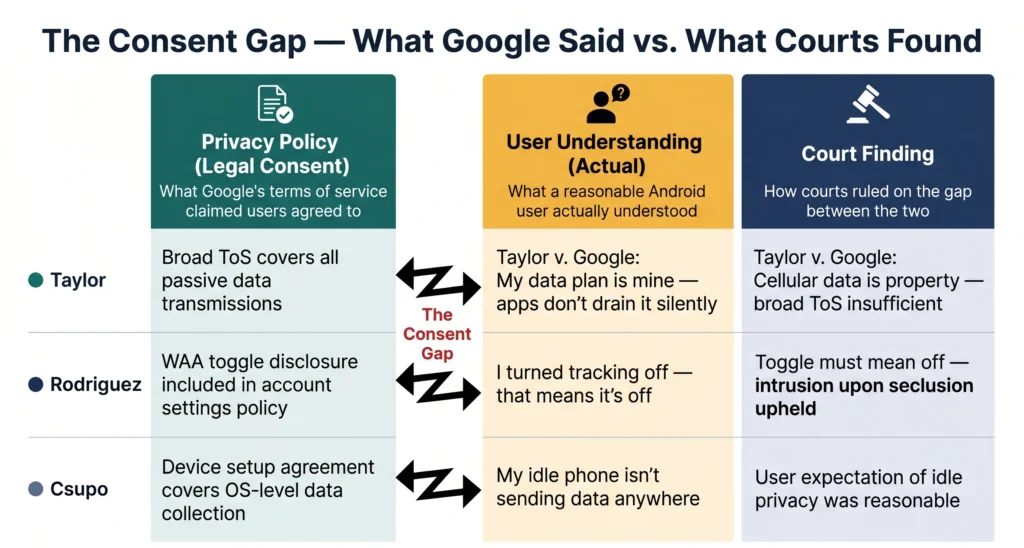
Google’s defense in all three cases followed a consistent script: you agreed to this. Set up an Android phone, accept the terms of service and somewhere in that wall of text is language that covers data transmissions. Case closed, right?
Not quite.
This is where things get philosophically interesting — and where courts started pushing back harder than Google probably expected.
What Google Argued
Every time Google faced these allegations, the company pointed to it’s privacy policy. The argument was straightforward: Android users consent to data collection when they create a Google account and set up their device. The disclosures are there. Nobody’s hiding anything. Users just… don’t read them.
The district court in Taylor actually bought this at first. That’s partly why the case got dismissed initially — the judge accepted that the privacy policy covered the challenged behavior.
Why That Argument Kept Losing
The Ninth Circuit wasn’t persuaded. Neither were two separate juries.
Let’s get back to reality and the fact that no one reads a 12,000 word privacy policy. Research continues to reveal that if users did read all terms of service agreements they are presented with, it would take about 76 work days a year. These cases began chipping away at the legal fiction that clicking ‘I agree’ means it is an informed consent.The legal fiction that clicking ‘I agree’ means it is an informed consent was quietly tolerated by courts for years; these cases were a crack in the dam.
The Rodriguez verdict is the most extreme one. Google had a toggle, visible to the user, that they could turn off: Web & App Activity. It was discovered, turned off and wisely determined that they had chosen not to participate. The message of the jury was loud and clear: A switch that is labeled “off” should work. Having an obscure “privacy policy” in settings does not grant what the interface says it is granting.
That was the discrepancy between the language of a document and what a reasonable person could reasonably conclude from it and that is where Google’s consent defense continued to fail.
What This Means Going Forward
The Taylor settlement adds a non-monetary requirement that’s arguably more consequential long-term than the $135 million: Google must notify Android users of it’s data-collection practices and obtain consent when users set up new devices. Not bury it in a ToS. Actually tell people, at setup, what’s happening with their data.
That’s a behavioral change baked into the settlement. It affects every new Android activation going forward.
Show Me the Money — Settlements, Verdicts and What You Might Receive
Let’s get to the part most people actually want to know about.
The Full Picture
| Case | Total Amount | Class Size | Geographic Scope | Status |
| Taylor v. Google | $135 million | ~100 million users | Nationwide (excl. California) | Settlement — preliminary approval March 2026 |
| Rodriguez v. Google | $425.7 million | ~98 million users | Nationwide | Verdict — appeal pending |
| Csupo v. Google | $314.6 million | ~14 million users | California only | Verdict — appeal pending |
| Federal parallel to Csupo | TBD | Remaining 49 states | Nationwide (excl. California) | Trial set April 2026 |
Combined confirmed damages/settlements so far: over $875 million.
And that number could grow. The April 2026 federal trial covering non-California users in the Csupo parallel case hasn’t concluded yet.
What Individual Users Actually Get
Here’s the honest answer — it’s not life-changing money per person, but it’s also not nothing.
Taylor Settlement:
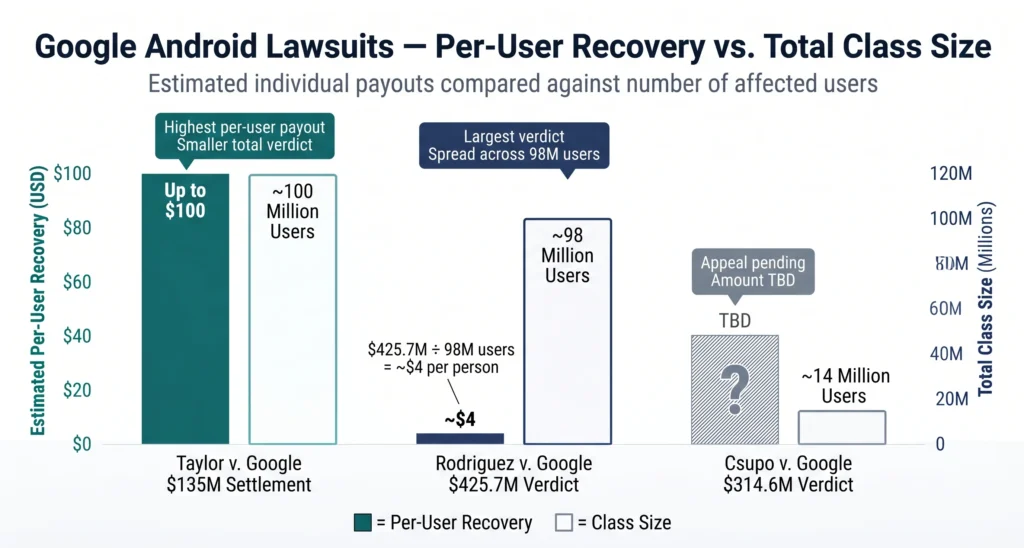
- Estimated up to $100 per eligible claimant
- Most class members won’t need to file a claim — a payment notice gets sent to you
- Payment options include PayPal, Venmo, Zelle, ACH or prepaid card
- Per-person amount decreases if claim volume is high
- Covers U.S. Android users who used cellular data between November 12, 2017 and the date of final approval (excluding California residents)
Rodriguez and Csupo:
- Both verdicts are under appeal — distribution timelines are uncertain
- If upheld, the per-user math works out to roughly $4 per device in Rodriguez across 98 million users
- Csupo covers a smaller California class, so per-user amounts could be higher
Why Such Small Individual Payouts on Such Big Numbers?
This is the paradox of class-action privacy litigation and it’s worth understanding.
The harm to any one person — a few megabytes of data drained per day, worth fractions of a cent — is real but tiny. Nobody’s going to hire a lawyer over $4. That’s precisely why class actions exist. They aggregate thousands of individually non-viable claims into something a court can actually address and they create financial consequences large enough to actually influence corporate behavior.
The $425.7 million verdict in Rodriguez isn’t really about getting 98 million people their $4 back. It’s about making the data-harvesting business model expensive enough that companies think twice before designing systems that quietly consume what users pay for.
What Happens Next — Appeals, Upcoming Trials and the Bigger Picture
Neither Rodriguez nor Csupo is final. Google is fighting both verdicts on appeal and the company has been pointed in it’s public statements about why.
Google’s Appeal Arguments
On Rodriguez, Google argued the jury “misunderstands how our products work” and maintains it’s privacy tools give users adequate control. On Csupo, the company’s position is that the challenged data transfers are essential to Android’s security, performance and reliability — that these aren’t surveillance mechanisms, they’re the OS doing it’s job.
These aren’t frivolous arguments. Appeals courts do sometimes overturn jury verdicts, particularly on novel legal questions. Whether cellular data truly fits the legal definition of convertible property and whether privacy tort law extends this far into operating system behavior — these are genuinely unsettled questions that higher courts will eventually have to resolve definitively.
The April 2026 Federal Trial
The parallel federal case to Csupo — covering Android users in the other 49 states — is set for trial in April 2026. Given the Csupo verdict, Google heads into that trial with some unfavorable precedent already on the board. A second major verdict there could push total damages well past $1 billion across all proceedings.
The Regulatory Layer
These lawsuits are not in isolation. Data privacy is a hot area for the Federal Trade Commission, while states have made a concerted effort to enact comprehensive data privacy laws inspired by the California Consumer Privacy Act (CCPA) and CPRA. The precedents being set in these cases – the significance of consent, whether data bandwidth is property, the scope of privacy torts into OS-level software behavior – will likely provide guidance for legislators when crafting the next cohort of privacy laws.
This is, in other words, not just a Google story. It’s a template.
Conclusion
These lawsuits started with a simple, uncomfortable question: if your phone is using your data without your knowledge, for someone else’s profit, is that okay?
Courts — federal and state, juries and appellate judges — have spent the last five years working out the answer. And increasingly, the answer is no.
The Taylor settlement forces Google to change how it informs users at device setup. The Rodriguez verdict says privacy toggles have to mean something. The Csupo verdict says California users have real, enforceable rights over their digital resources. And the appeals and upcoming trial mean this story isn’t over.
If you’re an Android user in the U.S., watch your email for settlement notices. You may not get rich — but you may get something. More importantly, the legal framework being built case by case here will shape what tech companies can quietly do in the background of your device for years to come.