 Olivia Florio Roberts ( Florida )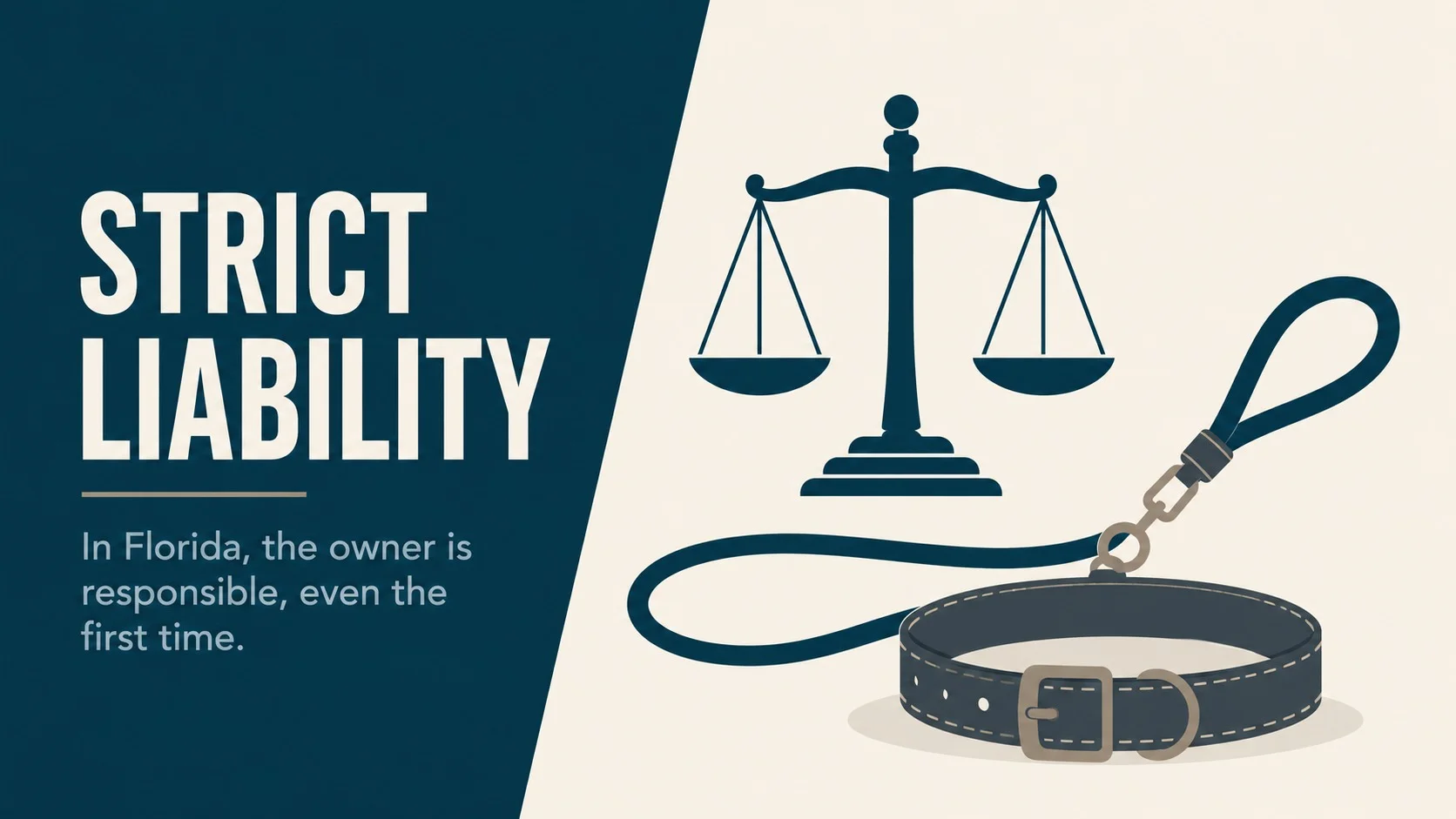
A sign that says “Bad Dog.”
Two words, printed on a piece of metal or wood or plastic, attached to the gate of the property or hammered in the ground close to the front door. In Florida, that sign can remove strict liability from the dog owner if an adult is bitten on the property. This means that if a person walks through a gate with a “Bad Dog” sign on it, then gets bitten, the owner’s Coverage E of their homeowner’s policy may never have to pay under the strict liability statute.
Unless the person bitten was five years old. Then the sign means nothing.
This is, in practical effect, Florida Statute § 767.04. It constitutes a strict liability system, with a two-word escape hatch for adult victims who might have read the sign and gone away. The sign offers no such protection when the victim is a child under six who cannot read at all. The legislature looked at that, and decided it was a distinction worth keeping. Whether it actually makes sense depends on which side of the bite you are standing on.
§ 767.04 Rejected the One-Bite Rule Before Most Other States Even Considered It
Fourteen states still employ what amounts to the “one free bite” rule. An owner is not held liable for their dog’s first bite if they had no reason to know that their dog may be dangerous. The dog would have to bite someone, the owner would have to be put on notice, and then liability attaches moving forward. Florida decided that logic was unacceptable.
The first subsection of § 767.04 provides that the owner of any dog which bites any person while that person is in a public place or lawfully on private property is liable for damages. “Regardless of the former viciousness of the dog or the owner’s knowledge of such viciousness.” Those are the statute’s own words. The sweetest golden retriever in Hillsborough County bites a neighbor’s hand on the first day it ever shows aggression and the owner is responsible, even with no prior bite, no previous growling, no previous lunging, no course of conduct. The bite is the event and the event creates the liability.
Thus, Florida is one of the most bite victim-friendly states in the country, but § 767.04 created an odd escape hatch for property owners.
The Sign Has to Say “Bad Dog” and Nothing Else Works
Not “Beware of Dog.” Not “Dog on Premises.” Not “Warning: Guard Dog.” Not a picture of a snarling German Shepherd on a generic security sign from the hardware store.
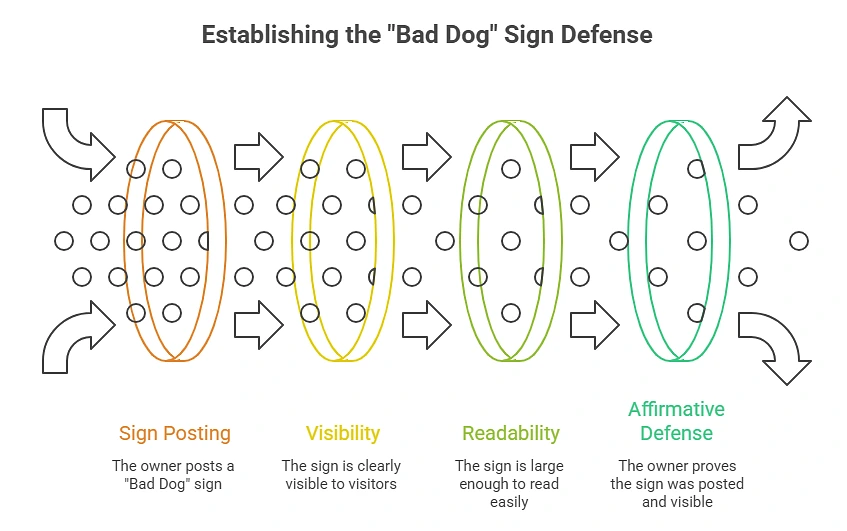
The statute requires the words “Bad Dog” on an easily readable sign displayed in a prominent place on the premises. “Prominent” has been interpreted by the courts to mean plainly visible to anyone lawfully approaching the property, posted at an entrance gate or front door, not obscured behind a bush or faded to the point where someone walking up the driveway would miss it.
Courts have also had to work out what “easily readable” means in practice. Big enough to read clearly from a reasonable distance. Not handwritten in pencil on a piece of cardboard. Not a bumper sticker on the garage door. The case law does not set a font size, the standard is functional, could a person approaching the property actually see and read the sign before encountering the dog? If yes, and the person is an adult, the owner may have a complete defense to strict liability under § 767.04.
“May” is an important word because the sign defense is an affirmative defense: the owner must plead and prove the sign was posted, visible, and legible at the time of the bite. Pictures of the sign, testimony of neighbors that it was there, the victim’s own testimony that he saw the sign but entered the premises anyway, all of it becomes relevant. And the victim’s attorney will try to show that the sign was not large enough, not placed properly, placed after the incident, or on one entrance while the victim entered through another one.
Children Under Six Cannot Read and the Law Knows It
The sign defense under § 767.04 does not apply when the victim is under age six. A five-year-old passing through a neighbor’s yard to pet a dog is not going to stop at the gate, read the sign, process that “Bad Dog” means danger, and decide to turn around. There is no such cognitive expectation for young children, and the legislature acknowledged this in the statute.
Furthermore, Florida common law generally precludes children under the age of six from being found comparatively negligent. Thus the two main defenses available to dog owners in adult dog bite cases, the sign defense and comparative fault, are not available against small children. All an owner is then left with is either that the bite never happened or that the child was trespassing, and it is much harder to show that a five-year-old was trespassing in a residential neighborhood than most owners think, especially where children cross yards as a shortcut.
According to the Centers for Disease Control and Prevention, children age 5 to 9 have the highest incidence of dog-bite-related emergency department visits in the country. Because children under six cannot be barred by the sign defense and cannot be found comparatively at fault, for the owner of an unfenced yard in a residential neighborhood the exposure to a claim is meaningful, and the premiums for a lot of Florida homeowner’s policies reflect this.
The 51% Bar Changed How These Cases Are Fought
Before the passage of HB 837 in March 2023, Florida followed the doctrine of pure comparative negligence in personal injury actions including dog bites. A victim who was 80% at fault for provoking the dog could still recover 20% of their damages. That is gone.
Florida currently uses the modified comparative negligence standard with a 51% bar under § 768.81(6), whereby a claimant recovers nothing if found more than 50% at fault.
Insurance adjusters dealing with dog bites know this rule cold. The defense in adult cases is twofold: the sign defense to eliminate strict liability entirely, and comparative fault applied to the victim’s behavior to push them over the 51% threshold if the sign defense fails. The defendant is not required to show that the victim caused the attack, but rather that the victim’s own conduct, ignoring the sign, entering a fenced lot, approaching a barking and growling dog, contributed enough to the incident that a jury would find the victim at least 50% responsible.
It is a very powerful combination. The sign defense tries to end the case now. If that fails, comparative fault attempts to resolve the case at trial by putting the blame on the victim’s actions rather than the owner’s liability. Both arguments pull from the same facts: the victim’s knowledge of the dog, the property condition, the placement of any signs, and whether the victim’s actions were reasonable under the circumstances.
Dog bite injuries that occur on posted property, or where the person entered knowing the hazard, or where the case is factually murky on its own, tend to draw exactly this two-layered defense, and the difference between full damages and no recovery at all may turn on how well the bite, the location, and the victim’s version of events were documented in the first hours after it happened.
SB 942 Ended Local Breed Restrictions Across the State
For decades, Florida law blocked local governments from enacting breed-specific legislation, with one carve-out: ordinances adopted before October 1, 1990 were grandfathered in. That exemption kept Miami-Dade County’s pit bull ban alive, along with the City of Sunrise’s pit bull confinement and muzzling rules, both on the books since 1989.
SB 942, signed in June 2023 and effective October 1, 2023, deleted that grandfather provision. The Miami-Dade and Sunrise ordinances became unenforceable. The bill also went further: local governments and public housing authorities are now barred from adopting any dog regulation that is specific to breed, and the law added size and weight to the prohibited characteristics as well.
What does that leave local governments with?
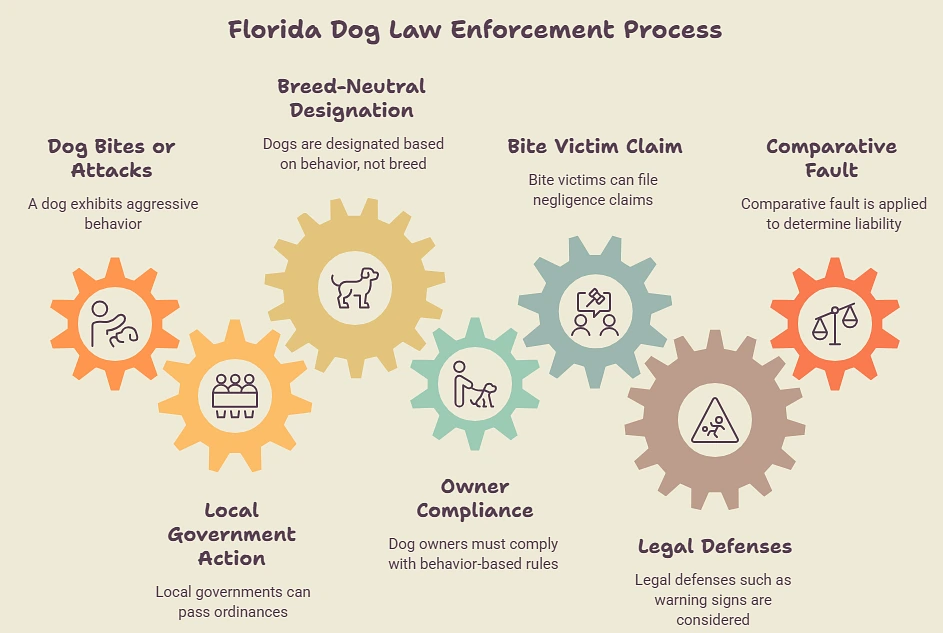
Behavior. A county or city can still pass ordinances aimed at dangerous dogs, mandatory confinement, muzzling, insurance requirements, but the designation has to rest on what an individual dog has actually done, not on what breed it looks like. A dog that has bitten or attacked can be restricted. A pit bull that has never shown aggression cannot be touched on breed alone, anywhere in Florida.
For dog owners this simplified the compliance landscape considerably, one statewide rule instead of a county-by-county patchwork. For bite victims, the negligence angle shifted with it: what matters now is whether the owner violated behavior-based rules, a prior dangerous dog designation, a confinement order, a leash requirement, at the time of the bite. That violation becomes additional evidence of negligence sitting on top of the strict liability claim under § 767.04.
The interplay between § 767.04 strict liability, the “Bad Dog” sign defense, the 51% comparative fault bar, and any dangerous-dog restrictions the owner was under creates a layered legal picture that depends on the age of the victim, the presence of warning signs, and the individual dog’s documented history.
How Homeowner’s Insurance Actually Pays These Claims
Most recoveries in dog bite claims in Florida come out of the owner’s homeowner’s or renter’s policy under Coverage E, the personal liability section. Coverage limits normally range between $100,000 and $300,000, but can be supplemented with an umbrella policy when the owner carries one.
There are two trends in the Florida insurance market worth knowing about.
Breed exclusions are expanding. More insurers are either refusing to write a new policy for households that own certain breeds, or excluding dog bite liability for those breeds from the policy entirely. And this is worth being clear about: SB 942 restricts governments, not insurance companies. A carrier can still refuse to cover a breed even though no Florida city can ban one. If the owner’s policy excludes the breed that bit you, the insurer has no obligation to pay regardless of what § 767.04 says about liability. The owner remains personally liable, but collecting from an uninsured individual is a different problem than settling with a carrier.
Bite history exclusions. Some policies contain a clause that voids coverage if the dog has a known bite history the owner did not disclose at underwriting. An owner who knew their dog had bitten someone before renewing the policy and failed to disclose it may find out at the worst possible moment, the second incident, that their coverage does not apply.
Most of these cases are resolved at the insurance level. The statute creates the liability. The insurance policy determines whether there is money available to satisfy it. And the “Bad Dog” sign defense, when it works, means the insurer never has to open its checkbook at all.
References
- Florida Statute § 767.04, strict liability for dog bites and the “Bad Dog” sign defense. Exceptions for children under six and owner negligence.
- Florida Statute § 767.01, strict liability for non-bite dog injuries.
- Florida Statute § 768.81(6), modified comparative negligence with 51% bar, enacted by HB 837 (March 2023).
- Florida Statute § 767.14 as amended by SB 942 (Chapter 2023-253, effective October 1, 2023): local governments and public housing authorities may not adopt dog regulations specific to breed, size, or weight; grandfather exemption for pre-1990 breed ordinances (Miami-Dade County, City of Sunrise) removed.
- Florida Statutes §§ 767.11-767.13, dangerous dog classification, owner requirements, and criminal penalties.
- CDC, children ages 5-9 have the highest rate of dog bite emergency department visits nationally.
- Florida Department of Health, approximately 800 dog bite hospitalizations annually statewide.