 Hayes A. Hunt (From Philadelphia)
In a Nutshell: Retail theft is a punishable offense in Philadelphia governed by 18 Pa.C.S. 3929 that classifies the offense between a simple citation and a third-degree felony depending on dollar value and prior offenses. In 2024 the policy was quietly shelved and replaced in March 2025 with a three-tier “bucket” system that classifies the offender according to the criminal history and organization. Meanwhile, Pennsylvania Act 42 of 2023 introduced a distinct felony of Organized Retail Theft with a maximum sentence of 20 years in case of losses over 50,000. In Philadelphia, which was cratered at 282 in 2019, arrests increased almost threefold in the first half of 2024 after police removed retail theft off their diversion program. The stores can also seek civil damages under 42 Pa.C.S. § 8308 irrespective of the occurrences in court.
If you’ve followed Philadelphia news in the last two years, you’ve probably noticed retail theft has gone from a quiet talking point to one of the loudest debates in the city’s criminal justice landscape. Stores closing. Locked-up toothpaste aisles. A district attorney walking back his own policy. State prosecutors flying in from Harrisburg to charge theft rings under laws that didn’t exist three years ago.
What is actually going on with the law- under all the headlines- is a system being rewired on the fly. Then we will proceed through it as you would like a friend of yours, who has a law degree, to explain it: and then we will not dress anything up.
The Pennsylvania Retail Theft Statute
All this begins with a single law. The retail theft law in Pennsylvania is a statute known as 18 Pa.C.S. § 3929 and it is wider than most people would assume. It does not simply include walking out with a merchandise. The law extends also over:
- Switching or altering price tags.
- Moving items from one container into another.
- “Under-ringing” — when an employee scans something at a lower price for a customer.
- Disabling or destroying anti-theft devices.
This way an individual who does not actually walk out of the store can be billed. That is an item to be known, as many arrests occur at the door, rather than in the sidewalk.
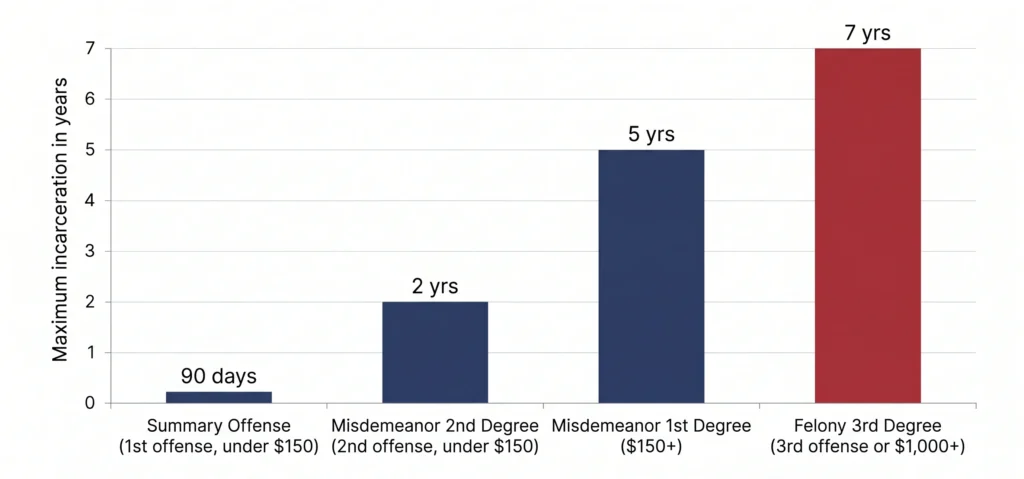
Grading is what actually constitutes the case, however. Pennsylvania has a tiered system that ramps up according to two factors; how much the merchandise is worth and whether or not the person has been caught before.
| Value & Prior Record | Grading | Maximum Penalty |
| First offense, under $150 | Summary offense | 90 days, $250 fine |
| Second offense, under $150 | Misdemeanor (2nd degree) | Up to 2 years |
| First or second offense, $150 or more | Misdemeanor (1st degree) | Up to 5 years |
| Third or subsequent offense (any value) | Felony (3rd degree) | Up to 7 years |
| Over $1,000 or a firearm/motor vehicle | Felony (3rd degree) | Up to 7 years |
Here’s a detail people miss. Prosecutors are allowed to aggregate — meaning if someone hits three different CVS locations across town in the same week as part of one plan, the values can be added together. A bunch of $90 thefts that would each be summary offenses can become a single felony. The phrase the statute uses is “single scheme or course of conduct,” and it gives prosecutors real leverage when they think they’re looking at a pattern rather than a one-off.
How Prosecutors Decide What to Charge
The limit is established by the statute. The office of the District Attorney determines the level to which they should really go. And in Philadelphia that vote has been changed twice in seven years.
In 2018 shortly after assuming office, D.A. Larry Krasner wrote an internal memo that re-set the charging practice throughout the office. That policy advised line prosecutors to prosecute most cases of retail theft as summary cases, essentially the legal analog of a traffic ticket, unless the stolen merchandise was worth more than $500 or the criminal had a long history of theft. A prosecutor was required to visit a supervisor and present the case to the supervisor to have the case advanced to a misdemeanor or felony.
The reasoning was straightforward. Krasner’s office argued that locking people up pretrial over a $40 theft created more harm than it prevented, fed mass incarceration and tied up court resources that could go elsewhere.
Opponents – such as retailers, leaders of the police union and ultimately even some of the political opponents of Krasner himself – argued that the policy was sending a different message: that low-level theft in Philadelphia would incur no actual penalty. The perception remained whether or not that was fair.
In early 2024, Krasner quietly shelved the policy. His own words at the time were striking — he said, plainly, that he didn’t think it was the best approach anymore. A police analysis that year showed 57% of retail theft arrests were still being downgraded by the D.A.’s office, which was an improvement from 2019 numbers but still high enough to keep political heat on.
By March 2025, Krasner went public with a replacement framework. It sorts retail theft cases into three categories:
- Organized retail theft — coordinated, multi-person, multi-store operations. These get pursued as high-level felonies, often in coordination with the state Attorney General.
- Prolific or habitual offenders — people with extensive theft histories. Charges are calibrated to that record, meaning misdemeanors and felonies rather than summary citations.
- Ordinary offenders — roughly 80% of arrests, according to the office. These are people with little or no record, often charged “at a lower level.”
In such a way the leniency did not vanish. It was narrowed down and renamed. The lower 80 percent also still experience the light treatment they do, the top 20 percent, the individuals the office considers organized or chronic, now receive much more challenging treatment than they did under the 2018 memo.
The issue of whether you are reading that as a corrective act or political triangulation is probably dependent on which side of the debate you found yourself in.
The Rise of Organized Retail Crime Charges
It is here that things become truly new. In Pennsylvania, the legal history of retail theft has been that, in most cases, retail theft was a single statute irrespective of the scale. As was technically charged under the same provision, albeit at different grades, was a teenager with a stolen hoodie and a logistics operation that was transporting stolen goods across state lines.
Act 42 of 2023 changed that. The legislature established a separate crime – Organized Retail Theft, 18 Pa.C.S. 3929.3 – whose purpose is specifically to cover those individuals who in the language of the statute organize, coordinate, control, supervise, finance or manage a theft business. The grading for this charge is much harsher than ordinary retail theft:
| Value of Stolen Merchandise | Grading | Maximum Sentence |
| $2,500 – $9,999 | Felony of the 3rd degree | Up to 7 years |
| $10,000 – $49,999 | Felony of the 2nd degree | Up to 10 years |
| $50,000 or more | Felony of the 1st degree | Up to 20 years |
Twenty years. For a property crime. That’s the same range a defendant faces for some violent felonies and it tells you how seriously Harrisburg now treats this category.
Act 42 made a structural thing, too. It established the Office of Deputy Attorney General of Organized Retail Crime Theft, which is subordinate to the state Attorney General, instead of any local D.A. The office includes five regional prosecutors who will be covering the state, with Philadelphia in District 1. It began operation on July 1, 2024 and during it’s first year had opened up over 65 investigations, charged over 40 alleged thieves and recovered nearly 2 million dollars in stolen merchandise.
Two instances in Philadelphia give us an idea of what this would look like in reality:
- August 2025 — 3 Philadelphia men were charged with several felonies including running a corrupt organization, after allegedly stealing over 50,000 worth of goods in Home Depot stores located in four counties.
- April 2025 — three other men were charged in connection with 22 coordinated robberies at shoe stores, with the loss estimated to be at least $28,500 in many different jurisdictions.
What both cases share, beyond the dollar amounts, is the multi-county task-force approach. Local police, state prosecutors and loss prevention investigators from major retailers are increasingly working the same files. That coordination is itself part of what Act 42 enabled — and it’s why a theft ring that might have generated three separate misdemeanor cases a few years ago now generates one consolidated felony case with serious prison exposure.
Recent Arrest Trends and Police Enforcement
Numbers tell this story better than commentary does.
Prior to the Krasner memo, in 2016, Philadelphia recorded more than 2,000 retail theft arrests. A year into the new policy on charging, which was in effect by 2019, this figure had crumpled to 282. Not a dip. A floor through the basement.
Whether the drop reflected fewer thefts or just less enforcement is genuinely contested. Officers in the field reported they had stopped bothering to make arrests they knew would be downgraded to summary citations, which functionally meant a ticket and a release. Stores, meanwhile, kept reporting losses. The disconnect between what merchants were experiencing and what arrest data showed became one of the loudest criticisms of the era.
Then 2024 happened.
First-half 2024 arrests were almost three times as many as in the first half of 2023. They surpassed both the aggregate of 2021 and 2022 combined. The catalyst was the decision by the Philadelphia Police Department to withdraw retail theft off it’s diversion program – that is, the people caught stealing in shops were no longer eligible to be placed in it’s alternative-to-prosecution program that was diverting them out of it’s formal criminal charges program.
The department’s framing was direct. They said the city needed to “move into an enforcement posture” because the perception that theft carried no consequence had become it’s own problem. By mid-2025, police data showed retail theft itself was down about 13% citywide while the arrest rate was up 40%. Take that pairing for whatever it’s worth — it’s the kind of stat that gets cited by both sides depending on which point they’re making.
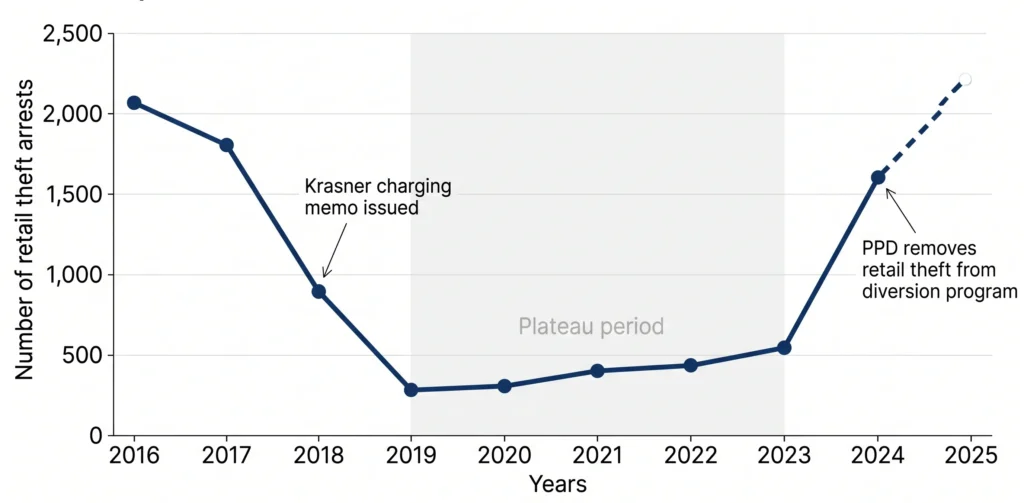
One point to note in case you are trying to make sense out of these numbers are that, arrests and crime counts are measuring different things. The falling arrest rate can indicate a reduction in the number of crimes or it can indicate a reduction in the number of enforcement actions of the same underlying activity. An increase in the rate of arrest, likewise, may represent a real increase in the incidence of theft or simply a change in policy in regard to the response of the police to it. The truthful assessment of Philadelphia is that they are both occurring simultaneously and that it is more difficult than the press releases imply to unravel them.
Can Store Owners Sue? Civil Liability in PA
Majority of reporting on retail theft revolves around the criminal aspect. However, there is an analogous off-road that receives minimal consideration and it counts: Pennsylvania merchants are permitted to seek civil damages and they do not have to get a criminal conviction to do so.
The relevant statute is 42 Pa.C.S. § 8308. Under it, a retailer can sue a shoplifter for:
- The merchandise itself or it’s retail value if it can’t be returned in saleable condition.
- Actual damages (with the carve-out that the merchant can’t bill for staff time or wages spent on the incident).
- Reasonable attorney’s fees and court costs.
- A civil penalty equal to the value of the merchandise plus an additional $150.
That last piece is the one most people don’t expect. Even on a $40 theft, the civil exposure is the $40 plus another $150 — and if the retailer pursues it through counsel, attorney’s fees on top.
The statute also gives defendants a way out. If the alleged shoplifter receives a demand letter and pays the retail value (capped at $500 for the demand) plus the $150 penalty within 20 days, they get a full release from civil liability. So in practice, many of these cases never reach a courtroom. The demand letter goes out, the person pays and it’s done — separate from whatever happens in criminal court, if anything.
It’s worth understanding why this matters strategically. A criminal case might get downgraded, dismissed or diverted. The civil claim doesn’t depend on any of that. So even in years when the D.A.’s office was charging most retail theft as summary offenses, retailers could — and many did — pursue parallel civil demands to recover losses.
Key Court Cases You Should Know
A statute is only as clear as the courts that interpret it. Three Pennsylvania cases give shape to how retail theft law actually plays out — and they’re worth knowing if you want to understand the legal exposure on all sides of the counter.
Szydlowski v. City of Philadelphia (2001)
The case was about the other side of the risk – what happens when a store is wrong. The plaintiff claimed that he was wrongfully arrested and beaten up by a manager of an Acme supermarket who suspected that he had shoplifted. The court undertook a stroll through the legal balance between the right of a merchant to detain somebody reasonably suspected of stealing something (the “shopkeeper’s privilege” in Pennsylvania) and the right of a customer against unlawful detention.
The takeaway for stores: detention has to be reasonable in scope, manner and duration. Tackling someone, holding them in a back room for an hour or using force without justification can flip the legal posture entirely — making the store the defendant rather than the alleged thief. You can read the decision through Justia’s case database or Google Scholar’s case search.
Umarov v. Outlaw (2024)
This one is recent and unusually instructive. A man was arrested for a $298 retail theft at a Philadelphia Home Depot, accepted entry into a diversion program and completed it. Then — somehow, through some administrative gap — he was charged a second time for the exact same incident.
He sued, raising double jeopardy claims under both federal and state constitutional law against the city and the District Attorney’s office. Without getting into the procedural weeds of the case’s outcome, the legal point it surfaces is bigger than one defendant: when a system processes thousands of low-level cases through diversion, plea deals and downgrades, the administrative record can fall apart. And when it does, the constitutional protection against being prosecuted twice for the same offense becomes the line that catches what the system missed.
Commonwealth v. Lee (2013)
If you ever want to argue that you “just forgot to pay,” read this case first. The defendant cut cell phones from a locked rack at a Philadelphia retailer and was charged with retail theft. His defense was that he intended to pay before leaving. The Superior Court wasn’t persuaded — it relied on surveillance video and loss prevention testimony to find that the act of bypassing security devices, on it’s own, was enough evidence of intent to deprive the merchant.
That’s the doctrinal point worth keeping. Intent in retail theft cases is almost always proven by circumstance — what the person did, not what they say they were thinking. Cutting a security cable, concealing items in a bag, walking past every register in the store before being stopped at the door. Those facts do the work that the defendant’s stated intentions cannot undo. The decision is searchable on Pennsylvania’s unified judicial system site and through Google Scholar.
Conclusion
Philadelphia’s retail theft framework is in a moment of real legal transition. The statute that governs everything — 18 Pa.C.S. § 3929 — hasn’t changed and probably won’t. But the layers built on top of it have shifted dramatically in seven years.
The District Attorney’s office moved from a flat leniency rule to a tiered approach that distinguishes the chronic from the occasional. The state legislature created an entirely separate felony for organized theft, with penalties stretching to 20 years and a dedicated state prosecution unit to enforce it. Police pulled the diversion exit ramp. Arrests tripled. And throughout all of it, retailers retained their parallel civil remedy, which operates whether or not anyone ever sees a criminal courtroom.
If there’s a single throughline, it’s this — the legal system is now sorting more aggressively. Organized rings get prosecuted hard at the state level. Habitual offenders see real charges. Most first-time, low-value shoplifters still face lighter consequences than they would have a decade ago. Whether that calibration holds depends on the next election cycle, the next round of crime data and whether the political pressure that bent the system toward reform — and then back again — finds a new target.
For now, anyone trying to understand retail theft in Philadelphia needs to read three things at once: the statute, the D.A.’s charging policy and Act 42. Miss any of them and the picture goes blurry.