 Michael Ettinger (Newyork Lawyer)
Someone owes money on a credit card. They stop paying. A few months of collection calls go nowhere. The creditor files a lawsuit. The debtor either doesn’t respond or loses at trial. A judge signs a money judgment. Then a piece of paper called an income execution arrives — and suddenly a chunk of every paycheck starts disappearing before it reaches the bank account.
That’s wage garnishment in New York. The law calls it an income execution, and it’s governed primarily by CPLR § 5231. The mechanics are more nuanced than most people realise when they first see the deduction on their pay stub.
The 10% Rule — and Why It’s Not the Whole Story
Under CPLR § 5231(b), a creditor with a court judgment can issue an income execution for up to 10% of gross income. Gross means everything before deductions — salary, wages, overtime, commissions, bonuses, trust income. No deductions subtracted yet.
But there’s a second calculation running at the same time. The law also says the amount withheld can’t exceed 25% of disposable earnings for the week. Disposable earnings are what’s left after legally required deductions — federal tax, state tax, local tax, Social Security, the employee portion of unemployment insurance. Voluntary deductions like health insurance premiums or retirement contributions don’t count.
And then there’s a floor. If your weekly disposable earnings don’t exceed 30 times the federal minimum wage or 30 times the New York State minimum wage (whichever is greater), nothing gets taken. Zero. The entire paycheck is protected.
What This Looks Like With Actual Numbers
Say someone in New York City earns $900 per week gross.
- After taxes and mandatory deductions, their disposable earnings come out to roughly $700.
- The 10% of gross calculation: $90.
- The 25% of disposable calculation: $175.
- The law takes the lesser of those two figures. So the garnishment is $90 per week, not $175.
Now take someone earning $500 per week gross. After deductions, their disposable earnings are around $400. New York’s minimum wage in New York City is $16.50/hour (as of 2025), so 30 times that is $495. Their disposable earnings of $400 fall below that threshold. Result: nothing gets garnished. The paycheck is untouchable for ordinary judgment creditors.
The law is deliberately layered this way — multiple caps stacked on top of each other, and the one most protective of the worker always wins. A creditor owed $15,000 on a defaulted credit card doesn’t get to push someone below the poverty line to collect.
How the Process Starts — It’s Not Instant
Wage garnishment doesn’t appear out of nowhere, even though it feels that way to most people when they first notice the deduction. There’s a sequence.
First, the creditor sues and obtains a money judgment. In New York, a credit card company or medical debt collector can’t garnish wages without going through the courts first. They file a complaint, serve the debtor, and either win at trial or — more commonly — get a default judgment because the debtor never responded. According to Legal Assistance of Western New York, more people are being taken to court for debt than at any point in recent years, driven partly by a 17.4% increase in credit card debt between 2022 and 2023 alone.
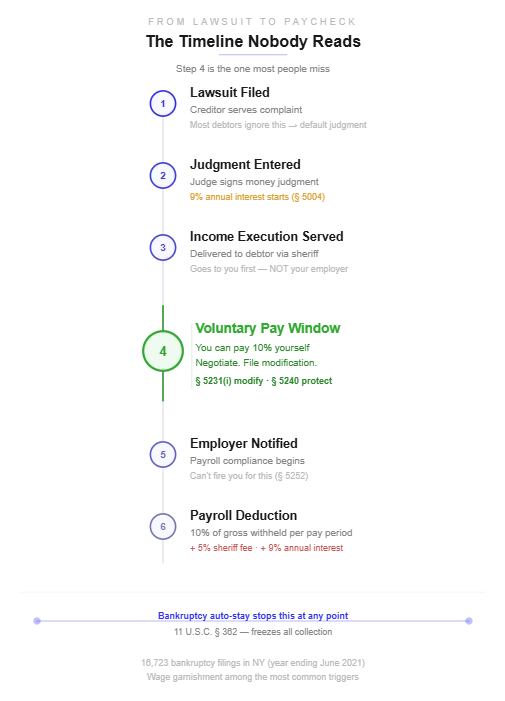
After the judgment, the creditor prepares the income execution and delivers it to the sheriff of the county where the debtor lives (or works, if they’re a non-resident). The sheriff then serves the debtor with a copy.
Here’s the part most people don’t know: the debtor gets a chance to pay voluntarily first. The initial income execution goes to the debtor, not the employer. The debtor has the opportunity to start making the 10% payments themselves. If they don’t pay within the allowed period, then the execution moves to the employer and the mandatory payroll deductions begin.
That window — between being served and the employer getting involved — is critical. It’s the moment where negotiation, modification motions, or legal challenges have the most room to work.
Income That Creditors Can’t Touch
Not everything in your financial life is fair game. New York law carves out specific categories of income that are exempt from collection, meaning a creditor can’t reach them through garnishment or bank account restraints:
- Social Security and Supplemental Security Income (SSI).
- Public assistance and welfare payments.
- Veterans’ benefits.
- Workers’ compensation.
- Disability benefits.
- Court-ordered child support received by the custodial parent.
- Pensions and retirement savings — including 401(k) accounts and IRAs.
- 90% of wages earned in the past 60 days — this protection applies specifically to bank account restraints, where a creditor tries to freeze money that’s already been deposited.
That last one is worth understanding properly. When wages hit your bank account, they transform from “earnings” into “deposits.” A different set of rules kicks in. New York protects certain amounts in bank accounts — creditors must leave at least a baseline amount untouched (the exempt amount has been set at various levels depending on when the case was filed). The bank sends you a notice, and you typically have about 27 days to object before funds are seized.
The distinction between payroll garnishment and bank account restraint trips people up constantly. Someone whose wages are too low to garnish through payroll might still face a bank freeze on the same money once it’s deposited. Knowing the difference isn’t academic — it determines which exemption you claim and how fast you need to respond.
Child Support and Taxes — Different Rules Entirely
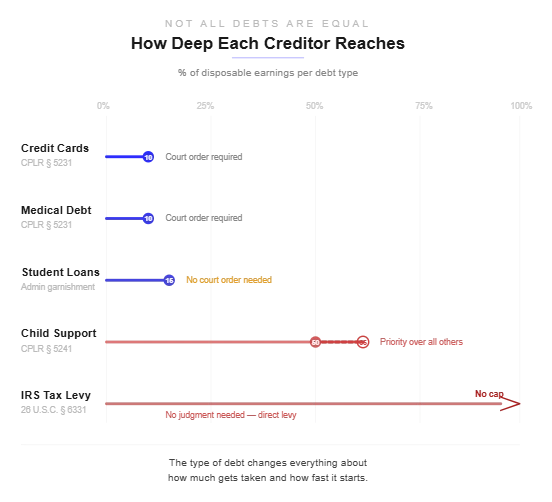
The 10% gross / 25% disposable framework applies to ordinary judgment creditors — credit cards, medical bills, personal loans, deficiency balances from repossessions. The familiar caps people read about online.
Child support and spousal support follow CPLR § 5241, which is a completely different statute with dramatically higher garnishment limits. For support obligations, a creditor can take between 50% and 65% of disposable earnings, depending on the debtor’s other support obligations and how far behind they are on payments. No comparison to the 10% cap for consumer debt.
Tax debts don’t need a court judgment at all. The IRS can issue a levy directly. New York State can do the same for unpaid state taxes. The procedural protections — the chance to pay voluntarily, the service requirements — largely disappear when the government is the creditor.
Federal student loans occupy a middle ground. The Department of Education (or its contracted servicers) can garnish up to 15% of disposable earnings without a court order through what’s called an administrative wage garnishment. The debtor gets notice and an opportunity to request a hearing, but it bypasses the regular court judgment process.
Anybody who reads an article about wage garnishment and assumes every deduction from their paycheck follows the same rules is walking into a trap. The type of debt changes everything about how much gets taken and how fast it starts.
Your Employer Can’t Fire You for This
CPLR § 5252 is one of those provisions that exists because enough employers tried the thing it prohibits. The statute makes it unlawful for any employer to discharge, lay off, refuse to promote, refuse to hire, or otherwise discipline an employee because one or more wage garnishments have been issued against their pay.
The same protection extends to prospective employees. An employer can’t refuse to hire someone because they have an outstanding judgment or pending debt collection lawsuit. And the law doesn’t stop at garnishments — it covers situations where the employer learns about a judgment or alleged contractual debt, even if no income execution has been served yet.
Federal law under the Consumer Credit Protection Act (15 U.S.C. § 1674) provides similar protection, though the federal version only prohibits termination for one garnishment. If you have multiple garnishments from different creditors, the federal protection doesn’t apply to the second and subsequent ones. New York’s CPLR § 5252 is broader — it covers “one or more” garnishments.
Practically speaking, enforcement of these protections requires the employee to prove the negative employment action was because of the garnishment. Employers rarely admit the connection. They’ll cite performance issues, restructuring, anything but the garnishment paperwork that arrived in HR two weeks before the termination. If you suspect retaliation, documenting the timeline matters more than anything else.
How to Challenge a Garnishment
Two statutory routes exist:
- CPLR § 5231(i) — Modification. At any time, the debtor can file a motion asking the court to modify the income execution. This might mean reducing the percentage, suspending it temporarily due to hardship, or adjusting it to account for changed financial circumstances. Courts have historically been receptive to installment payment orders where the debtor can demonstrate that the current garnishment level is causing genuine hardship — inability to pay rent, keep utilities on, or maintain basic living expenses.
- CPLR § 5240 — Protective order. This is the broader tool. A debtor can ask the court to deny, limit, condition, regulate, extend, or modify any post-judgment enforcement procedure, including income executions. Courts have wide discretion here. If a garnishment is creating “unreasonable annoyance, expense, embarrassment, disadvantage, or other prejudice,” as the statute puts it, the court can intervene.
Neither of these options eliminates the underlying debt. The judgment still exists. But they can make the collection process survivable for someone whose rent and grocery money is disappearing into a creditor’s pocket every payday.
The income execution itself contains a required notice telling the debtor about these challenge rights. Most people don’t read it carefully — it’s written in dense legal language, which is ironic given that its purpose is to inform non-lawyers about their options. But the rights are there, and they’re usable.
What Happens When You Have Multiple Creditors
Only one ordinary income execution can be active against a debtor’s wages at a time. If creditor A is already garnishing 10% of gross income and creditor B obtains a judgment and tries to execute on the same wages, creditor B’s execution gets returned as unsatisfied — for now. Creditor B can re-serve the execution later, once creditor A’s judgment is paid off or the execution is otherwise released.
That said, creditor B isn’t prohibited from pursuing other enforcement methods — bank account restraints, property liens, information subpoenas. The one-at-a-time rule applies specifically to wage garnishments, not to judgment enforcement generally.
Support obligations under CPLR § 5241 get priority over ordinary income executions. If a child support garnishment is already deducting 50% of disposable earnings, an ordinary creditor’s income execution can only take from what’s left — and only if the total of all deductions stays within the 25% disposable earnings cap. In practice, this often means the ordinary creditor gets nothing while the support obligation is being satisfied.
The interest calculation is another element that catches debtors off guard. Under CPLR § 5003 and § 5004, money judgments in New York accrue interest at 9% per annum from the date of entry. That interest compounds while the income execution is being collected. So a $10,000 judgment doesn’t stay at $10,000 — it grows. Add the sheriff’s or marshal’s 5% poundage fee and the filing costs, and the total amount the debtor ends up paying can be meaningfully higher than the original judgment.
Bankruptcy as a Stop Button
Filing for bankruptcy triggers an automatic stay under federal law — 11 U.S.C. § 362 — that halts virtually all collection activity, including wage garnishments. The creditor must stop. The employer must stop deducting. Everything freezes while the bankruptcy case proceeds.
For debts that are dischargeable in bankruptcy — credit cards, medical bills, personal loans — a Chapter 7 filing can eliminate the underlying judgment entirely. Once the debt is discharged, the garnishment dies with it. In the year ending June 2021, there were 16,723 bankruptcy filings in New York, and wage garnishment is one of the most common triggers for those filings. Living paycheck to paycheck with 10% of gross income disappearing before you see it pushes people past the point where they can sustain the situation.
Chapter 13 bankruptcy is the alternative for debts that aren’t dischargeable in Chapter 7, or for people who want to repay their debts over a structured 3-to-5-year plan rather than liquidating. The garnishment still stops during the case, but the repayment continues under court supervision and at amounts the debtor can actually afford.
Neither option is free or simple. But for someone whose rent is at risk because a five-year-old credit card judgment is eating 10% of every paycheck plus 9% annual interest, bankruptcy might be the tool that breaks the cycle.
References
- New York Civil Practice Law and Rules § 5231 — Income Execution. https://www.nysenate.gov/legislation/laws/CVP/5231
- New York Civil Practice Law and Rules § 5241 — Income Execution for Support Enforcement.
- New York Civil Practice Law and Rules § 5252 — Discrimination Against Employees and Prospective Employees Based Upon Wage Assignment or Income Execution.
- New York Civil Practice Law and Rules § 5240 — Modification or Protective Order; Supervision of Enforcement.
- New York Civil Practice Law and Rules § 5004 — Rate of Interest (9% per annum on money judgments).
- Consumer Credit Protection Act, 15 U.S.C. § 1671 et seq.
- Legal Assistance of Western New York, “Debt Collection Practices and Lawsuits” (updated February 2026) — https://www.lawny.org/page/609/debt-collection-practices-and-lawsuits
- The Langel Firm, “Know Your Rights Against Wage Garnishment Discrimination” (January 2023) — https://www.thelangelfirm.com/debt-collection-defense-blog/2023/january/know-your-rights-against-wage-garnishment-discri/
- NYC Office of Payroll Administration, “Disagreeing with the Garnishment” — https://www.nyc.gov/site/opa/my-pay/garnishments.page