 Aarthy Venkat Head - Strategy at SignDesk
Georgia’s civil procedure rules — specifically this statute — were substantially rewritten by Senate Bill 68, signed April 21, 2025. The amendments are applicable in most cases even to pending cases. You might miss a waiver deadline, a discovery stay you hadn’t intended on or a procedural advantage to the other side, if you or your attorney is not abreast of it.
We’re going to walk through all of it. The seven defenses you can raise. The waiver traps that catch even experienced counsel off guard. The new 2025 discovery stay rules. And what all of it actually means in practice for defendants and plaintiffs alike.
Why This Statute Actually Matters Right Now
If you’re involved in Georgia civil litigation — whether you got served with a lawsuit, you’re suing someone or you’re just trying to understand what’s happening in your case — OCGA § 9-11-12 is probably already shaping the timeline and strategy. It’s the procedural engine that drives early-stage civil cases in this state.
Most clients hear the word ‘motion to dismiss’ and assume it’s a long shot. Something lawyers file just to delay things. That’s not wrong, exactly — but after the tort-reform overhaul that took effect in 2025, that motion is now a strategic weapon with real teeth. It can freeze all discovery. Indefinitely.
What OCGA § 9-11-12 Actually Says and What Changed
The Basics
The OCGA § 9-11-12 is embedded within the Civil Practice Act (Title 9, Chapter 11) of Georgia and forms the base of the provision of answers, defenses, objections and dismissal motions in civil cases. It dates back to the 1966 Civil Practice Act, which was based on Federal Rule of Civil Procedure 12, but Georgia has always put it’s spin on it.
The statute has a regime of notice-pleading in Georgia – the courts have construed pleadings to administer substantial justice, under § 9-11-8(f). That would be generous, but the rules of procedure in § 9-11-12 are strict and exacting regarding time.
The 2025 Tort-Reform Changes (SB 68)
The General Assembly passed sweeping tort reform through SB 68 and § 9-11-12 was one of the biggest targets. Two subsections changed dramatically: (a) answer timing and (j) the discovery stay.
- Answer timing — new (a)(2): If you file a pre-answer motion under this statute and the court denies it (or kicks it to trial), your answer is now due 15 days after you get notice of that ruling — not another 30-day window.
- The discovery stay — revised (j): This is the headline. In the old rule, a motion to dismiss would initiate a 90-day stay of discovery. Within 90 days (that was not binding), the court was expected to make a decision. After 2025, the stay will remain until the court actually makes a decision – no limit, no time limit. Apply the motion, all comes to a standstill.
| Strategic note (2025+): If you’re the defendant, do NOT file your answer before the court rules on your motion to dismiss. Filing an answer immediately lifts the discovery stay as to you — that’s baked into the new statute. |
The Seven Defenses Under (b) — And the Waiver Trap
Overview of the Seven Defenses
Under § 9-11-12(b), a defendant can raise any of seven specific defenses either in a pre-answer motion or in the responsive pleading itself. They don’t have to be raised separately. But — and this is critical — when and how you raise them determines whether you’ve preserved them or permanently waived them.
| # | Defense | When to Raise It | Waivable? |
|---|---|---|---|
| (b)(1) | Lack of subject-matter jurisdiction | Anytime — even on appeal | No — never waived |
| (b)(2) | Lack of personal jurisdiction | Must be in first motion or answer | Yes — strict waiver |
| (b)(3) | Improper venue | Must be in first motion or answer | Yes — strict waiver |
| (b)(4) | Insufficiency of process | Must be in first motion or answer | Yes — strict waiver |
| (b)(5) | Insufficiency of service of process | Must be in first motion or answer | Yes — strict waiver |
| (b)(6) | Failure to state a claim | Motion, answer or at trial | No — preserved |
| (b)(7) | Failure to join indispensable party | Motion, answer or at trial | No — preserved |
The Waiver Trap — Read This Carefully
Defenses (b)(2) through (b)(5) — personal jurisdiction, venue, process and service — are gone forever if you skip them. Not just hard to raise later. Gone.
The Georgia Court of Appeals made this clear in Adams v. Adams, 260 Ga. App. 597 (2003): once you file that initial responsive pleading without raising personal jurisdiction, you’ve consented to the court’s authority over you. Same principle from Cale v. Eastern Air Lines, 159 Ga. App. 630 (1981).
Subject-matter jurisdiction (b)(1), failure to state a claim (b)(6) and failure to join a party (b)(7) are various – these may be appealed at trial or even on appeal. Subject-matter jurisdiction can be raised at any stage by the court of it’s own initiative. That’s a constitutional floor, not a procedural courtesy.
One more nuance worth knowing: immunity defenses — quasi-judicial or otherwise — aren’t in the (h)(1) waiver list, so they don’t get caught in the same trap. Raise them early anyway, but they’re not subject to automatic forfeiture.
Answer Deadlines, Discovery Stay & the 2025 Timeline
The Answer Deadline
The base rule is simple: 30 days from the date of service. Miss it and you’re looking at default. Georgia courts don’t have much patience here.
Post-2025, there’s a new wrinkle. If you file a pre-answer motion and the court denies it or defers it to trial, your answer is due 15 days after notice of that ruling. If the court grants a motion for a more definite statement, you’ve got 15 days after the amended pleading is served. Track these windows carefully — they’re not interchangeable.
The Discovery Stay — Old vs. New
| Stage | Pre-2025 Rule | Post-2025 Rule (SB 68) |
|---|---|---|
| Answer deadline | 30 days from service | 30 days — OR 15 days after court rules on pre-answer motion |
| Discovery stay triggered by | Filing motion to dismiss (pre-answer or with answer) | Filing motion to dismiss before the answer |
| Stay duration | 90 days or until ruling (whichever sooner) | Indefinite — until the court actually rules |
| Court ruling deadline | 90 days (directory — no sanction for delay) | No deadline imposed |
| Stay lifted early if… | Court terminates or modifies it | Defendant files an answer before ruling |
| Limited discovery still allowed for | Certain (b) defenses; identifying parties | Same exceptions remain |
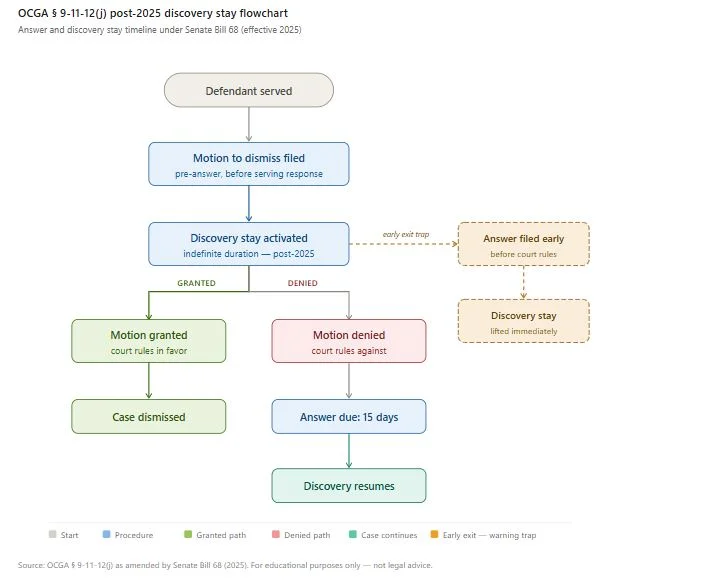
The practical impact of the indefinite stay is great. Motions to dismiss may languish for months in busy Georgia courts. By the old rule, discovery was resumed after 90 days without any consideration. A properly written motion to dismiss can now actually freeze the whole case until the court makes it’s decision – a considerable bargaining advantage to the defendant amidst costly, sweeping discovery demands.
To plaintiffs: the statute retains narrowed discovery to some (b) defenses, such as personal jurisdiction, venue, service and problems of joinder. When your opponent is concealing himself behind a jurisdictional defense, insist on limited jurisdictional discovery. In Kolb v. Daruda, 350 Ga., the Court of Appeals. App. A plaintiff was affirmed to have a right to limited discovery on a (b)(2) motion without prior court authorization, 642 (2019).
Practical Tips & Common Pitfalls

For Defendants
- Raise (b)(2)–(b)(5) immediately. Every. Single. Time. If there’s any colorable personal jurisdiction or venue issue, it goes in your first motion or your answer — not later.
- Don’t file your answer early if you’ve filed a pre-answer motion to dismiss and want the discovery stay intact. Filing the answer kills the stay as to you. That’s the new rule.
- Use the indefinite stay strategically. A well-supported motion to dismiss now buys real time. If the plaintiff’s complaint has genuine deficiencies, filing pre-answer is worth serious consideration.
- Watch the 15-day post-ruling window. If your motion gets denied, you don’t get another 30 days. Fifteen days is tight, especially if you’re in trial prep on another case.
- Immunity defenses aren’t in the waiver trap — but raise them early anyway. Courts appreciate clean records.
For Plaintiffs
- Anticipate the discovery freeze. Post-2025, there may be no discovery until the motion to dismiss is resolved. Build your complaint to survive a (b)(6) challenge without needing early discovery to bolster it.
- Move for termination or modification of the stay if delay is causing real prejudice — the court has discretion to terminate or modify it.
- Push for limited jurisdictional discovery if the defendant raises a (b)(2) defense. Under Kolb, you’re entitled to it without seeking special permission.
- Serve promptly and correctly. Insufficiency of service defenses (b)(4) and (b)(5) disappear if the defendant waives them — but only if they do. Don’t hand them an easy waiver to assert by sloppy service.
- A (b)(6) motion that attaches outside documents converts to a motion for summary judgment — which requires notice and a chance to respond. Know when that’s about to happen.
General Pitfalls — Don’t Let These Happen
- Assuming a cross-claim or counterclaim needs a formal answer — it doesn’t, unless the court orders one. It’s automatically denied.
- Attaching affidavits or evidence to your (b)(6) motion without realizing you’ve just triggered summary-judgment procedures. Expensive surprise.
- Multi-defendant cases: each defendant needs to independently raise their own (b)(2)–(b)(5) defenses. Coordination matters.
- Treating the court’s 90-day ruling deadline (pre-2025) as enforceable — it wasn’t and there’s no deadline at all now. Plan accordingly.
Georgia vs. Federal Practice — A Quick Comparison
Georgia modeled § 9-11-12 on FRCP 12 and the parallels are clear. But the differences matter — especially now.
| Feature | Georgia (OCGA § 9-11-12) | Federal (FRCP 12) |
|---|---|---|
| Waiver of personal jurisdiction | Strict — omit once and it’s gone | Similar but circuit application varies |
| (b)(6) → Summary Judgment conversion | Requires notice + opportunity to respond | Also converts; less rigid notice requirement |
| Discovery stay | Statutory — now indefinite post-2025 | No analog; courts have inherent power only |
| Answer timing after motion denied | 15 days post-ruling (new 2025 rule) | 14 days post-ruling under FRCP 12(a)(4) |
| Pleading standard | Notice pleading (§ 9-11-8(f)) | Plausibility pleading (Twombly/Iqbal) |
The large divergence is the discovery stay. Federal courts have no statutory analogue – judges will impose inherent power to stay discovery, although it is discretionary and intermittent. Georgia defendants now can freeze discovery by motion to dismiss and are given a statutory right to do so. That is a structural significant advantage that is not present in federal court.
The pleading standard is different too. Georgia continues to apply notice pleading, more liberal than the federal Twombly/Iqbal plausibility standard. Nevertheless, even with a well-written (b)(6) motion to dismiss, vague Georgia complaints may nonetheless be struck down, particularly after 2025, when plaintiffs will no longer be able to correct their pleading flaws with the aid of early discovery.
Real-World Takeaways for 2026
One of the most litigated Georgia civil procedure statutes has always been OCGA 9-11-12. The 2025 amendments only made the stakes a lot higher. Defendants are more likely to have leverage in early litigation than is the case in a long time. Plaintiffs must have more robust first complaints and a clear-eyed approach to lengthy motion practice without the discovery tools upon which they had previously been dependent.
A few things to keep in mind heading into 2026:
- Timing is everything. The 30-day answer deadline, the 15-day post-ruling window and the mechanics of when the discovery stay lifts, these aren’t technicalities. They’re outcome-determinative.
- Waiver is permanent. (b)(2)–(b)(5) defenses don’t get a second chance. If your first pleading doesn’t include them, you’ve consented to jurisdiction, venue and valid service, whether you meant to or not.
- The discovery stay is a real asset — but only if you don’t accidentally waive it by filing your answer too early. Coordinate the timing deliberately.
- Courts are backed up. An indefinite discovery stay means the stay can now last as long as the court’s docket is congested. That’s both a defense benefit and a plaintiff headache that has no easy workaround.
- The (b)(6) conversion rule catches people. Attach one document to your motion to dismiss and you’re suddenly in summary-judgment territory. Know the rules before you file.
| © 2026 — Educational content only. Not legal advice. Consult a licensed Georgia attorney for guidance specific to your case. |