 Gretchen Taylor Pousson
Let’s start somewhere specific. September 27, 1988. A 23-year-old man named Roy David Summers steps out of an apartment complex in Fairfax, Virginia and into an arrest that would eventually help shape how federal courts handle sentencing departures for the next three decades.
What happened after his arrest — the charges, the guilty plea, the surprisingly lenient sentence and then the appellate smackdown that followed — that’s the real story here. Not because Summers himself was unusual, but because the Fourth Circuit’s response to what the district court did became a foundational piece of early Guideline jurisprudence.
This article walks through U.S. v. Summers, 893 F.2d 63 (4th Cir. 1990) from the ground up – who Summers was, what he was charged with, how the sentencing went sideways and why the reasoning of the appellate court is still important today. Whether you’re a law student, a practicing attorney, or just someone trying to figure out how federal sentencing really works, there’s something useful here.
Who Was Roy David Summers?
The case record doesn’t tell us much about Summers the person – federal appellate opinions usually don’t. What we know comes mostly to us from his presentence report. Born around 1965–1966. Twenty-three years of age at the time of sentencing. Extensive prior record, including juvenile arrest, adult convictions for grand larceny, narcotics possession, weapons violations and numerous probation violations.
The presentence report also described him as a “well known member” of the Crips – the Los Angeles-based street gang with a long history of drug and firearms trafficking. That detail found its way into the appellate record but interestingly enough, the court did not rely on gang affiliation as an enhancement in itself. It was context not lever of sentencing.
Here’s where it gets operationally interesting. A few months before his 1988 arrest, Summers had purchased three handguns using a falsified Maryland driver’s license under the alias “Richard Roy Ray.” He signed the federal acquisition form swearing he had no prior felony convictions. He did. That false statement alone was a separate federal crime.
The Arrest and Search
On September 27, 1988, police officers served an arrest warrant on Summers when he was getting into a vehicle outside a Fairfax apartment complex. What they found during the search was something important, to put it mildly.
- Three kilos cocaine base (crack cocaine) and half a kilo cocaine – powder – in the vehicle.
- Cocaine residue in mixing bowls in the apartment.
- Seven kilograms of cocaine in his Forestville, Maryland residence.
- $62686 in cash hiding inside a mattress.
- A loaded .45 caliber semi-automatic pistol and ammunition.
Summers didn’t consider going into questioning the searches. He pled guilty. That decision shifted the legal fight across entirely to sentencing – which turned out to be where the real fight was.

Federal Charges Filed
| Charge | Statute | Jurisdiction |
| Narcotics possession & distribution (cocaine/crack) | 21 U.S.C. § 841 | Virginia & Maryland |
| Use of firearm during drug trafficking | 18 U.S.C. § 924(c)(1) | Virginia |
| False ID to acquire firearm | 18 U.S.C. § 922(a)(6) | Maryland |
| Felon in possession of firearm | 18 U.S.C. § 922(g)(1) | Maryland |
For reference on the firearms statutes, see 18 U.S.C. § 924 at Cornell Law and the U.S. Sentencing Commission’s guidelines manual.
Procedural History
So, Summers was indicted in the Eastern District of Virginia, or in the District of Maryland. Under the provisions of Federal Rule of Criminal Procedure 20 he took his case in Maryland to Virginia and entered guilty pleas to all counts in the Eastern District.
Because the offenses occurred after November 1, 1987, the Sentencing Reform Act of 1984 applied – that is, Summers was sentenced to punishment under then-new U.S. Sentencing Guidelines. No more Judicial Discretion in the old sense. Every factor got calculated, point by point.
How the Guidelines Math Worked
The probation officer was in charge of running the numbers. Base offense level: 36, reduced by 2 for Summer’s leadership position under U.S.S.G. S 3B1.1(a) and reduced by 2 for acceptance of responsibility under S 3E1.1 Net offense level: 36.
Criminal history came out to Category V – 10 Points under section 4A1.1. That included points for offenses committed while under supervision, juvenile arrests and yes – driving-related violations.
That combination resulted in one range of 292 to 365 months for the counts of narcotics, plus a mandatory consecutive 60-month sentence under section 924(c)(1) for the use of a firearm in connection with the drug traffic. Bottom line, the guidelines indicated somewhere between 352 and 425 total months.
The Downward Departure
The district court didn’t go there. Summers argued – and the judge agreed – that his Criminal History Category V overstated seriously the seriousness of his actual history. The driving violations in particular had inflated his point total. He claimed that he was a realistic Category IV defendant.
The judge went down on the narcotics counts alone and sentenced Summers to 180 months as well as the mandatory 60 consecutive. Total: 240 months. The government immediately appealed.
Case Timeline
| Date | Event |
| Mid-1980s | Summers begins criminal activity; first arrests for larceny, narcotics, weapons violations |
| ~Early 1988 | Purchases three handguns using falsified Maryland ID (alias: Richard Roy Ray) |
| Sept. 27, 1988 | Arrest outside Fairfax, VA apartment — 3 kg crack + 0.5 kg cocaine found in vehicle |
| Sept. 27, 1988 | Search of Forestville, MD residence yields 7 kg cocaine, $62,686 cash, loaded .45 pistol |
| 1988–1989 | Indicted in both Virginia and Maryland federal courts |
| 1989 | Pleads guilty under Rule 20; sentenced to 240 months (180 + 60 mandatory) |
| 1990 | Fourth Circuit vacates sentence; remands for resentencing in Cat. IV range |
Key Legal Issues on Appeal
The Fourth Circuit framed the appeal around a single core question: was the district court’s downward departure legally permissible under 18 U.S.C. § 3553(b)?
That statute allows departures only when a circumstance exists that the Sentencing Commission didn’t “adequately” consider. So the court built a three-part framework.
The Three-Part Departure Test
- Is the departure factor (here: overstated criminal history) something the Commission already addressed? — Reviewed de novo as a legal question.
- Did that circumstance actually exist in this case? — Reviewed for clear error.
- Was the extent of the departure reasonable? — Reviewed for abuse of discretion.
On the first question, the court said yes — the Commission did address this. Specifically, U.S.S.G. § 4A1.3 contains a policy statement explicitly allowing departures when a category “significantly over-represents” the seriousness of a defendant’s history. So the door wasn’t closed.
On the second question — did overrepresentation actually exist here? — the court found no clear error. The driving violations had genuinely inflated Summer’s score from Category IV to V. That much was defensible.
Where the District Court Went Wrong
The extent. That’s where it fell apart.
The Fourth Circuit read § 4A1.3 narrowly and purposefully. Departures under that provision are designed to move defendants to the adjacent category — not to freefall past it. If the argument is that Summers was really a Category IV, then the sentence should reflect the Category IV range: 262–327 months, not 180.
180 months didn’t just undercut Category V. It undercut Category IV by over 80 months at the floor. The court wasn’t having it.
Age: Not a Valid Basis Here
The district court had also cited Summer’s age — 23 — as a partial basis for departure. The Fourth Circuit rejected this cleanly. U.S.S.G. § 5H1.1 states that age is “not ordinarily relevant” to sentencing unless the defendant is elderly or infirm. Twenty-three does not qualify.
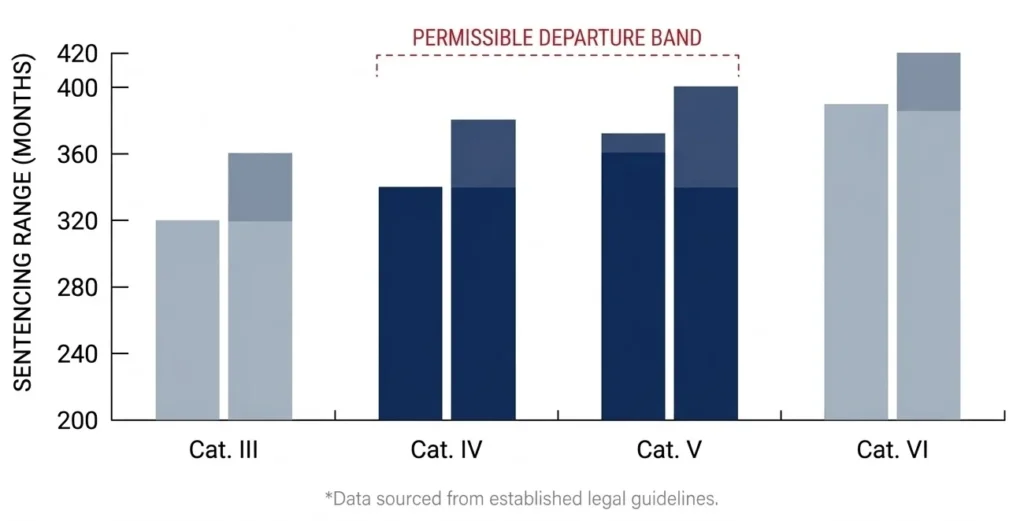
Sentencing Comparison
| Criminal History Category | Guideline Range (Narcotics) | + § 924(c) Consecutive | Total Range |
| Category IV (actual) | 262–327 months | 60 months | 322–387 months |
| Category V (calculated) | 292–365 months | 60 months | 352–425 months |
| District Court (departed) | 180 months | 60 months | 240 months ❌ Vacated |
| Remand (Cat. IV floor) | 262 months min. | 60 months | 322 months min. |
Current sentencing guidelines tables are available directly from the U.S. Sentencing Commission at ussc.gov.
Outcome: Vacated and Remanded
The Fourth Circuit vacated the 240-month sentence and sent the case back to the district court for resentencing. The new sentence had to fall within the Category IV range on the narcotics counts — 262–327 months — plus the mandatory 60 months consecutive.
What happened on remand isn’t detailed in publicly available records, but the legal principle landed clearly: departures under § 4A1.3 are tethered to adjacent categories. You can argue your defendant belongs in a lower box. You can’t invent a sentence that doesn’t correspond to any box at all.
Broader Legal Implications
Establishing Early Guideline Discipline
This case came just one year after Mistretta v. United States (1989), where the Supreme Court upheld the constitutionality of the Sentencing Guidelines. The circuits were still figuring out how much flexibility judges actually had. Summers helped answer that.
The message from the Fourth Circuit was disciplined: the Guidelines aren’t a starting point for judicial instinct. They’re a framework. Departures have to be anchored to something the Guidelines themselves recognize and the extent of any departure has to correspond to the framework’s own structure.
Gang Affiliation in Presentence Reports
Something worth pausing on — the Crips affiliation noted in Summer’s presentence report appeared in the record without directly affecting his sentence calculation. That’s notable. Courts today continue to wrestle with how gang labels in PSRs can color judicial perception without constituting a formal enhancement. Summers didn’t challenge it. But the issue didn’t vanish with his case.
Youth and Criminal History
Summers was 23. His criminal history stretched back to juvenile arrests. Under the Guidelines as written, those still counted. The court’s rejection of age as a mitigating factor reflected the Guidelines’ deliberate move away from individualized discretion — something that would remain contested for fifteen more years, until Booker.
Post-United States v. Booker (2005), the Guidelines became advisory rather than mandatory. A district court today could, in theory, give weight to a defendant’s youth more freely. But Summers still gets cited for the criminal history overrepresentation analysis — the analytical framework for § 4A1.3 departures didn’t change just because the Guidelines became advisory.
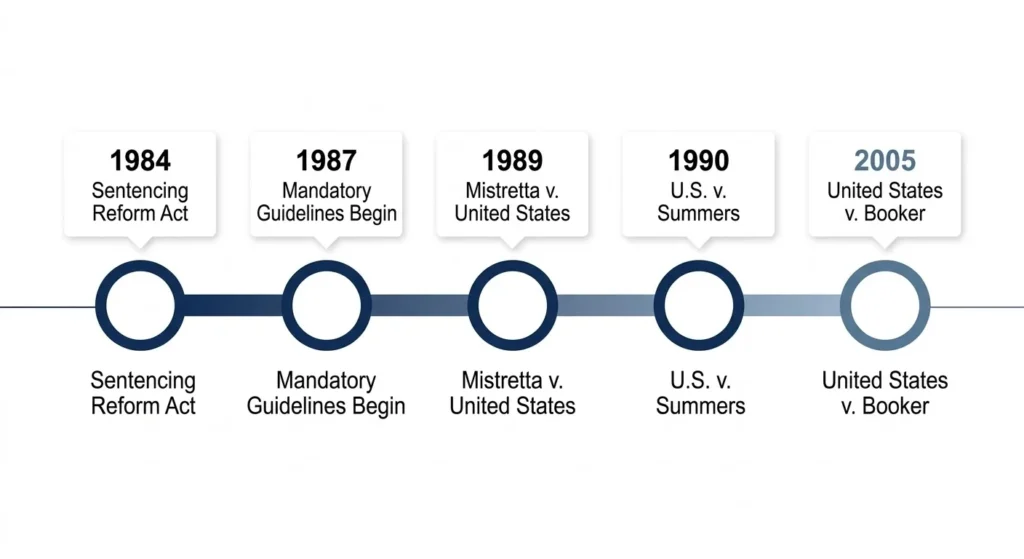
For further reading on the post-Booker advisory Guidelines framework, see the U.S. Sentencing Commission’s overview of Booker at ussc.gov.
Conclusion
Roy Summer’s case isn’t famous. It doesn’t show up in constitutional law courses or get cited in op-eds about criminal justice reform. But it does something useful — it shows, clearly, how early federal courts interpreted the boundary between judicial discretion and guideline structure.
The district court’s instinct wasn’t unreasonable. A 23-year-old with driving violations inflating his criminal history score, facing 352 months minimum — there’s a human argument for leniency there. The Fourth Circuit didn’t say the instinct was wrong. It said the execution was.
That distinction — between the direction of a departure and the extent of it — is still the right one. Judges can recognize when a category overstates a defendant’s history. What they can’t do is use that recognition as a blank check to sentence however they see fit. The framework has to mean something, or it means nothing.
Summers was remanded. The Guidelines held. And U.S. v. Summers became one of those cases that quietly shapes how practitioners argue § 4A1.3 departures to this day.