 Gretchen Taylor Pousson
Last week, a potential client called me panicking. Bar fight. Someone shoved him, he shoved back. Now he’s charged under section-16-5-23. “I didn’t even punch anyone,” he kept saying.
That’s the thing about simple battery in Georgia—most people don’t realize how little it takes to catch this charge.
I’ve been practicing criminal defense here since 2003. Handled maybe 200+ battery cases, everything from domestic disputes to parking lot arguments gone sideways. And I’ll tell you what surprises people most: you don’t need to leave a mark. You don’t even need to cause pain.
Let’s break down O.C.G.A. § 16-5-23 the way I’d explain it if you walked into my office.
What Actually Counts as Simple Battery?
The statute itself? Pretty straightforward on paper:
“A person commits the offense of simple battery when he or she either: (1) Intentionally makes physical contact of an insulting or provoking nature with the person of another; or (2) Intentionally causes physical harm to another.”
Two paths to a conviction. That’s it.
Path One is where most folks trip up. “Insulting or provoking nature”—what does that even mean?
I had a case three years back. Client was at a Braves game. Drunk guy behind him kept bumping his seat. My client turned around, poked him in the chest while telling him to stop. One finger. No injury. Still got arrested.
Here’s what prosecutors look at:
- Did you touch someone intentionally?
- Would a reasonable person find that contact offensive?
- Context matters (a tap on the shoulder to get attention? Different story than an aggressive chest poke)
Path Two seems clearer. Causing physical harm. But “harm” doesn’t mean what you think.
A bruise? Obviously. Temporary pain that leaves nothing? Still counts. Making someone stumble? Yep.
The Georgia Court of Appeals dealt with this in Harden v. State (you can dig into case law on Georgia’s judicial website). They basically said if the victim felt pain, even briefly—that’s enough.
The Elements Prosecutors Must Prove
They need all of these:
- Intentional act (not accidental contact).
- Physical contact OR physical harm.
- No consent from the other person.
Number three trips people up. I’ve seen bar fights where both parties were willing participants—but Georgia doesn’t recognize “mutual combat” as a defense. If you touched someone offensively, consent better be crystal clear.
Quick story. Client bumped into someone at a grocery store. Accident. Other person went wild, claimed battery. Case dismissed in about ten minutes once the DA saw the security footage. Intent matters.
What You’re Actually Facing
Simple battery is a misdemeanor. Sounds better than a felony, right?
Sure. Until you see what comes with it.
Standard Penalties:
- Up to 12 months in jail.
- Fines up to $1,000.
- Probation.
- Anger management classes.
- Restitution to the victim.
Most first-timers don’t see jail. But that’s not guaranteed.
When Things Get Worse
Georgia law has specific situations where section-16-5-23 penalties jump. Aggravating factors.
| Aggravating Factor | Enhanced Penalty | Notes |
| Victim is 65+ years old | Misdemeanor of high and aggravated nature | Mandatory minimum 90 days (can be suspended/probation) |
| Victim is pregnant (offender knew/should’ve known) | Misdemeanor of high and aggravated nature | Same as above |
| Battery in a public transit vehicle | Enhanced penalties | Includes MARTA buses, trains |
| Public school property battery | Additional consequences | Can trigger school-specific sanctions |
I represented a guy who pushed someone on a MARTA train. He didn’t know about the public transit enhancement. Judge wasn’t sympathetic.
Family Violence Battery—Different Beast Entirely
If your victim is a household member? That’s Family Violence Battery. Still under section-16-5-23 technically, but with special rules:
- Mandatory 24-hour hold after arrest.
- Firearms restrictions.
- Batterer intervention programs required.
- Protective orders likely.
- Employment consequences (especially for jobs requiring background checks).
The Georgia Commission on Family Violence has resources on this at their state portal, but honestly? If you’re charged with FV battery, you need a lawyer immediately. Don’t wait.
Defenses That Actually Work
Not every case is winnable. Some are. Here’s what I look for first.
Self-Defense/Defense of Others
Georgia law is clear: you can use reasonable force to protect yourself or someone else from imminent harm. O.C.G.A. § 16-3-21 spells this out.
But “reasonable” is subjective. I won a case last year where my client grabbed someone’s wrist to stop them from hitting his girlfriend. Prosecutor tried to argue excessive force. Jury saw it differently.
You can’t be the initial aggressor, though. If you started the fight, self-defense gets shaky.
Lack of Intent
Accidents happen. Bumped into someone on a crowded sidewalk? Tripped and grabbed someone? Not battery if it wasn’t intentional.
Had a client with cerebral palsy. His arm spasmed and hit someone. The person called the cops, claimed assault. We brought medical records, neurologist testimony. Case dismissed.
Consent
Trickier than you’d think. Contact sports have implied consent. Horseplay between friends? Maybe. Depends on whether it crossed a line.
I’ve never won a case arguing consent in a genuine dispute. But I have gotten charges reduced by showing the context made the contact less offensive than it looked.
Mistaken Identity
Chaotic situations. Multiple people involved. Sometimes witnesses get it wrong.
Bar fight case I handled—security footage showed someone else threw the first punch. My client just happened to be standing nearby. Without that video? He’d have been convicted based on witness testimony alone.
What Else Gets Charged Alongside Battery?
Simple battery rarely travels alone.
Common companion charges:
- Disorderly conduct (O.C.G.A. § 16-11-39).
- Simple assault (§ 16-5-20) – the threat without contact.
- Criminal trespass (if you weren’t supposed to be there).
- Public intoxication.
Sometimes prosecutors stack charges hoping you’ll plead to something. It’s a negotiation tool.
The Assault vs. Battery Confusion
People mix these up constantly.
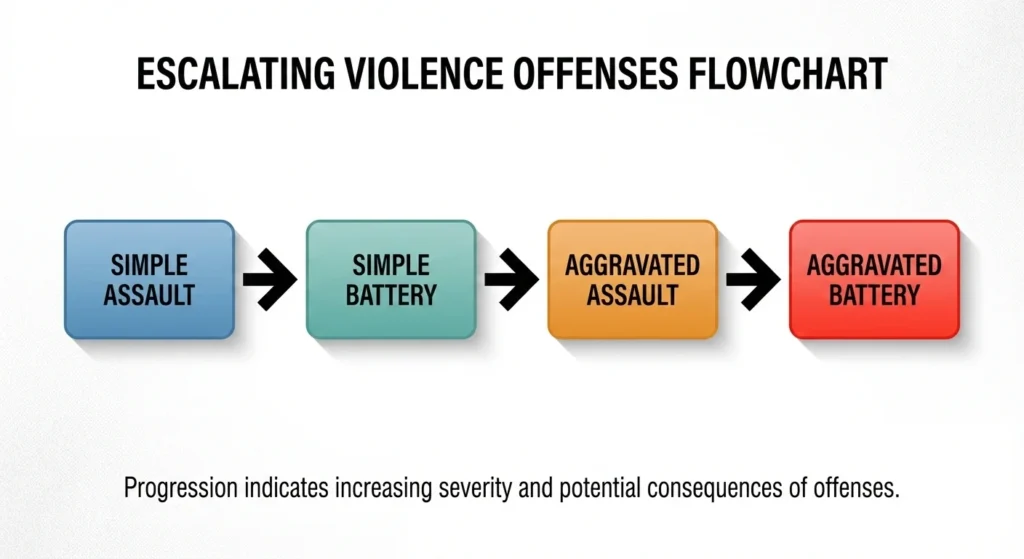
Simple Assault = attempting to cause violent injury OR placing someone in fear of violent injury. No contact needed.
Simple Battery = actual physical contact or harm.
You can commit both in the same incident. Threaten to hit someone (assault), then actually hit them (battery). Two separate charges.
How This Law Has Changed
Section 16-5-23 has been around since Georgia’s criminal code was recodified in 1968. But amendments matter.
1995: Added the pregnant victim enhancement. Came after a case where a woman lost her pregnancy after being battered—existing law didn’t address it adequately.
2010: Enhanced penalties for elderly victims (65+). Georgia’s population was aging, elder abuse cases were rising.
2017: Clarified language around family violence battery provisions. Made it explicit that household members include dating partners, not just married couples.
You can track legislative history through the Georgia General Assembly website.
The trend? Georgia keeps expanding what qualifies for enhanced treatment. Lawmakers respond to high-profile cases, advocacy groups push for tougher penalties in specific contexts.
What Courts Have Said
Case law shapes how section-16-5-23 gets applied. Few examples:
Touch doesn’t need to be forceful. Reese v. State established that even minimal contact counts if it’s offensive in nature. Poking, pushing, slapping—all equal under the statute.
Victim injury isn’t required for “insulting or provoking” prong. Johnson v. State made this clear. If the contact itself was offensive, physical harm is irrelevant.
Pain can be momentary. That Harden case I mentioned earlier. Victim testified the push hurt for maybe five seconds. Court said that’s enough for the “physical harm” prong.
These cases are on Justia and Georgia case law databases, if you want to dive deeper.
Practical Advice from Someone Who’s Seen It All
If you’re charged:
Don’t talk to police without a lawyer. I mean it. “I was just defending myself” sounds reasonable to you. To prosecutors, it’s a confession that you did commit battery, just with an excuse. They’ll use your words against you.
Document everything immediately. Injuries, witnesses, text messages, photos. Memory fades. Evidence disappears. Do this the same day if possible.
Get medical attention if you’re injured. Creates a record. Shows your state of mind. If you claim self-defense but didn’t seek treatment for your own injuries, juries get skeptical.
Don’t contact the alleged victim. Protective orders are common. Violating one turns a misdemeanor case into multiple charges. I’ve seen people dig themselves deeper by sending “I’m sorry” texts.
Consider pretrial diversion if eligible. First offense? Clean record? Some Georgia counties offer diversion programs. Complete classes, community service, probation—charges get dismissed. Not available for everyone, but worth exploring.
Should you go to trial? Depends. I’ve taken cases to trial and won when evidence was weak. I’ve also negotiated pleas that saved clients from jail time when conviction was likely.
Risk assessment is personal. Can you afford a conviction on your record? What’s your employment situation? Prior criminal history? All factors.
Wrapping This Up
Section-16-5-23 looks simple. It’s not.
One shove. One poke. One slap. That’s all it takes to end up in my office facing jail time, fines, a criminal record that follows you for years.
I’ve gotten charges dismissed. I’ve negotiated pleas down to disorderly conduct. I’ve won jury trials. But I’ve also watched people tank their own cases by talking to police, contacting victims, or assuming “it wasn’t that serious.”
It is serious.
If you’re dealing with a battery charge in Georgia, get legal help. Public defenders do good work—if they have time. Private attorneys can give your case more attention. Either way, don’t go it alone.
And if someone’s getting physical with you? Walk away if you can. Not worth the legal mess, even if you’re in the right.