 Gretchen Taylor Pousson
Three weeks ago, I was called and it changed my thinking towards this type of cases. One of the sons of a client, an honor roll student, who had never been in trouble, was now confronted with twenty years of his life over what began as a fender bender. The other motorist became aggressive and my client who was in the vehicle managed to get a tire iron that was in his trunk. No one was injured but the prosecutors accused him of aggravated assault.
“How is this possible?” his father asked me. Fair question.
The aggravated assault law in Georgia O.C.G.A. § 16-5-21 does not play around. What the majority believe to be assault with a deadly weapon is in fact spans a significantly greater distance than you would have guessed. And the next time you cross that threshold between simple attack and aggravated ground, you find yourself looking at a felony charge to derail your whole life.

After fifteen years of criminal defense work, I’ve seen too many people get blindsided by these charges. Smart people who thought they understood the law. People who believed they were defending themselves. People who made split-second decisions that prosecutors later dissected frame by frame.
It is not about frightening you, but knowledge. This is because interpretation of the aggravated assault law in Georgia could be what stands between escaping a fight and serving the following ten years in prison.
What is It exactly that Makes Assault Aggravated?
Let’s start with the basics. In Georgia, Simple assault represents either the attempt to inflict violent harm to another individual, or place that person in a reasonable fear of you causing them harm. Imagine it as the Russian roulette of law that is, the fighting words – misdemeanor and possibly a night in jail.
Aggravated assault builds on that foundation but adds specific elements that bump it into felony territory:
- Intent to murder, rape, or rob – Even if you don’t succeed, having this intent during an assault makes it aggravated
- Deadly weapon – Guns, knives, broken bottles, baseball bats.
- Objects that are serious sources of injury – Here is the juggernaut; it can be a hammer or a car.
- Firing a gun out of a car – Drive-by shootings, however, also road rage cases.
- Strangulation – This was added in 2014 following the pressure by domestic violence lobbyists.
- Attack of weak victims – seniors, pregnant women, children, policemen.
In Dunagan v., there is something that was made clear by the Georgia Supreme Court. State back in 1998: prosecutors do not require that you had the intent. They are able to know it on the basis of your actions, the weapon employed, what you uttered at the scene.
This is where the clients become confused. You do not need to put anyone seriously hurt. The prosecution only has to show that you had an intention of causing serious harm or you had in your possession something that had the ability to cause such harm. I have witnessed instances where one swung a pool cue and missed the target completely, however, he or she was convicted of aggravated assault due to the weapon having the potential to inflict serious harm.
That controversial “deadly weapon” interpretation? Sometimes even fists qualify if there’s extreme disparity in size or strength, though this happens rarely and depends heavily on circumstances. The courts haven’t been eager to expand this interpretation, which is probably smart policy.
The Price of Poor Decisions: Penalties and Sentencing
Georgia does not play around with such charges. Ordinary aggravated assault bears a sentence of 1 to 20 years in jail, and also fines no more than 100000 dollars. However, a true sentence is mostly dependent on aggravating circumstances and a history of crime.
| Circumstance | Minimum | Maximum | Additional Consequences |
|---|---|---|---|
| Standard aggravated assault | 1 year | 20 years | Fines up to $100,000 |
| Elderly/pregnant victim | 3 years | 20 years | Possible lifetime probation |
| Public safety officer | 5 years | 20 years | No parole for minimum term |
| Family violence context | 3 years | 20 years | Mandatory counseling, restraining orders |
| Firearm from vehicle | 5 years | 20 years | Enhanced if gang-related |
Georgia Bureau of Investigation is tracking them with religion. Considering their most recent statistics, aggravated assault incidents have decreased instead of increased, 11,200 in 2019 to 9,900 in 2023. The mean sentences fell marginally as well – 8.0 years in 2020 have decreased to 7.4 years in 2023.
However, there is the inconvenient truth, which is sentencing disparities. Research findings have been consistent in identifying that on average, black defendants are given longer sentences. The rates of conviction are higher in cities such as Fulton and DeKalb counties compared to rural. In case you are struggling with your third felony, the three strike policy as provided by the state of Georgia under the O.C.G.A. 17-10-7 can sentence you to life imprisonment without parole.
In addition to spending time in prison, being convicted is equal to losing your right to own guns, being unable to easily find a job and even being deported, in case you are not a U.S citizen. Licenses are frequently suspended or terminated. It is not only about serving time – it is about new life after that.
Fighting Back: Defenses That Actually Work
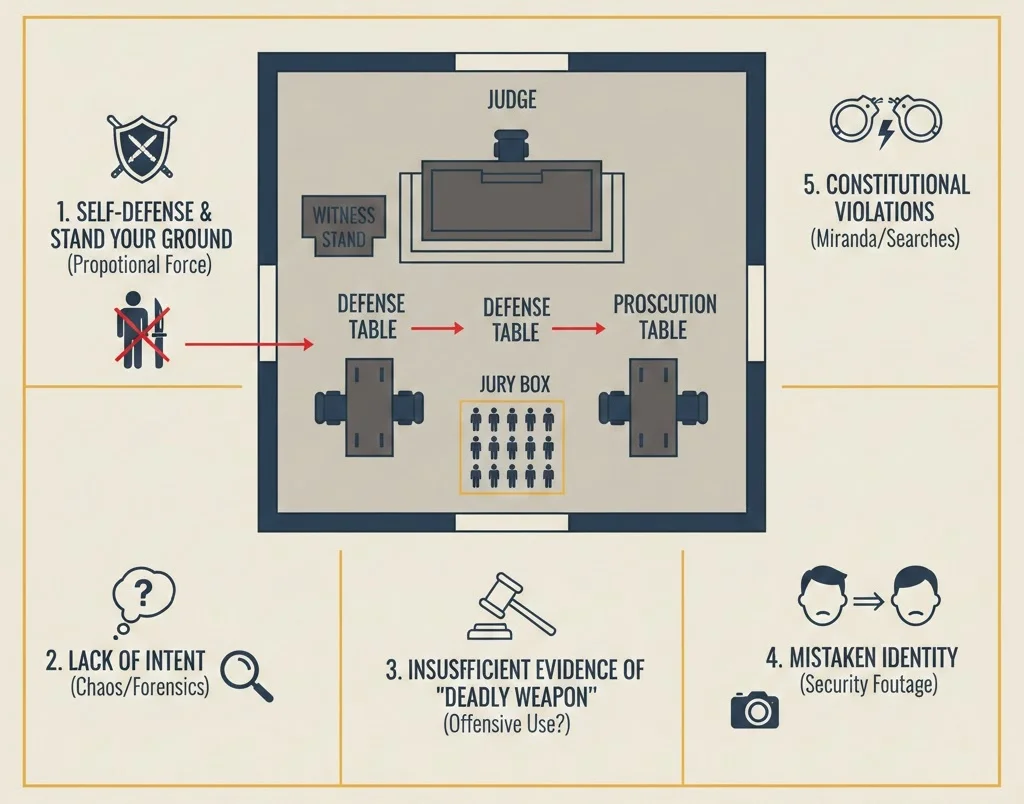
Good news: about 30% of aggravated assault cases get dismissed before trial, according to the Georgia Public Defender Council’s 2022 analysis. Usually because the initial evidence doesn’t hold up under scrutiny.
1. Self-Defense and Georgia’s Stand Your Ground Law
The original requirement of retreating then being able to defend oneself was abolished in Georgia by the stand your ground law (O.C.G.A. 16-3-23.1). However, the degree of force must be equal to the danger. One pushes you, you can push him. You draw a knife, somebody pushes you. That’s probably excessive.
2. Lack of Intent
This defense works surprisingly often. Bar fights happen in chaos – people react instinctively, not with premeditated intent to cause serious harm. Good forensic analysis can show what really happened versus what witnesses thought they saw.
3. Insufficient Evidence of “Deadly Weapon”
A lethal weapon is not necessarily easily determined. I have managed to defend that some objects were not used in an offensive way or would not result in serious injuries considering their holding.
4. Mistaken Identity
Occurs more frequently than you might imagine, particularly in cases of multi-party. Surveillance video usually tells a more different story than preliminary eyewitness testimonies.
5. Constitutional Violations
Improper searches, Miranda violations, coerced confessions – these can get evidence excluded or charges dropped entirely.
The key is acting fast. Write down all this asap: photos of wounds (yours and theirs), contacts of witnesses, medical history, social media posts which may be of interest. Do not suppose that the police report was accurate in everything.
Broader Impact: Why These Laws Matter
Aggravated assault is not only the criminal cases of individuals – it is the health problem of population. According to the CDC data, aggravated assault is correlated with increased homicide risk, and Georgia is in the middle of the national homicide rates.
The new aggravating factor of strangulation was added in 2014 with a direct result of research on domestic violence that revealed that strangulation is a significant predictor of future homicides in cases of intimate partner violence. Intelligent policy modification supported with quality data.
Efforts against vulnerabilities that are effective:
- Conflict de-escalation training – This is being offered by many employers.
- Mental health resources – Georgia increased access by Medicaid.
- Community intervention programs – Atlanta cities that have been successful with violence interruption models.
- Responsible serving of alcohol -A majority of aggravated assault cases concern alcohol.
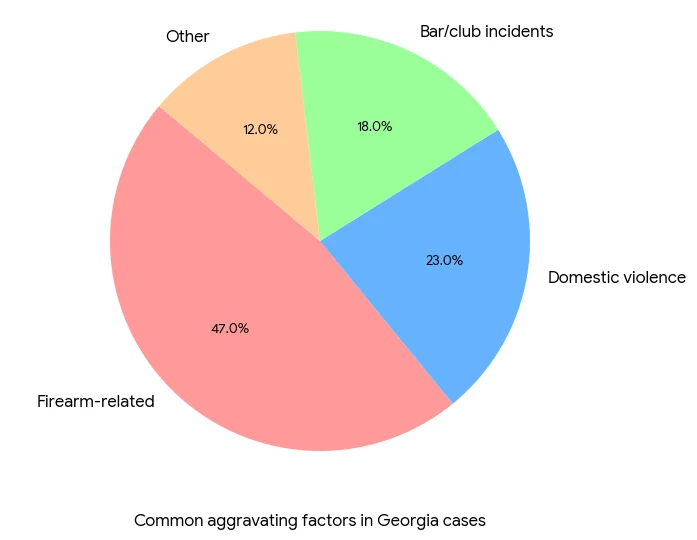
The legal reforms are still being pursued, especially in the areas of sentencing differences and compulsory minimums. The argument revolves around the idea of prioritizing community security and commensurate penalty, as well as breaking down the imbalanced system of law enforcement of these statutes.
Know Your Rights, Know the Stakes
The consequences of the aggravated assault charges in Georgia are very severe and far reaching beyond the effects of being in prison. The legal knowledge will not stop all the unpleasant scenarios, but it may assist you in making the better choices in the moments when the tensions are very high.
When you are under arrest, keep in mind: such cases are not impossible to win, when you have the right defense. Early intervention matters. Never speak to the police without an attorney. Do not suppose that the facts are self-evident.
Above all, when you happen to be in a circumstance that is on the verge of blowing up, please bear in mind that it is better to walk out. Twenty years of your life is not worth your pride and nothing is worth destroying your future.
The law exists to protect everyone – including you. Use that knowledge wisely.