 Jeffrey S. Kelly Group PLLC (Real Estate)
Summary
Area code 601 is in the center of the state of Mississippi – all the way to the state capital of Jackson and beyond that, but not to the Gulf Coast. Inhabitants of this area are approximately 1.2 million. Although you may be tempted to think that it is appropriate to apply the Mississippi Code 57-1-601 to this case, since the numbers are the same, right? anyway, it is actually addressing Senatobia to the north. The actual activity to 601 communities is done via the Mississippi Main Street Revitalization Grant Program that has injected serious financial resources to downtowns such as Hattiesburg and Laurel since 2024.
I’ve been practicing law in Mississippi for over a decade, and clients constantly ask me about development opportunities in the 601 area. Makes sense – you’ve got Jackson’s government jobs, university towns, and some surprisingly vibrant small cities that outsiders miss completely.
Here’s what caught my attention recently: a client in Pearl wanted to know about that “601 grant program” they’d heard about. Turns out they were mixing up area codes with statute numbers. Happens more than you’d think. The real story? Mississippi’s got this patchwork of development programs that can be goldmines if you know which ones actually apply where.
Geography & Coverage: Where 601 Actually Reaches
Area code 601 blankets central and southern Mississippi, but not in any neat geometric pattern. Picture an irregular blob that starts north of Jackson and stretches down to Louisiana, carefully avoiding the coast.
Major Coverage Areas:
- Metro Jackson: The obvious center, plus suburbs like Brandon, Pearl, Madison.
- Pine Belt: Hattiesburg dominates here, with Laurel as backup.
- River Counties: Vicksburg on the Mississippi, Natchez further south.
- Eastern Border: Meridian anchors this side.
- Rural Pockets: Dozens of smaller towns from Brookhaven to Carthage.
The overlay with area code 769? That started in 2005 when phone numbers got scarce. Same geographic area, two codes. Confusing for newcomers, but locals barely notice anymore.
What’s interesting from a legal standpoint – this region doesn’t align with judicial districts or legislative boundaries. So when you’re advising clients on development incentives, you can’t assume area code boundaries mean anything for eligibility purposes.
Key Demographics Table:
| City/County | Population (Est. 2023) | Primary Economic Drivers | Notable Features |
| Jackson | ~160,000 | Government, healthcare, education | State capital, JSU |
| Hattiesburg | ~48,000 | University, healthcare, military | USM, Camp Shelby |
| Meridian | ~35,000 | Transportation, manufacturing | Rail hub |
| Vicksburg | ~22,000 | Tourism, river commerce | Civil War history |
| Brandon | ~25,000 | Retail, residential | Jackson suburb |
Economic Insights: What Actually Drives Growth Here
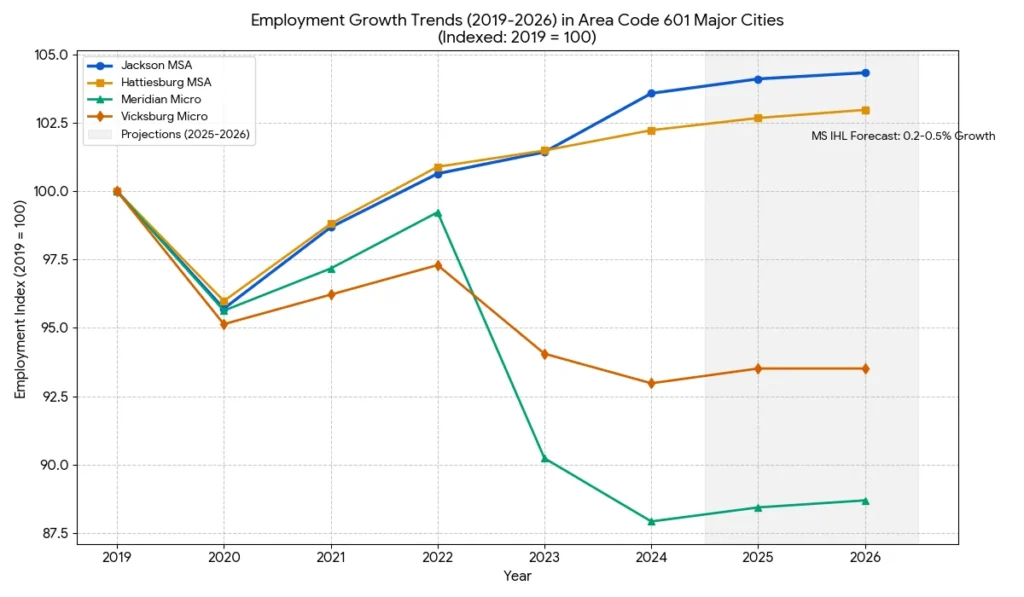
Jackson dominates the economic picture, obviously. State government employs thousands, plus you’ve got the medical center, Jackson State, and a decent financial sector. But here’s what surprised me when I started digging into the data for clients – the real growth stories are happening outside the capital.
Take Hattiesburg. University of Southern Mississippi anchors it, sure. But Camp Shelby brings in military dollars that most people overlook. Then there’s Forrest General Hospital, which serves a massive rural area. Manufacturing’s picked up too – I’ve worked on several plant expansions in the past three years.
Economic Sectors by Employment (Approximate):
| Sector | % of Regional Employment | Key Players |
| Government | 22% | State agencies, municipal, federal |
| Healthcare & Social Services | 18% | UMMC, regional hospitals, clinics |
| Education | 12% | Universities, K-12 districts |
| Manufacturing | 11% | Automotive suppliers, food processing |
| Retail & Hospitality | 15% | Tourism, casinos, shopping centers |
| Transportation & Logistics | 8% | Rail, trucking, river commerce |
| Other Services | 14% | Professional, financial, construction |
What’s fascinating – and this comes from representing both employers and economic development authorities – is how the casino revenue flows through the region. Vicksburg’s riverboat casinos generate serious tax revenue that funds infrastructure projects. Not just local either. Some of that money eventually trickles into state programs that benefit communities hundreds of miles away.
Manufacturing’s the sleeper story though. Auto parts suppliers scattered throughout the region feed the Nissan plant up in Canton (that’s 662 area code, but they share supply chains). Food processing plants in smaller towns like McComb and Brookhaven employ more people than you’d guess from driving through.
Recent Economic Indicators:
- Unemployment consistently below national average.
- Population growth concentrated in Rankin County suburbs.
- Downtown revitalization visible in Hattiesburg, Laurel, Meridian.
- Tourism revenue climbing in Vicksburg, Natchez.
The challenge I see clients facing? Infrastructure. Internet’s spotty outside metro areas. Roads need work. But that’s actually creating opportunities for the right investors, especially with federal infrastructure money starting to flow.
Legal Overview: Development Programs That Actually Matter (And Which Ones Don’t)
Here’s where I see the most confusion among clients. They hear “Mississippi Code § 57-1-601” and assume it covers area code 601. Logical mistake, but completely wrong.
Let me clear this up once and for all.
Mississippi Code § 57-1-601: The Senatobia-Only Program
This statute creates the Mississippi Main Street Investment Grant Fund. Sounds broad, right? It’s not. The law defines “municipality” as specifically “the City of Senatobia, Mississippi.” That’s it. One town. And Senatobia’s up in Tate County – area code 662, nowhere near the 601 region.
I represented a client in Brandon who spent weeks preparing an application under this statute before we caught the geographic restriction. Embarrassing for everyone involved.
Why did Mississippi write such a narrow law? Best guess from talking to legislators – Senatobia had specific historic downtown needs and political support for a targeted solution. The law passed as essentially a earmarked appropriation disguised as general legislation.
Key Legal Framework of § 57-1-601:
- Creates special fund in State Treasury.
- Administered by Mississippi Development Authority (MDA).
- Funds infrastructure, property improvements, signage in designated “revitalization zones”.
- Requires 60% property owner approval for master plans.
- Zone boundaries subject to MDA review and adjustment.
Mississippi Main Street Revitalization Grant Program (MMSRGP): The Real Deal
Now we are talking of something that would be handy to 601 communities. This statewide competitive program was developed when Senate Bill 2696 (2024) was enacted. It was signed by Governor Tate Reeves and the MDA began to issue checks in a few months.
Grant Structure:
- Up to $500,000 per community.
- Requires matching funds (usually 25-50%).
- Priority is given to the so-called shovel-ready projects.
- Must involve designated Main Street communities or qualified nonprofits.
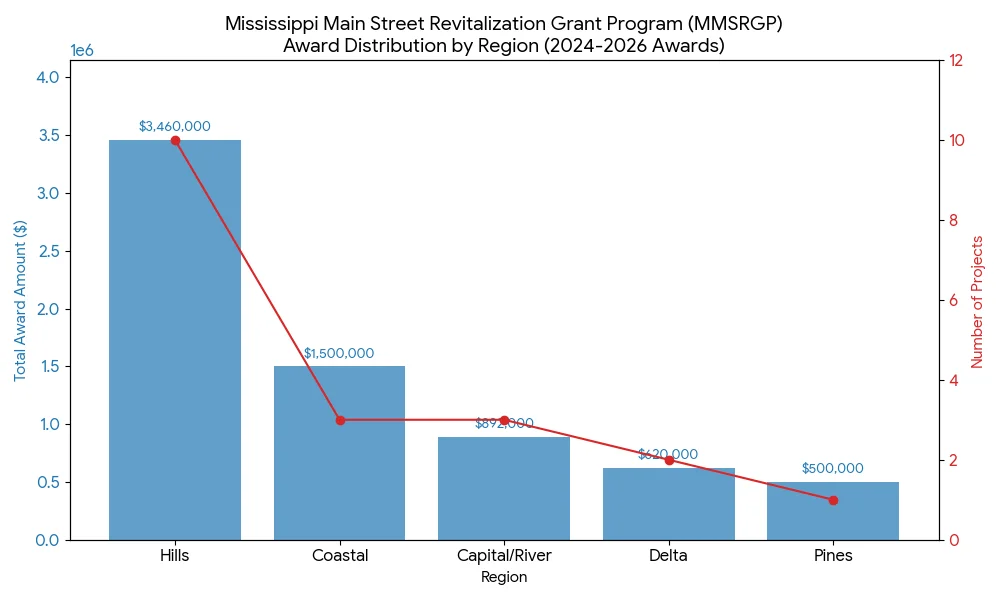
So far I have facilitated three clients in MMSRGP applications. It is a simple process, though the competition is intense. The average is nearly 370,000, but the awards were all over the board as 19 communities divided approximately 7 million in 2024.
Areas: Area Code 601 is eligible to apply:
- MMSA-designated Main Street communities.
- Municipal governments.
- Business improvement districts with 501(c)(3) or 501(c)(6) status.
Application Requirements (From My Experience):
- Detailed project scope with timelines.
- Community impact analysis.
- Matching fund documentation.
- Letters of support from local stakeholders.
- Compliance with state procurement laws.
The legal complexity comes in implementation, not application. State procurement rules apply to grant-funded projects. Environmental reviews may trigger for infrastructure work. And if you’re dealing with historic properties, prepare for additional federal oversight.
Community Development Grants: The Small Money That Adds Up
Mississippi Main Street Association runs these separately from MMSRGP. $2,500 grants for specific improvements – string lights, murals, website updates. Sounds trivial until you realize how much these projects accomplish for downtown aesthetics.
I have witnessed clients rejecting them as too small to count on. That is shortsighted thinking. Application is straightforward, funding is nearly assured assuming that you pass the minimum qualifications and success on this application generates contacts on bigger grants in the future.
Recent Winners in Area Code 601:
- Brandon: website redevelopment.
- Hattiesburg: artistic crosswalk installation.
- Pearl: interactive mural walk.
- Woodville: community garden development.
Real Impacts & Practical Advice for Clients
A customer had a client who was thinking of opening up a restaurant in downtown Laurel and I was with him in my car last month. The same block two years ago was worn out – empty shops, broken pavements, all the little-town blight you can find anywhere. Now? Completely different story.
Laurel grabbed one of those $500,000 MMSRGP grants in 2024. They used it smart – streetscape improvements, facade renovations, new lighting. But here’s the kicker: that half-million in grant money leveraged nearly $2 million in private investment. Property owners started renovating on their own dime once they saw the city was serious.
Success Stories I’ve Witnessed Firsthand
Hattiesburg’s Downtown Transformation: My firm handled the legal work for their MMSRGP application. They focused on infrastructure – boring stuff like water lines and sidewalks. Results? Three new restaurants opened within six months. A boutique hotel started construction. Property values jumped 15% in the core downtown area.
The artistic crosswalk they funded with that smaller grant? Pure genius. Cost maybe $8,000 total, but it shows up in every downtown photo now. Social media marketing you can’t buy.
Pearl’s Mural Walk Project: This one seemed questionable when they first pitched it. Interactive murals scattered through downtown Pearl? My client thought it was “artsy nonsense.” But foot traffic increased 40% along that route. The antique shop that was struggling? Now they’re expanding into the adjacent space.
Brandon’s Digital Investment: Website redevelopment doesn’t sound sexy, but Brandon’s new site includes an interactive business directory with real-time event listings. Local businesses report increased online inquiries. The farmers market that barely drew 20 vendors now has a waiting list.
Grant Impact Data (2024-2026)
| Community | Grant Type | Amount | Leveraged Investment | Measurable Outcomes |
| Hattiesburg | MMSRGP | $500,000 | ~$1.8M private | 3 new restaurants, 15% property value increase |
| Laurel | MMSRGP | $500,000 | ~$2.1M private | 12 facade renovations, 2 new retail businesses |
| Pearl | Community Dev | $2,500 | ~$25,000 private | 40% foot traffic increase on mural route |
| Brandon | Community Dev | $2,500 | ~$15,000 private | 200% increase in business directory usage |
| Woodville | Community Dev | $2,500 | ~$8,000 volunteer labor | Community garden serving 45 families |
What Actually Works (And What Doesn’t)
I’ve reviewed dozens of applications now, successful and failed. Here’s what separates winners from losers:
Winning Strategies:
- Focus on infrastructure first, aesthetics second.
- Document community support with actual signatures, not just letters.
- Include realistic timelines with buffer time for permit delays.
- Partner with existing nonprofits instead of creating new ones.
- Plan for maintenance costs after grant money runs out.
Common Mistakes:
- Underestimating matching fund requirements (cash flow kills projects).
- Ignoring state procurement rules (adds 3-6 months to timelines).
- Proposing projects without proper zoning or permits in place.
- Focusing on single businesses instead of district-wide improvements.
Legal Pitfalls I’ve Seen
Procurement Compliance Issues: Procurement rules are applicable to state grant money means. I have witnessed projects which have been delayed by six months due to incorrect bidders. The regulations are not complicated, yet it is specific. Get a person familiar with them or spend more time to learn.
Proprietor Challenges 60 Percent Master Plan Approval? It’s harder than it sounds. Boundaries of property are challenged. Dead owners make consent procedures difficult. Rental property is a source of confusion regarding who is giving a green light on plans.
A client in McComb paid 5000 dollars to get research on the law, only to determine the titleholder of a key downtown property. The act had not been revised since 1987 and the original family had dispersion in three states.
Federal Tax Complications: Grant money can create unexpected tax obligations. If your project increases property values significantly, local millage rates might trigger reassessments sooner than expected. Plan accordingly.
My Recommendations for Potential Applicants
Start Small: Apply for Community Development Grants first. $2,500 won’t change everything, but success builds credibility for larger applications. Plus you learn the system without major financial risk.
Build Relationships Early: MDA staff know which communities are serious versus those just fishing for easy money. Attend their workshops. Ask questions. Show up to other communities’ ribbon cuttings. This stuff matters when applications are borderline.
Document Everything: Take detailed notes of community meetings, contacts of property owners, costs estimates, permit applications. I have witnessed the postponement of grants due to a failure of the applicants to demonstrate that they have indeed conducted the necessary community outreach.
Plan Beyond the Grant: The most effective projects I have been involved with had sustainability plans during the initial stages. Grant funds can be used to start you off but constant maintenance and programming keeps the improvements pertinent.
Conclusion: What’s Next for Area Code 601 Development
Mississippi’s throwing more money at downtown revitalization than I’ve seen in twenty years of practice. And honestly? It’s working.
The MMSRGP program proved itself in year one. When you can turn $7 million in grants into over $50 million in combined public-private investment, legislators notice. I’m hearing rumors about expanded funding in the next legislative session. Maybe bump those $500,000 caps to $750,000. Possibly create regional partnerships so smaller towns can pool resources for bigger projects.
House Bill 1066 and House Bill 625 from 2026 suggest the legislature’s still tinkering with funding mechanisms. Nothing dramatic, but they’re clearly committed to keeping these programs alive and growing.
What I’m Watching:
- Federal infrastructure money finally trickling down to local projects.
- Broadband expansion creating new development opportunities in rural 601 areas.
- Tourism growth along the Mississippi River corridor.
- Manufacturing reshoring trends that could benefit smaller towns.
Immediate Opportunities for Clients: The 2025 application cycle for MMSRGP opens this spring. Communities that missed the first round now have two years of examples to learn from. Competition will be stiffer, but so will the quality of applications.
Community Development Grants are ongoing. No reason to wait if you’ve got a shovel-ready small project.
For businesses considering expansion into 601 markets, pay attention to which communities are investing in themselves. Hattiesburg, Laurel, and Brandon are obvious choices now. But watch Pearl – they’re making smart moves with limited resources. Meridian’s got potential if they can get their act together on downtown planning.
Last Legal Word: Do not pursue grant money in order to get the money. Such programs are most effective in line with the community-wide development programs. When your downtown is already doing well, perhaps you should concentrate on more of on workforce development or infrastructure than on streetscaping.
And please – check geographic eligibility before spending money on applications. I can’t bill you for explaining that Senatobia isn’t in area code 601.
The 601 region isn’t going to become the next Austin or Nashville. But it doesn’t need to. Small-scale, sustainable growth that builds on existing assets – that’s what these grant programs enable. And that’s exactly what Mississippi communities need right now.