 Michael Simmrin (Criminal Lawyer)
Imagine the scenario, you are walking in a bank parking lot and you happen to find an envelope full of cash containing 5,000 dollars. No one’s around. Do you pocket it or turn it in?
One Connecticut man selected door number one. Three months after, he was being charged with the third degree larceny. That was a real case, which occurred in 2023 and it perfectly demonstrates the operation of the theft laws in Connecticut.
Third-degree larceny can catch you off guard as I’ve experienced in multiple cases as a criminal defense attorney that I defended. Possibly, one of them believed that he or had the right to use company money. Or they felt that they actually had that costly watch. Good intentions are not always of concern to the law.
3rd Degree Larceny Definition What 3rd Degree Larceny Means
Third-degree larceny Connecticut Third-degree larceny occurs in cases of basic larceny (the unlawful taking of another person’s property) and one of the following conditions applies:
- The stolen services or property has a value of over $2,000.
- A government office record was stolen by you.
- You stole trade secrets or proprietary formulas.
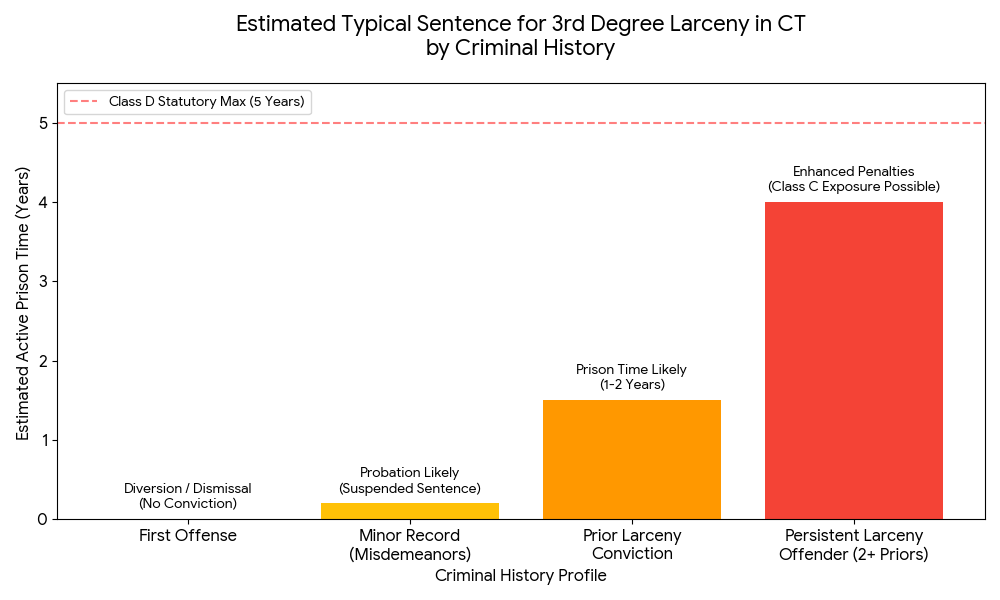
It’s a Class D felony. That entails actual incarceration not a slap on the wrist.
This charge is in the middle of the Connecticut General Statutes, 53a-124 larceny hierarchy. It is worse than taking a candy bar (sixth-degree) and better than taking $50,000 (first-degree).
Introduction to Connecticut Larceny Framework
Connecticut organizes theft crimes by dollar amounts and circumstances. Here’s how it breaks down:
| Larceny Degree | Value Threshold | Classification | Max Prison | Max Fine |
|---|---|---|---|---|
| First Degree | Over $20,000 | Class B Felony | 20 years | $15,000 |
| Second Degree | $10,001-$20,000 | Class C Felony | 10 years | $10,000 |
| Third Degree | $2,001-$10,000 | Class D Felony | 5 years | $5,000 |
| Fourth Degree | $1,001-$2,000 | Class A Misdemeanor | 1 year | $2,000 |
| Fifth Degree | $501-$1,000 | Class B Misdemeanor | 6 months | $1,000 |
| Sixth Degree | Up to $500 | Class C Misdemeanor | 3 months | $500 |
The legislature keeps adjusting these numbers. Back in 1982, the threshold was just $50. They bumped it to $1,000 in the late 80s, then $2,000 in 2009. Inflation, basically.
What’s interesting? In 2022, Connecticut removed all the specific motor vehicle theft provisions from this statute. Used to be that stealing a car worth under $5,000 automatically triggered third-degree charges. Now it’s just about the dollar value like everything else.
The Three Elements Prosecutors Must Prove
Every third-degree larceny case comes down to three things the state has to establish beyond reasonable doubt:
1. Wrongful Taking or Obtaining
This covers a lot of ground. You could physically grab something, trick someone into giving it to you or just refuse to return property that isn’t yours. The basic larceny statute (§ 53a-119) lists about a dozen ways this can happen:
- Classic theft (shoplifting, burglary).
- Embezzlement from your employer.
- Fraud schemes and false promises.
- Keeping lost property without trying to return it.
- Extortion through threats.
- Service theft (skipping out on bills).
- Receiving stolen goods.
2. Intent to Permanently Deprive
Here’s where a lot of cases get won or lost. The state has to show you meant to keep the property forever, not just borrow it.
I’ve had clients charged with stealing company equipment they genuinely thought they could use at home temporarily. Intent matters. A lot.
3. The Third-Degree “Enhancer”
This is what bumps simple larceny up to felony level:
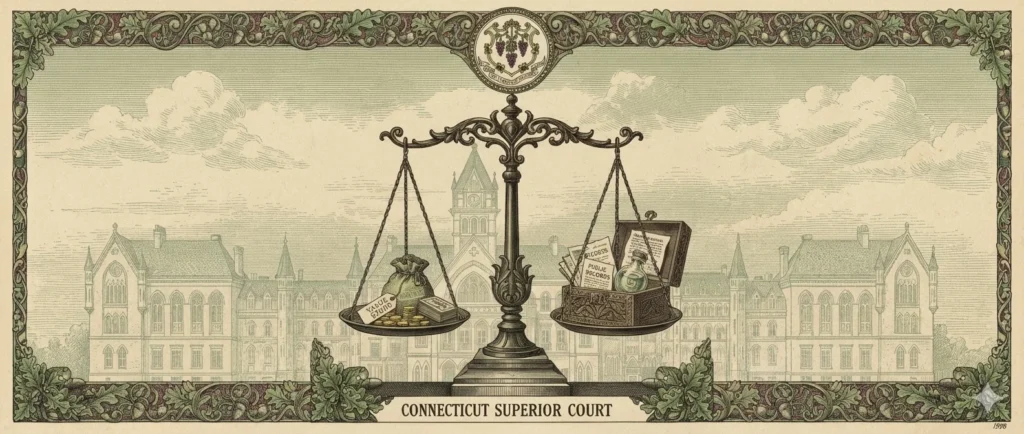
- Value over $2,000: Fair market value, usually. Courts look at receipts, replacement costs, expert appraisals. Multiple smaller thefts can be added together if they’re part of the same scheme.
- Public records: Taking documents from government offices, even if they’re not worth much money.
- Trade secrets: Confidential formulas, processes or technical information that gives someone a competitive advantage. Has to be actually secret – not something available to the public.
Real-World Examples That Led to Charges
I have heard of some real cases which I have heard or I have read about in the news:
The DraftKings Scam (2025): A Danbury man was accused of stealing identities and using them to make counterfeit DraftKings accounts in order to loot more than 190,000. His charges against identity theft and computer crimes coupled with a third degree larceny were only a few.
The Hartford Councilman (2024): One member of the city council was charged with directing shell companies to funnel money from church funds. The larceny count came with money laundering indictments.
The Impounded Car (2024): A person literally took back his impounded car by himself without paying the fines. Was struck with 3 rd larceny and trespass.
These cases show the range. White-collar schemes, public corruption and just plain poor decision-making.
Penalties: What You’re Actually Looking At
Class D felony means:
- Prison: Up to 5 years (minimum 1 year if not suspended).
- Fines: Up to $5,000.
- Probation: Often used instead of or after prison.
- Restitution: Paying back what you stole.
- Community service
- Criminal record: This sticks around unless expunged.
But here’s what happens in practice: First-time offenders often get offered diversion programs. Complete them successfully, charges get dismissed. No conviction on your record.
Civil Consequences Too
Connecticut has this nasty civil statute (§ 52-564) that lets victims sue you for three times the value of what you stole. Win a criminal case? You might still lose big in civil court. That $3,000 TV could cost you $9,000 plus legal fees.
Defense Strategies That Actually Work
Every case is different, but here are the defenses I see succeed:
Lack of Intent
- “I thought it was mine”
- “I planned to return it”
- “I was just borrowing it”
Intent is subjective. Hard to prove what someone was thinking.
Consent
- “The owner said I could take it”
- “I had permission”
Consent can be implied in some situations. Business partners using company assets, for example.
Duress/Necessity
- “Someone threatened me if I didn’t do it”
- “I had to steal food because my family was starving”
These are tough to prove but occasionally work.
Mistaken Identity
- “Wrong person”
- “I wasn’t even there”
Surveillance footage helps. Or hurts, depending on which side you’re on.
Insufficient Evidence
Sometimes the state just can’t prove value exceeded $2,000. Or they can’t establish intent. Challenge everything.
The Court Process: What to Expect
Arrest/Citation → Arraignment → Discovery → Plea Negotiations → Trial (maybe)
Most third-degree larceny cases resolve through plea bargains. Going to trial is expensive and risky for everyone involved.
Arraignment
You get formally charged, enter a plea (usually not guilty), get a lawyer if you don’t have one.
Discovery
Both sides exchange evidence. Police reports, surveillance footage, witness statements.
Plea Negotiations
This is where cases really get decided. Prosecutor offers a deal, your lawyer pushes back, hopefully you get something reasonable.
Pretrial Programs
First-time offenders often qualify for accelerated rehabilitation or other diversions. Complete the program, charges disappear.
Frequently Asked Questions
Q: Can multiple small thefts be combined into one third-degree charge? A: Yes, if they’re part of the same scheme. Stealing $500 from your employer each week for five weeks = $2,500 total = third-degree larceny.
Q: What if I return the property before getting caught? A: Helps with sentencing but doesn’t eliminate the crime. The theft already happened when you took it.
Q: Is there a statute of limitations? A: Five years for felonies like this, starting from when the crime occurred.
Q: What about juvenile offenders? A: Different court system, usually more focused on rehabilitation than punishment.
Q: Can I get this expunged from my record? A: Sometimes. Connecticut has limited expungement options, mostly for cases that were dismissed or where you completed a diversion program.
Practical Tips If You’re Facing Charges
- Shut up. Seriously. Don’t talk to police without a lawyer present. That “just clearing things up” conversation can destroy your case.
- Document everything. Receipts, text messages, emails – anything showing you had permission or believed you had a right to the property.
- Get a lawyer early. The sooner we get involved, the better your chances of a good outcome.
- Consider the civil exposure. Although criminal proceedings are dismissed, you may be sued a lawsuit on treble damages.
- Do not get in contact with the so-called victim. This nearly invariably increases the badness.
Various Scenarios and Top Defenses
| Type of Case | Example | Likely Defense Strategy |
|---|---|---|
| Employee theft | Taking $3,000 of cash register | Claim of right (thought that the competitor had been overpaid) |
| Shoplifting | Stealing electronic equipment worth $2,500 | Lack of intent (thought that money was due to the owner) |
| Found property | Keeping $5,000 found in parking lot | Attempted to locate owner, no way to reimburse |
| Embezzlement | Diverting client funds | Information was not secret / Information was no longer secret |
Key Takeaways
Larceny of the third category in Connecticut is a big business. It is a felony, which can sentence you to some five years of jail time, with a permanent mark on your record.
But it’s also defendable. Intent matters. Value matters. The circumstances matter.
The legislation amended more recently – in 2022 they simplified it by eliminating certain provisions of the motor vehicles. It is now narrowed down to value exceeding 2,000, public records or trade secrets.
In case you are being charged, you should not panic and at the same time you should not wait. Hire qualified legal services that are familiar with the laws of theft in Connecticut. The earlier you begin to establish your defense, the higher the probabilities of ensuring that this has not been recorded in your records.