 Adriana Campos ( Colorado )
If you are 50% or more at fault for a car accident in Colorado, you recover nothing. Not reduced compensation. Nothing. Under C.R.S. § 13-21-111, Colorado runs a modified comparative negligence system with what lawyers call the “50% bar.” Below that line you can still collect, but your payout shrinks by whatever percentage of fault lands on you. At the line or above it, the claim dies.
That one-percentage-point gap between 49% and 50% is where insurance companies focus most of their energy.
The Math on a $100,000 Claim at Different Fault Levels
| Your Fault | Award Before Reduction | Your Recovery |
|---|---|---|
| 0% | $100,000 | $100,000 |
| 10% | $100,000 | $90,000 |
| 25% | $100,000 | $75,000 |
| 40% | $100,000 | $60,000 |
| 49% | $100,000 | $51,000 |
| 50% | $100,000 | $0 |
That last row is the whole game. The jump from 49% to 50% is not a $1,000 reduction. It is a $51,000 loss. The insurance adjuster who pushes your fault from 49% to 50% did not reduce the payout by one percent. They eliminated it.
How Adjusters Push You Past the 50% Line
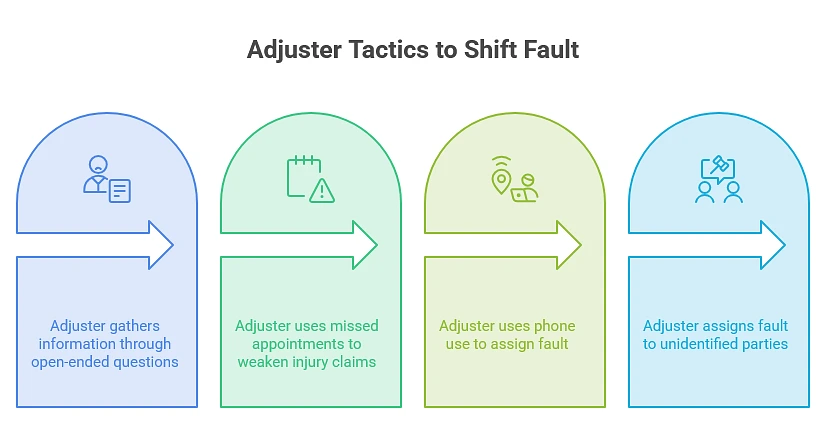
Insurance companies know this rule cold. Their adjusters are trained to find anything that shifts fault toward you, and they do not need to prove you caused the accident. They just need to get your number to 50.
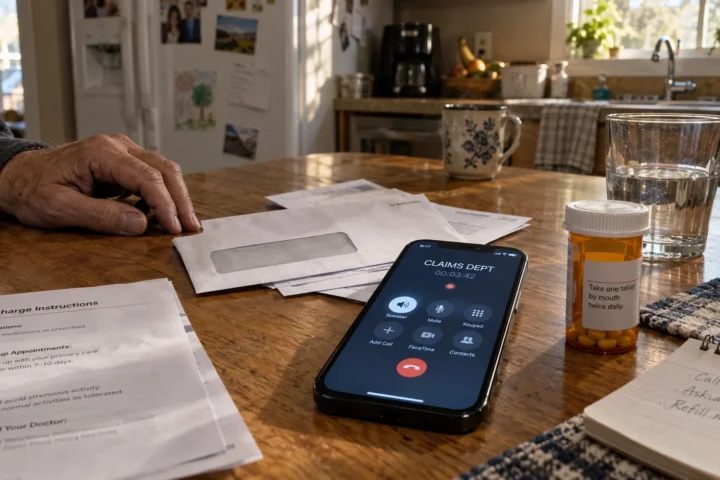
- The recorded statement. The call comes within 48 hours, sometimes sooner. The adjuster sounds helpful. They ask open-ended questions. “Can you walk me through what happened?” “Did you see the other car before impact?” “How fast were you going?” Every answer gets written down and filed. “I didn’t see them” becomes evidence of inattention. “I think I was going about 40” gets compared to the posted limit. You are building their case for them and most people do not realize it until the fault assessment comes back higher than expected.
- Medical treatment gaps. You skip a follow-up appointment because you feel better, or because you cannot get off work, or because the copay is $75 you do not have right now. The adjuster spots that two-week gap and writes it up as “claimant’s injuries were not serious enough to require consistent treatment.” That gap does not just weaken the injury claim. It feeds the fault argument too, because the adjuster ties it to “claimant’s own failure to mitigate damages.”
- The GPS and phone records. If you were using your phone at the time of the crash, even hands-free navigation, the defense will find out. Colorado’s distracted driving laws are strict, and phone use at the time of impact gives the adjuster a concrete behavior to assign fault to. Five percent of fault for checking a GPS notification does not sound like much until it is the five percent that pushes you from 47% to 52%.
- Blaming a nonparty. Colorado law allows defendants to designate nonparties at fault. An unidentified driver who cut someone off and left the scene. A city that failed to maintain a traffic signal. A tire manufacturer whose product blew out. Each percentage point assigned to a nonparty reduces what you collect, and defendants use this aggressively because the nonparty is not in the courtroom to defend themselves.
Scenarios Where Fault Splits Get Ugly
- You got rear-ended but your brake lights were out. The other driver hit you from behind, which is normally a clear liability case. But burned-out brake lights mean the driver behind you had less warning. The adjuster argues 30% on you. Maybe a jury agrees, maybe they put it lower. Either way the conversation shifted from “they hit me” to “we both contributed” and that shift costs real money.
- Left turn at an intersection, both drivers claim the right of way. These are the most contested fault scenarios in Colorado car accident cases. The left-turning driver is usually at fault, but if the oncoming driver was speeding or ran a yellow-turning-red, the split can land anywhere from 70/30 to 50/50. At 50/50 neither side recovers under Colorado law.
- Winter weather crash on I-25. Colorado Springs gets ice. I-25 through the city is a corridor where multi-vehicle pileups happen every winter. The defense argument in these cases almost always includes “driving too fast for conditions,” which is a fault allocation tool even if you were technically under the speed limit. The posted limit is 65 but the road was icy and visibility was poor and you were doing 55, was that reasonable? The adjuster says no. Whether a jury agrees depends entirely on the evidence.
- You were hit while jaywalking. A pedestrian struck by a car outside a crosswalk in Colorado Springs is not automatically barred from recovery. But the fault allocation for crossing outside the designated area can be significant. If the pedestrian was also wearing dark clothing at night, the percentage climbs. If the driver was speeding through a residential area with poor lighting, the percentage tilts back. These cases swing hard depending on the specific facts.
The Three-Year Clock and Why It Matters Less Than You Think
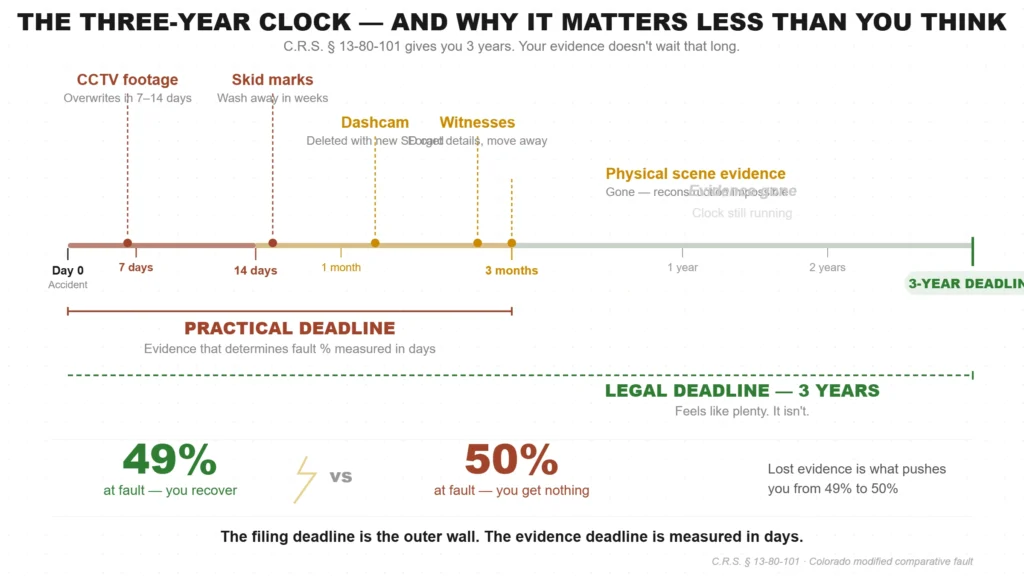
Colorado gives car accident plaintiffs three years to file under C.R.S. § 13-80-101. General personal injury is two years, but motor vehicle accidents get the extra year.
Three years feels like plenty of time. It is not.
Evidence that determines fault percentages degrades fast. The gas station camera that caught the intersection overwrites in 7 to 14 days. Skid marks wash away. Witnesses forget details or move. The other driver’s dashcam footage gets deleted when they buy a new card. The accident reconstruction specialist who could have mapped the point of impact needs physical evidence that may not exist three months from now.
The filing deadline is the outer wall. The practical deadline for preserving the evidence that determines whether you land at 49% or 50% is measured in days.
What Determines Your Fault Percentage
Who decides? If the case settles, the parties negotiate based on evidence and what a jury would likely do. If it goes to trial, the jury assigns percentages under the court’s instructions based on C.R.S. § 13-21-111.
A few things people get wrong about this:
- A traffic citation does not automatically establish fault. Getting a ticket at the scene is evidence, but it is not a binding fault determination for purposes of a civil claim. An officer’s decision to cite one driver does not prevent a jury from assigning a different fault split.
- The police report is not the final word either. Adjusters rely heavily on police reports, but officers arrive after the crash, not during it. Their report reflects what they were told and what they observed at the scene. It does not capture everything and it can be challenged with contradicting evidence.
- Fault is not always split between two parties. Colorado allows multiple defendants and nonparties to share fault. In a three-car pileup, the jury can assign 40% to Driver A, 35% to Driver B, and 25% to Driver C. Each driver’s recovery is then calculated against their own percentage. If Driver C is suing and holds 25% fault, they can recover 75% of their damages from the other two combined.
Getting help with a personal injury case in Colorado Springs starts with understanding where you fall on that fault percentage, because everything else follows from it. The difference between 45% and 55% on a $200,000 claim is not $20,000. It is $110,000 versus zero. Evidence that moves your number five points in either direction is worth more than most people realize when they are still dealing with the hospital bills and the wrecked car and the insurance company calling every other day.
Colorado’s rule is not unfair. It just does not leave room for being close.
References
- Colorado Revised Statutes § 13-21-111 (Modified comparative negligence, 50% bar rule).
- Colorado Revised Statutes § 13-80-101 (Statute of limitations, three years for motor vehicle accidents, two years for general personal injury).
- Keating Wagner Polidori Free, “Understanding Colorado’s Negligence Law” (May 2025).
- Durango Injury Lawyers, “Colorado Comparative Negligence: Can You Still Recover If You’re Partly at Fault?” (May 2025).
- Fuicelli & Lee, “How Colorado’s Modified Comparative Negligence Laws Affect Your Injury Claim” (November 2025).
- Born & McCaffrey Injury Law, “Colorado 50% Bar Rule in Denver Car Crashes” (November 2025).