 Marc Mackenzie ( Probate Lawyer )
Here’s the part that surprises most people: if you die without a will in Alberta, your spouse does not automatically get everything. Whether they do comes down to one question the law cares about far more than you’d expect are all your kids also your spouse’s kids?
That single detail can redirect a big chunk of your estate away from the person you’d have wanted to have it. So before you keep putting this off, it’s worth knowing exactly what the province does with your money when you leave no instructions.
The Quick Version, By Family Situation
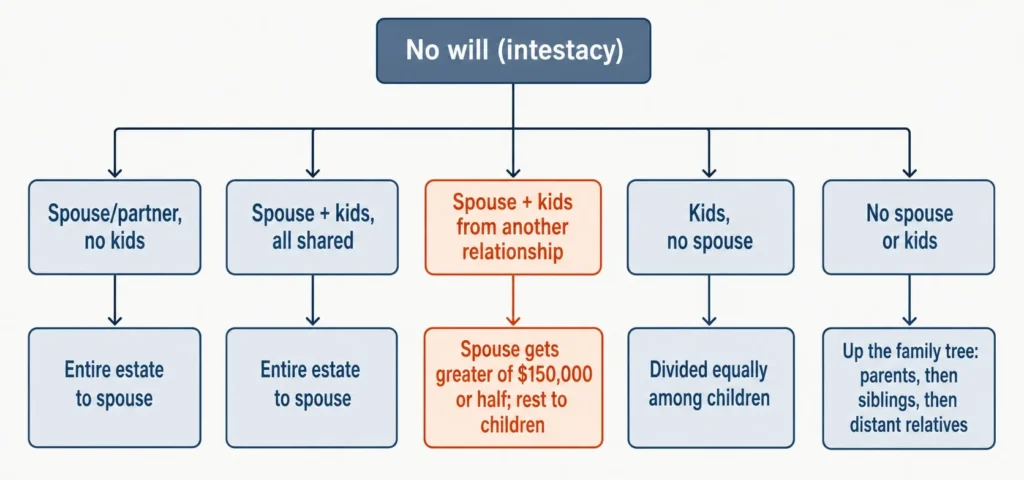
When there’s no will, Alberta’s Wills and Succession Act takes over and runs a fixed formula. Instead of your preferences guiding the process, provincial law determines who gets what, how much, and when. Roughly, it breaks down like this:
- Spouse or adult interdependent partner, no kids — the whole estate goes to your spouse or partner. Simple.
- Spouse plus kids, and every child is also your spouse’s child — still the whole estate to the spouse. The Act presumes you’d have wanted everything to go to your spouse, trusting them to look after the children.
- Spouse plus kids from another relationship — this is where it splits. Your spouse or partner receives a preferential share of $150,000 or one-half of the net estate, whichever is greater, and the rest passes to your children.
- Kids, no spouse or partner — divided equally among your children.
- No spouse, partner, or kids — it climbs the family tree: parents, then siblings, then more distant relatives.
That third scenario is the one that catches people, so it’s worth slowing down on.
The Blended-family Trap
Say you’re in a second marriage. You’ve got a child from your first. Your new spouse assumes that if something happens to you, they’re taken care of — that’s what spouses are for, right?
Not quite. Picture an estate worth two hundred thousand dollars, a surviving spouse and one child from a previous relationship. Under the Act, the spouse receives $150,000 and the child receives the remaining $50,000. Now shrink the estate. If most of your worth is tied up in a house valued at, say, a hundred and forty thousand in equity, the preferential share can swallow nearly the whole thing before your child sees a cent or force a sale to divide it. Stretch the estate the other way, past the three-hundred-thousand mark, and the “one-half” figure kicks in instead of the flat amount, pulling a larger slice toward the spouse. The formula doesn’t know your family. It just runs.
And this is the thing the intestacy rules can never account for. They don’t know that you promised the lake property to your daughter, or that your stepchildren are yours in every way that matters but not on paper. Stepchildren you never formally adopted inherit nothing under intestacy — the formula only sees biological and adopted descendants.

Common-law Counts, Ex-spouses Might Not
Alberta treats adult interdependent partners — the province’s term for common-law partners — much like married spouses for intestacy. If you die intestate leaving a common-law partner and an adult, financially independent child you had together, that partner receives your whole estate. A lot of people assume common-law partners are shut out. In Alberta, they’re not.
The flip side catches the separated. If you’re legally married but haven’t made a will, a separation of two years or more automatically disinherits your spouse — as does a court declaration of irreconcilability or a finalized split. So the person you’ve been apart from for three years could still be your spouse on paper while inheriting nothing, and you may have no idea where that leaves the rest of your estate. Because you never said.
What The Formula Can Never Do
There’s a longer list of things a will does that intestacy simply can’t touch, and it’s worth seeing them together:
- Name a guardian for your minor children. Die without a will and there’s no default guardian — a court decides, family members may end up in conflict applying and the process is slow at the worst possible time.
- Leave anything to a friend, a charity, or a non-relative. Intestacy laws don’t accommodate special bequests, so those wishes evaporate.
- Choose who administers the estate. With no named executor, someone has to apply to court to be appointed administrator — more delay, more cost, more room for disputes.
- Handle a business. If you’re a sole owner, the lack of a succession plan can freeze operations and leave partners without direction.
One more quiet detail worth knowing: your spouse or partner has the right to stay in the family home for ninety days after your death, at the estate’s expense, whether it’s owned, co-owned, or rented. A small mercy the Act builds in — but a narrow one.
The Fix Is Boring And That’s The Point
None of this is exotic. A valid will replaces the entire formula with your actual wishes — your split, your guardian, your executor, your stepkids included if you want them included. That’s the whole difference between a plan and a default.
Because the blended-family and preferential-share rules are where things get genuinely technical, this is worth doing properly rather than off a template. An Estate Planning Lawyer in St. Albert can map your specific family structure onto Alberta’s rules and draft around the gaps the formula would otherwise leave — the stepchild who inherits nothing, the ex who technically still counts, the house that can’t be split without being sold.
The intestacy rules aren’t malicious. They’re just generic, and your family isn’t. That mismatch is the entire reason to write the will.