 Aarthy Venkat Head - Strategy at SignDesk
As of June 2026, the Nintendo–Pocketpair case is still very much alive in Tokyo, but it has drifted so far from where it began that the people watching it most closely now expect Nintendo to walk away with almost nothing.
Summary
Nintendo and The Pokémon Company sued Palworld developer Pocketpair back in September 2024 — over patents, notably, not over the Pokémon-ish art everyone fixated on. Two years later the game has been quietly re-engineered to sidestep the disputed mechanic, Nintendo’s patents are taking damage in both Japan and the United States and the Tokyo District Court is finally set to weigh the evidence this autumn.
Key Takeaways
- This is a patent dispute, not a copyright one — the “Pokémon with guns” resemblance was never the legal hook.
- The entire fight lives in Tokyo; there is no parallel U.S. lawsuit to track.
- Nintendo narrowed it’s claims in late 2025 to aim only at older, pre-patch versions of Palworld.
- A U.S. patent examiner rejected all 26 claims of Nintendo’s “summoning” patent as obvious.
- The Tokyo court hears evidence on October 1, 2026, with an opinion expected November 9.
Where the Case Actually Stands Right Now
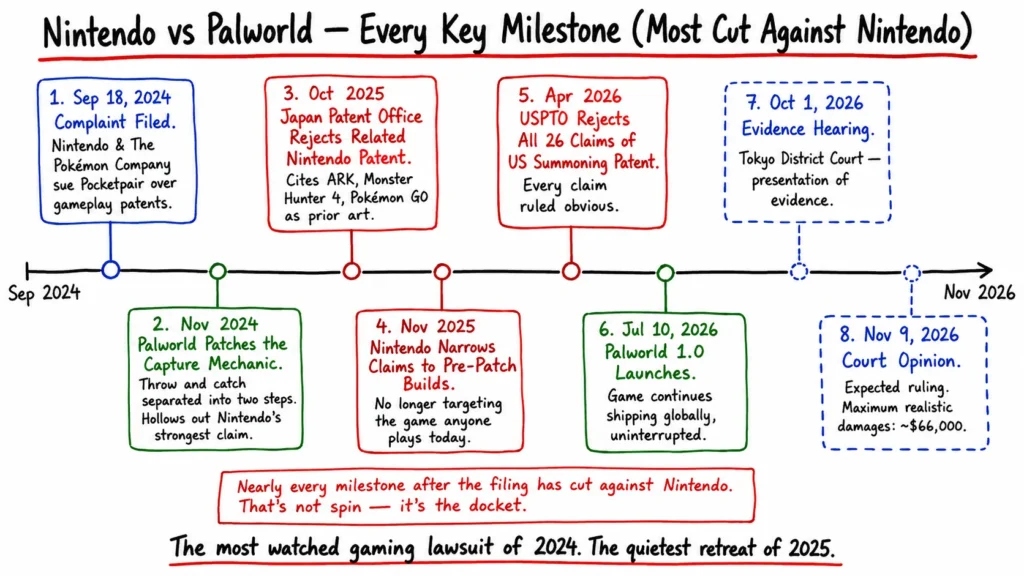
Let me start with the part everyone gets wrong, because the coverage has been all over the map — some outlets declaring Nintendo victorious, others insisting the whole thing quietly settled months ago. Neither is true. As I write this in June 2026, there’s no ruling, no settlement and no winner. What there finally is, though, is a date. The parties have wrapped up their pleadings and evidence and the Tokyo District Court has scheduled a presentation of evidence for October 1, with it’s opinion to follow on November 9, 2026. So we’re close — close enough that the next real chapter is a few months out rather than years.
And the mood heading into that hearing is what makes this an interesting update rather than a dull docket note. The analysts who’ve actually combed the court record think Nintendo’s realistic best case is now small — a token damages figure, possibly around $30,000, with no real route to pulling Palworld off PC or consoles. For a company that filed seeking an injunction against a global phenomenon, that’s a remarkable climbdown and it’s worth understanding how Nintendo got here.
Why This Was Always a Patent Fight, Never a Copyright One
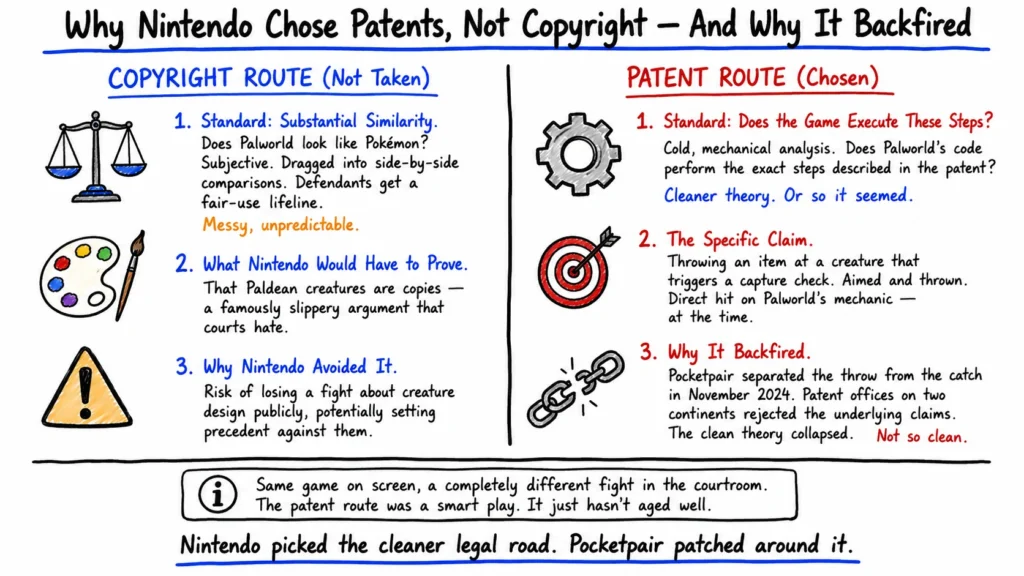
Here’s the piece that trips up even sharp observers. Palworld got tagged early as “Pokémon with guns,” and that nickname quietly rewired how people read the lawsuit — everyone assumed Nintendo was suing over creatures that look suspiciously familiar. It wasn’t. The complaint deliberately steered clear of character likeness and went after gameplay patents instead and that single choice tells you almost everything about the strategy.
Think about what a copyright suit would have forced Nintendo to argue: that Palworld’s monsters are “substantially similar” to Pokémon, a famously slippery standard that drags courts into subjective side-by-sides and hands defendants a fair-use lifeline. Patents let Nintendo skip all of it. Instead of “does this look like ours,” the question turns colder and more mechanical — does Palworld carry out the precise steps we patented, like aiming and throwing an item to trigger a capture check. Same game on screen, a far more clinical fight in the courtroom and on paper a much cleaner road to an injunction. It was a smart play. It just hasn’t aged well.
The Quiet Patch That Changed Everything
Two months after the complaint landed, Pocketpair did something quietly brilliant. In November 2024 it shipped a patch that rebuilt the capture mechanic: instead of the player hurling a Pal Sphere directly at a wild creature to catch it, the throw now simply makes one of your own Pals appear beside you, with the actual capture moved to a separate step. On screen, you’d barely register the difference. In legal terms, it may have hollowed out Nintendo’s strongest claim.
The reason sits in the patent language itself. The capture patent describes throwing an item that results in possession of the creature — so by prying the throw apart from the catch, Pocketpair handed itself a genuine argument that the current game no longer practices the patented method at all. And Nintendo seems to know it, because by late 2025 the company had narrowed it’s claims to target only older versions of Palworld — the builds from before the patch. When a plaintiff retreats to suing over a version of the product almost nobody still runs, that isn’t the posture of a side that believes it’s winning.
The Patents Themselves are Starting to Crack
Even a flawless infringement argument collapses if the patents behind it don’t hold and in 2026 Nintendo’s began buckling on two continents at once. In the United States — where Nintendo had been quietly stockpiling patents to potentially open a second front — an examiner re-examined it’s marquee “summoning” patent and rejected all 26 of it’s claims as obvious, knocking back the exact mechanic the company leaned on hardest. Japan sent the same signal closer to home: the patent office rejected a related Nintendo application for lacking originality and the prior art it cited is almost embarrassing — ARK: Survival Evolved, Monster Hunter 4, Kantai Collection, Pocketpair’s own Craftopia, even Pokémon GO. When examiners can rattle off a half-dozen earlier games doing roughly what you claim you invented, the “we pioneered this” story gets very hard to tell.
What a Win Without Teeth Would Look Like
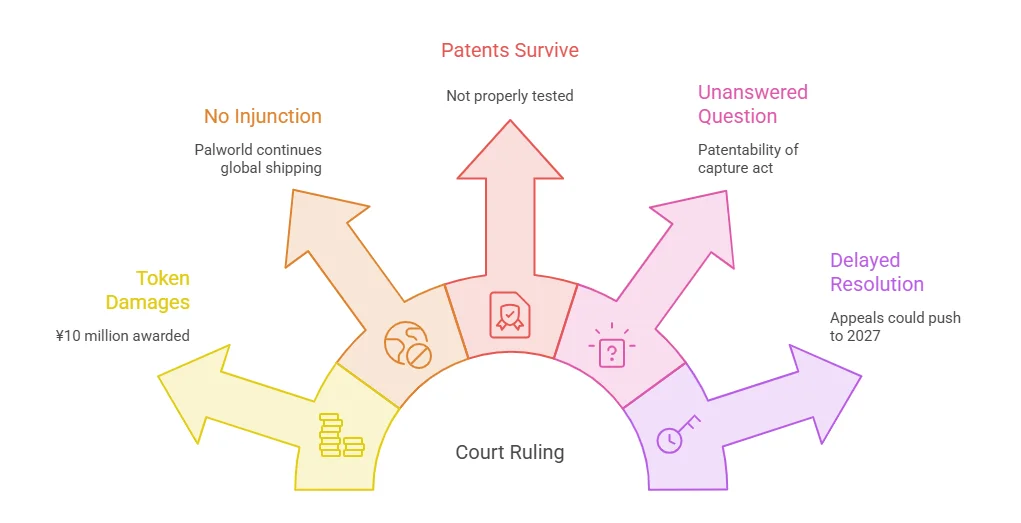
So picture Nintendo’s likeliest remaining path: the Tokyo court rules this November that the original Palworld build infringed the capture patent and orders Pocketpair to pay. Even then — what does Nintendo actually win? A modest sum, with the figures being floated landing near ¥10 million, roughly $66,000, pinned to a version of the game nobody’s run since 2024 and no injunction reaching the Palworld people download today. Damages without an injunction is a familiar patent outcome, but here it’s a symbolic figure and little else.
There’s a subtler problem the whole industry is left holding, too. A narrow ruling on old code won’t settle the question developers actually care about — whether you can patent the basic act of throwing an object to catch a creature in 3D space. Nintendo’s leverage survives without ever being properly tested; the patents end up neither blessed nor struck down and everyone else just keeps guessing.
What to Watch From Here
The calendar is short. October 1 brings the presentation of evidence and November 9 is when the court signals where it’s landing. Even that won’t be the final word — whoever loses can appeal to the IP High Court, which could push a true resolution into 2027. But after two years as gaming’s loudest legal cliffhanger, November is when the suspense finally breaks.
And the lesson is already half-written: a company can hold the deepest legal war chest in the business and still discover that a generic-feeling mechanic is far harder to fence off than it looks. Pocketpair didn’t out-lawyer Nintendo so much as out-patch it, then let the patent offices handle the rest — though it’s worth remembering that not every studio has tens of millions of players to bankroll that kind of fight.