 Michael Simmrin (Criminal Lawyer)
In Phoenix, sex crime allegations are dealt with very seriously by the courts of the area; they affect not only your reputation and social relations but also your personal freedom. If you or someone you care about is up against such charges, offering a strong defense to the case is of utmost importance in order to receive either an easy trial and successfully use the legal system as protection. This article discusses the law and procedures applicable to sexual assault cases under Arizona law, the defenses commonly asserted by lawyers, and how an experienced team of attorneys can help you in your time of need.
The Legal Framework of Sex Crimes in Arizona
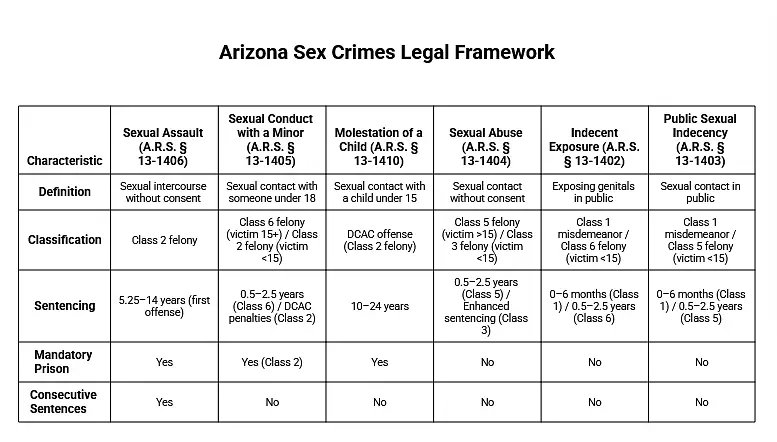
Arizona Revised Statutes Title 13, Chapter 14, defines six primary sexual offenses. Each carries its own classification, sentencing range, and registration requirements. Understanding where your charge falls within this framework is the first step toward building a defense.
Sexual Assault (A.R.S. § 13-1406) is what most people would commonly consider rape — intentionally or knowingly engaging in sexual intercourse or oral sexual contact without consent. It is classified as a Class 2 felony with its own sentencing range that is harsher than the standard Class 2 grid. First-time offenders face a minimum of 5.25 years in prison, a presumptive sentence of 7 years, and a maximum of 14 years. With one prior felony, the range jumps to 7–21 years. With two priors, 14–28 years.
A conviction under A.R.S. § 13-1406 carries mandatory prison time — no suspension of sentence, no probation, no pardon, and no release until the sentence is fully served. And all sexual assault sentences must be served consecutively (stacked) with any other sexual assault sentence, meaning multiple counts don’t run at the same time.
Sexual Conduct with a Minor (A.R.S. § 13-1405) covers sexual intercourse or oral sexual contact with anyone under 18. If the victim is at least 15, it is a Class 6 felony. If the victim is under 15, the charge escalates to a Class 2 felony punishable under the Dangerous Crimes Against Children (DCAC) statute — A.R.S. § 13-705 — which imposes significantly harsher penalties.
Molestation of a Child (A.R.S. § 13-1410) involves sexual contact with a child under 15. As a DCAC offense, first-time offenders face 10–24 years in prison with no early release.
Sexual Abuse (A.R.S. § 13-1404) involves intentional or knowing sexual contact without consent. Sexual abuse of a victim over 15 is a Class 5 felony (0.5–2.5 years for first offenders). Sexual abuse of a victim under 15 is a Class 3 felony with enhanced sentencing.
Indecent Exposure (A.R.S. § 13-1402) is a Class 1 misdemeanor unless the victim is under 15, in which case it becomes a Class 6 felony.
Public Sexual Indecency (A.R.S. § 13-1403) is a Class 1 misdemeanor, escalating to a Class 5 felony if the victim is under 15.
Because of the way evidence, police procedure and legal definitions all vary depending on which statute applies — these cases are often very complex. Having familiarity with all of your defenses accordingly is why knowing what applies to your specific situation is so important.
Dangerous Crimes Against Children: Arizona’s Most Severe Sentencing
If the victim is under 15 years of age, charges for sexual assault, sexual conduct with a minor, molestation, and sexual abuse are automatically classified as Dangerous Crimes Against Children under A.R.S. § 13-705. The sentencing consequences are dramatic.
For sexual assault or sexual conduct with a minor aged 12, 13, or 14, the sentencing range is 13–27 years (presumptive 20 years). If the victim is under 12, the sentence is life imprisonment with no eligibility for release until at least 35 years have been served.
DCAC sentences require the defendant to serve 100% of the prison term — no earned release credits, no 85% rule, no early release of any kind. If convicted on multiple counts, all sentences must be served consecutively. Two counts of a DCAC offense with a 20-year presumptive each means 40 years. Three counts means 60.
Arizona law allows for prosecution of individuals as young as 14 in the adult criminal system for DCAC offenses. These are not charges limited to adults victimizing children — a 15-year-old charged under A.R.S. § 13-1405 with a victim under 15 faces the same DCAC sentencing framework.
Common Defense Strategies Under Arizona Law
- Challenging the Evidence
Any assessment begins with scrutiny of the prosecution’s evidence. Lawyers pay attention to police reports, witness statements, and physical evidence for inconsistencies or procedural errors. If evidence was obtained through an illegal manner — such as a search conducted without a warrant in violation of the Fourth Amendment — it may be excluded under the exclusionary rule. Arizona’s own state constitution, Article 2, Section 8, provides additional search-and-seizure protections that defense attorneys can invoke.
- Consent
Under A.R.S. § 13-1406, the prosecution must prove beyond a reasonable doubt that the sexual intercourse or oral sexual contact occurred without consent. Consent is an affirmative defense — the defendant argues that the alleged acts were consensual and the accuser’s account is inaccurate. This defense can be supported by text messages, communications between the parties, witness testimony, or other evidence demonstrating the nature of the relationship before and after the alleged incident.
Note that consent is not a valid defense under A.R.S. § 13-1405 if the victim is under 15 — the law does not recognize consent for minors below that age in sexual conduct cases.
- The Conduct Did Not Meet the Statutory Definition
Arizona law defines “sexual intercourse” and “oral sexual contact” with precise statutory language under A.R.S. § 13-1401. Sexual intercourse means “penetration into the penis, vulva, or anus by any part of the body or by any object, or masturbatory contact with the penis or vulva.” If the alleged conduct — even if inappropriate — did not meet this specific definition, it may not constitute sexual assault under § 13-1406. It could constitute a lesser offense like sexual abuse under § 13-1404, which carries significantly lower penalties.
- False Accusation
False accusations of sexual assault are a recognized defense in Arizona courts. Motivations for false reporting can include jealousy, custody disputes, revenge, or regret after a consensual encounter. Defense attorneys may introduce exculpatory evidence including communications showing the relationship was consensual, testimony from witnesses that contradicts the accuser’s timeline, physical evidence such as video recordings placing the defendant elsewhere, or inconsistencies in the accuser’s account across multiple statements.
- Questioning Witness Credibility
Most sex crime cases rely heavily on the testimony of witnesses or statements made by the alleged victim. Impeaching a witness by demonstrating motives to lie, inconsistencies between their statements to police and their testimony at trial, or cognitive biases that may have influenced their recollection can significantly weaken the prosecution’s case. If a witness’s version of events is deemed not credible, it can change everything about the outcome.
- Addressing Police Procedures and Constitutional Violations
If officers failed to respect protected rights during the investigation — conducting searches without warrants, obtaining coerced confessions, failing to provide Miranda warnings before custodial interrogation, or using improper forensic procedures — this may be grounds for suppressing evidence or dismissing charges entirely. Arizona courts apply both the federal exclusionary rule and the state constitutional protections under Article 2, Section 8.
Sex Offender Registration in Arizona
A conviction under A.R.S. § 13-1406 (sexual assault), § 13-1405 (sexual conduct with a minor), or § 13-1410 (molestation of a child) carries mandatory lifetime sex offender registration in Arizona. For sexual abuse under § 13-1404, registration is mandatory if the victim is under 18; if the victim is 18 or older, the sentencing judge has discretion on whether to impose registration.
Registration means being listed on Arizona’s public sex offender registry. It restricts where a registrant can live, limits contact with minors (including, in many cases, the defendant’s own children), and affects employment and housing opportunities for the rest of the registrant’s life.
In addition to registration, convictions for felony sexual offenses under Chapter 14 expose a defendant to lifetime probation under A.R.S. § 13-902(E). If placed on probation (for those offenses where probation is possible), that probation may last for the remainder of the defendant’s natural life.
The stakes in these cases extend far beyond prison time. Registration and lifetime probation follow a person permanently.
In Phoenix, legal professionals offer comprehensive defense services, often under the banner of Phoenix sex crimes defense by Suzuki Law, which is renowned for its expertise. Their team works to protect clients’ rights and seek the most favorable outcomes, whether through pre-trial motions to suppress evidence, negotiated plea agreements to lesser charges, or full trial defense.
Selecting the right defense attorney involves evaluating experience, reputation, and familiarity with local courts and laws. Websites like Martindale list reputable law firms specializing in sex crime defense in the Phoenix area.