 James Mcleod NZ (AU NZ Immigration Lawyer)
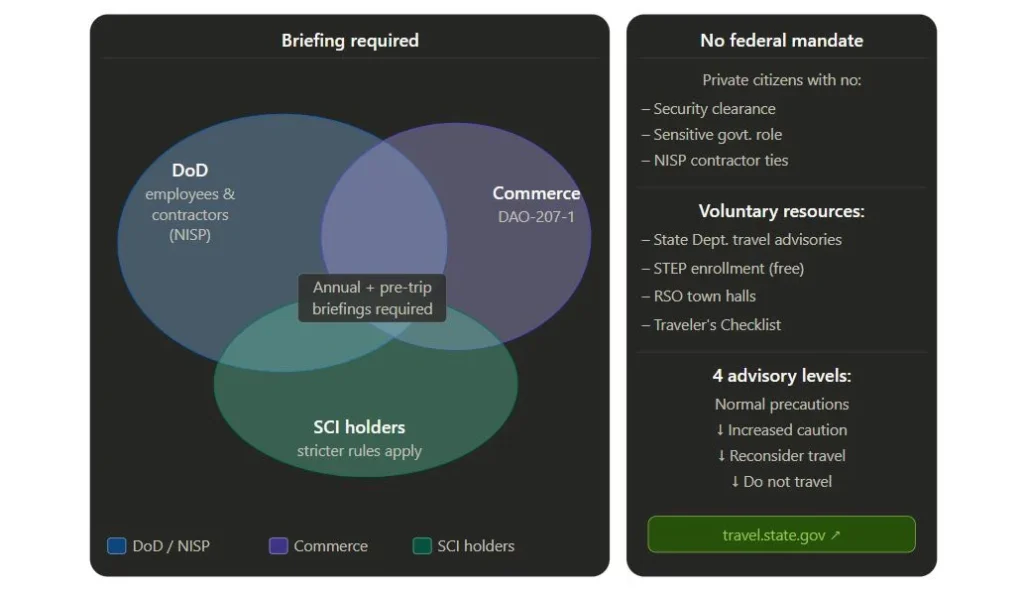
If you hold a security clearance or work in a sensitive government or contractor role, you’re required to complete a defensive foreign travel briefing at least once a year and before every international trip — personal or official. If you’re a regular U.S. citizen with no clearance? No federal mandate. The State Department has free tools for you, but nobody’s checking.
What a Defensive Foreign Travel Briefing Actually Is?
It’s not a travel safety pamphlet. That’s the first thing worth clearing up.
These are formal counterintelligence and security awareness sessions — run by government agencies or Facility Security Officers — specifically designed to protect cleared personnel and sensitive information from foreign intelligence entities (FIEs), espionage operations, terrorism and criminal targeting during international travel. The National Counterintelligence and Security Center (NCSC) and Center for Development of Security Excellence (CDSE) are the primary bodies behind the content frameworks.
The threat model here is specific. FIEs don’t just target intelligence officers — they target program managers, engineers, procurement staff, researchers. Anyone with access to information that’s worth stealing. A “chance” conversation at a hotel bar in Beijing isn’t always chance. These briefings teach you to recognize what that looks like.
Delivery varies by agency and situation — in-person sessions, CDSE eLearning modules at cdse.edu, video briefings or signed acknowledgment forms. Format matters less than completion and documentation.
Who’s Actually Required to Attend
Short answer: not everyone. But the net is wider than people assume.
Mandatory for:
- All DoD employees, contractors and subcontractors under the National Industrial Security Program (NISP), governed by 32 CFR Part 117.
- Security clearance holders — Secret, Top Secret or SCI and anyone in a “sensitive position” as defined by SEAD 3.
- Department of Commerce employees with access to or eligibility for Classified National Security Information (CNSI), including temps, summer hires and contractors — under DAO-207-1.
- SCI-access holders, who face stricter requirements on top of standard clearance rules.
Not mandatory for:
- Private U.S. citizens without clearances or sensitive roles.
- General federal employees outside sensitive positions.
- Tourists, business travelers, expats with no government or contractor ties.
One thing that catches people off guard: the requirement applies to personal trips too. A vacation to Europe still triggers reporting and potentially a pre-travel briefing if you hold a clearance. FIEs don’t distinguish between your work trip and your anniversary cruise.
The Frequency Requirements: Annual Plus Pre-Trip — Not One or the Other
This is the piece most people get wrong. They think completing an annual briefing covers them. It doesn’t — not entirely.
The requirement has two distinct components:
1. Annual (Recurring) Briefing
At minimum once every 12 months, regardless of travel plans. The purpose is staying current — FIE tactics evolve, threat assessments update and cleared personnel need a baseline refresher even in years they don’t travel internationally. DoD components fold this into annual security awareness training cycles. Commerce mandates it under DAO-207-1.
2. Pre-Travel Briefing (Event-Driven)
Before each foreign trip — official or personal — covered personnel typically need a destination-specific session from their security office or FSO. High-risk destinations trigger mandatory advance briefings and sometimes pre-approval requirements:
- China
- Russia
- Iran
- North Korea
- Cuba
- Venezuela
You’re not filing paperwork after landing. Pre-approval for travel to these countries is required in many agencies before you book the flight.
3. Post-Travel Debriefing (Conditional)
Required when:
- Trip duration exceeds 90 days.
- Any suspicious contact or incident occurred abroad.
- Something felt anomalous — you’re expected to report, not self-assess whether it matters.
Emergency travel has a grace period — post-reporting within approximately five days is generally acceptable. That’s a narrow exception, not a standard operating procedure.
Agency-Specific Rules: What Your Organization Actually Requires
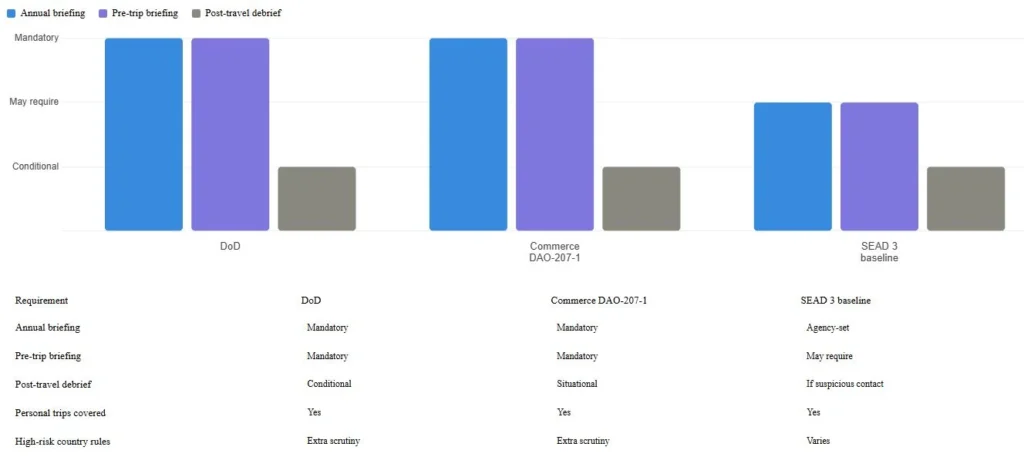
SEAD 3 sets the DNI-level baseline — foreign travel reporting is mandatory and agencies may require CI briefings pre-travel. The word “may” does a lot of heavy lifting there. In practice, the agencies implementing SEAD 3 have closed that gap with their own directives.
Here’s how the major frameworks compare:
| Agency / Framework | Who It Covers | Annual Requirement | Pre-Trip Requirement | Post-Travel Debrief |
| SEAD 3 | All cleared personnel, sensitive positions | Agency-determined | Agency-determined | Required if suspicious contact |
| 32 CFR Part 117 (NISPOM) | Cleared contractors under NISP | Yes | Yes | Yes, where applicable |
| Commerce DAO-207-1 | CNSI-eligible employees + contractors | Yes — explicitly mandated | Yes | Situational |
| DoD Directives | DoD employees, SCI holders | Yes — tied to AT/FP Level 1 training | Yes — country clearances often required | Yes — 90+ day trips or incidents |
SCI holders operate under a stricter layer on top of whatever base framework applies to them. More detailed pre-travel approval processes, more granular reporting, sometimes more frequent briefing cycles. If you hold SCI access and you’re uncertain about your exact obligations — that conversation needs to happen with your security officer directly, not sourced from a blog post.
Frequent travelers should also know: the annual briefing doesn’t absorb the pre-trip requirement. What typically happens in practice is the annual session covers general FIE tactics and reporting obligations, while each trip gets a shorter destination-specific add-on from the FSO. Some contractors with very high international travel frequency work out aggregated reporting arrangements — but that’s agency-specific. Ask your FSO. Don’t assume.
What the Briefings Actually Cover
Worth knowing before you go in, because these sessions are more operationally specific than people expect. Content is drawn from CDSE frameworks and NCSC guidance — it’s not generic travel safety material.
Core topics typically include:
- FIE targeting methods — elicitation techniques, surveillance patterns, how “chance” social encounters abroad are sometimes orchestrated, indicators that you’re being assessed.
- Information and device security – no classified information on personal devices; there are loaner devices, which are not without purpose; what to do in case of a lost, stolen or tampered device.
- Individual security measures – hotel, room security, transport, keeping a low profile, not showing signs of belonging to sensitive programs.
- Local laws and customs,- this is a point that is worth consideration. Being arrested in a foreign country on what would be legal in the home country is not a theoretical issue but a fact.
- Gift and package policies – accepting gifts and packages by foreign nationals, particularly those in high risk countries poses security and occasionally legal risks.
- The contacts of the U.S. Embassy and Regional Security Officers (RSOs) – whom to call, how to get in touch, what they can actually do.
- Reporting obligations — what constitutes a reportable contact, how to file post-travel reports, timelines.
Briefings are delivered through in-person sessions, CDSE eLearning modules, video formats or signed PDF acknowledgment forms depending on your agency. CDSE modules are also accessible through usalearning.gov for many covered personnel.
Resources for Private U.S. Citizens
No clearance, no sensitive role — here’s what applies to you. And it’s genuinely useful, not bureaucratic filler.
Travel Advisories — Four levels updated regularly by the State Department:
- Level 1 — Exercise Normal Precautions
- Level 2 — Exercise Increased Caution
- Level 3 — Reconsider Travel
- Level 4 — Do Not Travel
This should be checked prior to booking, not a day before you leave. Other warnings are evanescent.
Smart Traveler Enrollment Program (STEP) -Free, 5-minutes, links you to the closest U.S. Embassy in case of any mishaps abroad. You also receive destination specific alerts sent to your email. It is really not necessary to not enroll prior to any international visit.
Your Passport to a Safe Trip Abroad — A State Department resource on crime, scams, safety in lodging, health crisis and response to detention. Practical, not bureaucratic. Available at travel.state.gov.
Regional Security Officer (RSO) Town Halls — At certain U.S. embassies, security briefs nation-specific. Value adding to the trip in case you are traveling to a high-risk area. Enquire with the appropriate embassy.
Other pre-departure briefings are occasionally provided by private employers and travel insurers – some are of higher quality, others lower, but it is worth requesting them to tell you whether you are going somewhere complex or not.
What Happens If You Don’t Comply
For cleared personnel, skipping these briefings isn’t a paperwork issue. The consequences are real and career-affecting.
Non-compliance can trigger:
- Security clearance check or suspension — foreign travel reports are not treated lightly by adjudicators. Unreported foreign travels, particularly to developing countries with high risks, are great alarm bells during periodic re-investigations.
- Cancellation of contract– in the case of cleared contractors, a revoked clearance will terminate the contract. No permission, no entry, no employment.
- Employment consequences — federal employees in sensitive positions face similar exposure; security violations are documented and follow you
- Legal exposure in serious cases — straightforward non-compliance rarely becomes criminal, but failure to report suspicious foreign contacts — especially repeated failure — is a different matter entirely
The Defense Counterintelligence and Security Agency (DCSA) tracks compliance for contractors under NISP. Your FSO is responsible for ensuring covered personnel complete required briefings and that records are maintained. If your FSO is asking you to complete a pre-travel briefing before your trip to Germany, that request has regulatory teeth behind it.
One thing worth knowing: clearance adjudication is holistic. A single missed briefing probably won’t end a career. A pattern of disregarding reporting requirements — foreign contacts not disclosed, trips not reported, briefings skipped — that’s what becomes a problem during a Periodic Reinvestigation (PR) or Continuous Evaluation (CE) review.
Practical Tips for Staying Compliant
A few things that make this easier in practice:
For cleared personnel and contractors:
- Know your FSO. They’re your first call for everything — pre-travel approval, briefing scheduling, reporting suspicious contacts post-trip. Don’t wait until the week before you leave.
- Complete CDSE modules early. The CI Foreign Travel Brief eLearning is free and accessible. Knock it out at the start of each year rather than scrambling before a trip.
- Document everything. Completed briefings, signed forms, post-travel reports — keep copies. Security records get audited.
- Report on the low end. If you’re unsure whether a foreign contact is reportable, report it. The cost of over-reporting is zero. The cost of under-reporting can be significant.
- High-risk country travel needs lead time. Don’t book a flight to China and notify your security office the next day. Pre-approval processes at many agencies take weeks.
For private U.S. citizens:
- Enroll in STEP before every international trip — not just high-risk ones.
- Check the Travel Advisory level for your destination and any transit countries.
- Make digital and physical copies of your passport, travel insurance and emergency contacts — store them separately from the originals.
- Know the address and phone number of the nearest U.S. Embassy or Consulate before you need it.
Key Takeaways
- Cleared personnel, DoD employees and cleared contractors: Annual briefing required — plus a pre-trip briefing before every international trip, personal or official.
- High-risk country travel (China, Russia, Iran, North Korea, Cuba, Venezuela): Mandatory advance briefing, pre-approval often required — plan ahead.
- Post-travel debriefs: Triggered by 90+ day trips or any suspicious contact abroad — not optional when the conditions are met.
- SCI holders: Stricter requirements apply on top of standard clearance rules — consult your security officer directly.
- Private U.S. citizens: No federal mandate, but State Department tools at travel.state.gov are free, practical and worth using — especially STEP enrollment.
- Non-compliance for cleared personnel can mean clearance review or revocation — the consequences scale with the pattern, not a single incident.
- Your FSO is your primary resource — for scheduling, pre-approval, reporting and anything that doesn’t fit a clean category.
Disclaimer: This article is intended to inform and educate on general purposes only. It is not legal advice and there is no attorney-client relationship. The requirements can greatly depend on the agency, level of clearance, contractor agreement and individual requirements. Rules and official guidelines are not permanent. In the event that your case requires certain clearances, NISP requirements or agency-based travel regulations, use the services of a competent attorney or an appointed security officer within your organization to provide advice based on your specific situation.