 Danielle R. Farahi (From California)
Medi-Cal Can Claim Your Parent’s House After They Die and Most California Families Have No Idea Until the Letter Shows Up
Your parent spent three years in a nursing facility. Medi-Cal covered it because they qualified. The monthly cost ran somewhere around eight to twelve thousand dollars depending on the level of care and over three years that quietly stacked up to roughly $300,000, sometimes more depending on the facility and the services involved.
Your parent dies. You are expecting to inherit the house.
A letter shows up from the Department of Health Care Services. They are filing a claim against the estate. The house you grew up in, the one your parent always said would go to you, that is what DHCS is coming after because the state paid for years of care and now they want the money back.
This catches families completely off guard but it is not unusual. It is the normal operation of Medi-Cal Estate Recovery under Welfare and Institutions Code § 14009.5. Federal law under 42 U.S.C. § 1396p(b) requires every state to attempt recovery for nursing facility services and home and community-based services provided to Medicaid recipients age 55 and older. California complies by going after the probate estates of deceased beneficiaries.
That word probate is carrying everything here and if you understand nothing else from this article, understand this one thing.
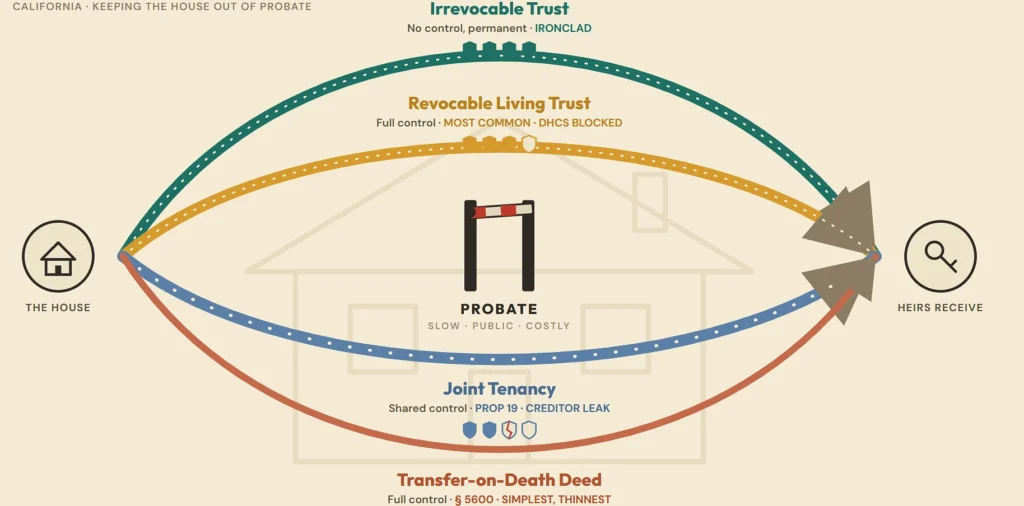
I will also explain this image later below with help of another illustration.
DHCS Can Only Reach What Goes Through Probate
SB 833 changed California’s recovery rules effective January 1, 2017. Before that the state went after a broader range of assets. After SB 833, recovery got narrowed down exclusively to assets subject to probate that the deceased beneficiary owned at death.
So hang on, if the house never enters probate, DHCS gets nothing from it?
That is exactly right. A house sitting in a revocable trust bypasses probate. A house held in joint tenancy with right of survivorship passes automatically to the surviving owner. A house with a transfer-on-death deed recorded on it goes straight to the named beneficiary. None of those paths touch probate and DHCS cannot file a claim against any of them.
A house named in a will though, that goes through probate. A house with no estate plan at all, probate. Anything that lands in the probate estate is reachable and DHCS files against it.
The entire difference between keeping the family home and losing it to a state recovery claim comes down to whether somebody set up the right structure while the parent was still alive. I asked Lars Kushner from Kushner Legal about this because his firm handles California trust and estate work and he said families come to him constantly assuming their parent’s will protects the house. It does not. A will is a set of instructions that gets executed through probate, which is exactly where DHCS files its claim. The will delivers the house into the system that takes it away.
There Is a Transfer Window Open Right Now That Closes December 31, 2025
This is the part most families do not know about and it is time-sensitive.
California killed the Medi-Cal asset test on January 1, 2024 under AB 133. People could qualify regardless of how much they owned, the old $2,000 individual limit was gone. Then AB 116, signed in 2025, created a protection window. Asset transfers made between January 1, 2024 and December 31, 2025 are permanently shielded. Gifts to children, transfers into irrevocable trusts, conversions to non-countable assets, all of it. Counties cannot review or penalise these transfers for eligibility purposes and because the recovery claim only attaches to probate assets, anything that left the beneficiary’s name during this window is permanently outside the recovery framework.
DHCS All County Welfare Directors Letter 25-18 confirms it.
A family home transferred to an adult child’s name in 2024, no Medi-Cal recovery exposure. An outright cash gift during 2025, same thing. These transfers are permanently protected and nobody can unwind them after the fact.
After December 31, 2025 nobody knows what happens. The legislature has not acted on what comes next. Maybe they extend the window. Maybe they do not. Families sitting on assets that could be transferred now are running out of runway to do it under the current protection.
Some Families Are Already Protected Without Doing Anything
Surviving spouse or registered domestic partner. DHCS will not file any claim while the spouse is alive. And even after the surviving spouse dies later, the recovery claim is permanently waived under SB 833. Not deferred, waived, gone, regardless of when the original Medi-Cal recipient died.
Minor child under 21. DHCS cannot pursue recovery. Period.
Blind or disabled child of any age. Same protection, no age limit on it.
Homestead-of-modest-value. Under 22 CCR § 50963 if the home is worth 50% or less of the average home price in the county at the date of death the hardship waiver may kick in automatically. In expensive counties even a modest house can fall under that threshold.
Sibling with equity interest who lived in the home. If a sibling of the deceased has an ownership stake in the property and lived there for at least a year before the beneficiary entered the nursing facility and continues living there, the house is protected.
The Specific Tools That Keep the House Out of Probate
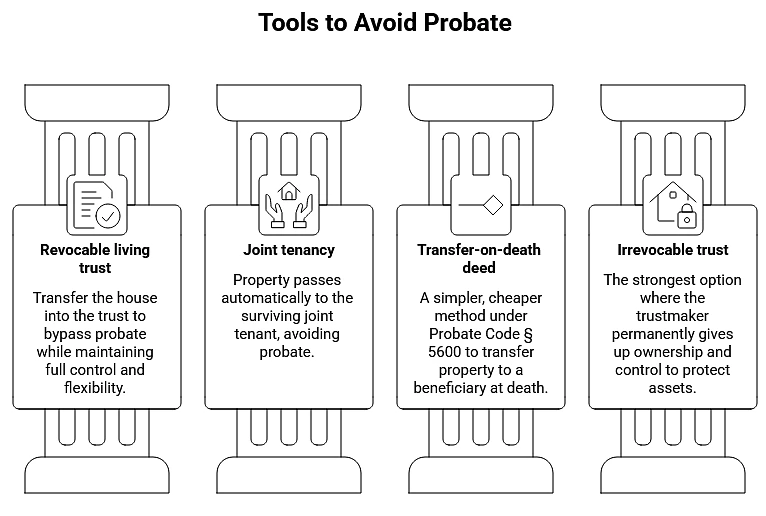
A revocable living trust is the most common approach in California. Transfer the house into the trust and it bypasses probate when the trustmaker dies. You keep full control during your lifetime, you can change the terms, you can revoke it entirely if circumstances shift. DHCS cannot reach it because it never enters the probate estate.
Joint tenancy with right of survivorship passes the property automatically to the surviving joint tenant. No probate. But it comes with a catch, the child’s own creditors can reach their ownership interest while the parent is still alive and adding someone to title can trigger a property tax reassessment unless the parent-child exclusion under Proposition 19 applies and the child uses the property as their primary residence.
A transfer-on-death deed under Probate Code § 5600 is simpler and cheaper than a trust. The property transfers to the named beneficiary at death without probate. Less flexible though, and it does not provide the broader protections a trust offers against other types of creditor issues.
An irrevocable trust is the strongest option and the one that requires the most commitment. The trustmaker gives up ownership and control permanently. Assets inside an irrevocable trust are not part of the estate for any purpose, not probate, not creditors, not recovery. The tradeoff is exactly what it sounds like, you cannot take it back.
The 90 Days After Death and the 60-Day Hardship Window
When a Medi-Cal beneficiary dies, whoever is handling the estate has to notify DHCS within 90 days. Death certificate included. This goes to the Estate Recovery Program in Sacramento and it is not optional, California law requires it.
DHCS reviews and if they decide to pursue recovery they send a claim letter with an itemised statement of what they are trying to recover. Tucked inside that letter is Form DHCS 6195, the hardship waiver application.
Families get 60 days from the date on the claim letter to submit the waiver. Miss that and the option closes. DHCS can reduce or waive the claim entirely if paying it would cause substantial hardship but the determination is case by case and discretionary.
The Voluntary Lien When the Family Wants to Keep the House
If the estate cannot pay the DHCS claim right away but the family does not want to sell, DHCS sometimes offers a voluntary post-death lien agreement. The lien attaches to the property and accrues interest. Gets satisfied whenever the house eventually sells or transfers to someone who is not exempt.
This is not a pre-death TEFRA lien. California has the authority to file those but has not used it since SB 833 took effect. The voluntary post-death lien is the only version families run into.
Whether signing a lien agreement makes sense depends on how long the family plans to hold the property and whether the interest accumulation eats into whatever equity they are trying to preserve. Sometimes it buys time. Sometimes it just delays a loss.
Every One of These Tools Stops Working the Day Your Parent Dies
The trust transfers and the joint tenancy additions and the TOD deeds and the AB 116 window transfers, all of it requires the Medi-Cal beneficiary to be alive and have the legal capacity to sign documents and make decisions about their property. After death the probate estate is fixed and DHCS files against whatever landed in it.
A family that walks into a lawyer’s office after the parent has already died and the DHCS claim letter has already arrived is down to two options. The hardship waiver and the voluntary lien. That is it. Everything else closed when the death occurred.
And the AB 116 window adds its own deadline because transfers made after December 31, 2025 might not carry the same permanent protection. Nobody knows yet what the legislature does next and waiting to find out is a gamble with the family home sitting in the middle of it. I spoke with Lars Kushner from Kushner Legal about this and he said he is happy to talk with anyone who has questions about how this applies to their family’s situation, no charge for the initial conversation. If you have a parent on Medi-Cal in California who owns a house or other assets and you have not looked at how those assets are titled, that conversation probably needs to happen before the window closes, not after. More about how their firm approaches estate planning for California families on their site.
References
- Welfare and Institutions Code § 14009.5. California Medi-Cal estate recovery authority.
- 42 U.S.C. § 1396p(b). Federal Medicaid estate recovery requirement, nursing facility and HCBS services, age 55+.
- SB 833, effective January 1, 2017. Recovery limited to probate assets only. Spousal protection permanently waives claim.
- AB 133 (2021). Eliminated Medi-Cal asset test effective January 1, 2024.
- AB 116 (Stats. 2025, Ch. 21). Transfers January 1, 2024 through December 31, 2025 permanently shielded. DHCS ACWDL 25-18.
- 22 CCR § 50960-50966. California Medi-Cal estate recovery regulations.
- 22 CCR § 50963. Homestead-of-modest-value hardship waiver.
- California Probate Code § 5600. Revocable transfer-on-death deed.
- CANHR, “California’s Medi-Cal Recovery Program FAQ” (February 2026).
- DHCS Estate Recovery Program, dhcs.ca.gov/services/estate-recovery-program.
- Brevy Care, “Will Medi-Cal Take Your House?” (May 2026). AB 116 transfer window analysis.