 John Veale Solicitor
Britain’s Divorce System Lets You Do It Alone – Then Punishes You for Trying
Since April 2022, ending a marriage in England and Wales has been technically simpler than it’s ever been. The Divorce, Dissolution and Separation Act 2020 brought in no-fault divorce, scrapped the old blame-based grounds, and let couples apply online through GOV.UK for a flat £612 court fee. Nearly 80% of divorce applications in 2024 were filed online, and a growing chunk of those came through without any legal representation at all.
So the system says you can do this yourself and plenty of people believe it because the application genuinely is straightforward – you fill in the form, state the marriage has broken down irretrievably, pay your fee, wait 20 weeks for the conditional order, then another 6 weeks for the final order. Done. Marriage over.
Except it isn’t, and this is where the system gets dishonest with people. Because the divorce application only ends the marriage on paper. It does absolutely nothing about the house, the savings, the pensions, the children, or the fact that your ex-spouse can come back years later with a financial claim you thought was settled but never actually was because nobody told you about consent orders.
That gap between what the system promises and what it actually delivers is why most people still end up needing divorce solicitors even when the government portal makes the paperwork look like something you could sort over a cup of tea.
The Application Is Simple but Everything Around It Isn’t
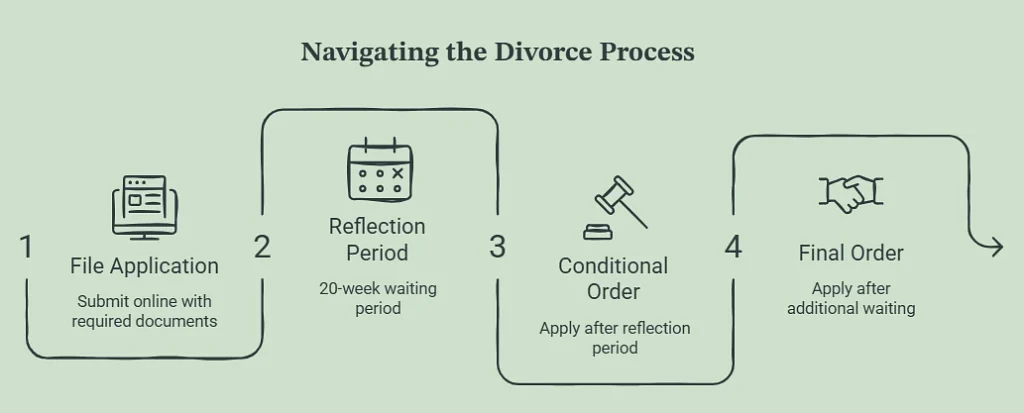
The divorce itself follows a clear enough timeline and the government has done a decent job of making the steps accessible:
- File the application online (sole or joint) with your marriage certificate and spouse’s details.
- 20-week reflection period starts from the date the court issues it.
- Apply for conditional order (used to be called decree nisi) after those 20 weeks pass.
- Wait 6 more weeks, then apply for the final order (formerly decree absolute).
Minimum seven months start to finish assuming nothing goes wrong, which for the application itself is manageable. The average time from application to conditional order was 37 weeks in 2024 according to Ministry of Justice figures, so realistically you’re looking at closer to nine or ten months.
But the application is just the frame. Everything that actually matters in a divorce – who keeps the house, how pensions get split, what happens with the children, whether spousal maintenance applies – sits outside that frame entirely and the online portal doesn’t handle any of it.
Financial Claims Don’t Die When the Marriage Does
This is the part that catches people out badly and it deserves its own space because the consequences are genuinely serious.
Does a final order automatically end your ex’s financial claims? No. And most people assume it does because the marriage is legally over so why would anything still be hanging. But under English divorce law, financial claims survive the final order unless they’re formally dismissed by a court through what’s called a consent order or a financial remedy order.
What that means in practice is this – you could get divorced, go your separate ways, build your career, buy a new property, accumulate savings over the next five or ten years, and your ex-spouse could come back and make a financial claim against you because there was never a binding court order that settled things between you. The marriage ended but the financial ties didn’t because nobody cut them properly.
A consent order costs an additional £313 in court fees on top of the divorce application, and getting one drafted typically requires a solicitor because the court needs to see that the agreement is fair before it’ll stamp it. Going without one to save money in the short term is the kind of decision that can cost tens of thousands later, and the frustrating thing is that the system doesn’t make this obvious at the point where people are making the choice to go it alone.
Assets, Property, and the Pension Nobody Mentioned
Dividing what a couple owns sounds like it should be the most straightforward part – work out what’s there, split it, move on. In practice it’s one of the most fought-over areas of family law because the court doesn’t just look at who paid for what, it considers the needs of both parties, the welfare of any children, earning capacity going forward, and contributions that weren’t financial like raising the family or keeping the household running.
For marriages that lasted a long time the courts tend to apply what’s sometimes called the yardstick of equality, so roughly a 50/50 split of marital assets regardless of who earned what during the marriage. Shorter marriages get treated differently and pre-marital assets sometimes stay with whoever brought them in, but none of this is automatic and nothing about it follows a fixed formula you can calculate at home.
Then there’s pensions, which people consistently undervalue or forget about entirely. A pension can be worth more than the house in plenty of marriages, and pension sharing orders have their own set of rules and actuarial calculations that aren’t exactly kitchen table maths. Getting the split wrong – or not splitting at all because nobody raised it – can mean walking away from what might be your largest financial asset without realising it.
A good lawyer can tell you exactly where you stand on all of this before any negotiation starts, and more importantly they can tell you what you’re entitled to claim that you might not know exists. People routinely leave money on the table in divorce settlements because they didn’t know what questions to ask.
Children, Custody, and What the Court Actually Looks At
England and Wales don’t technically use the word “custody” anymore – the correct term is child arrangements, and it covers where the children live, how much time they spend with each parent, and who makes decisions about their education, health, and religious upbringing.
Most parents sort this out between themselves and never need a court order, which is genuinely how it should work when both people are being reasonable. But “reasonable” is a word that does a lot of heavy lifting during a divorce, and when emotions run high and one parent starts using contact time as leverage or making unilateral decisions about schools and holidays, the informal arrangement falls apart fast.
Can you apply for a child arrangements order without a solicitor? Technically yes, and you’re expected to attend a Mediation Information and Assessment Meeting (MIAM) before the court will even accept your application unless there are safeguarding concerns. But family court proceedings involve case management hearings, welfare reports from Cafcass, position statements, and potentially a contested final hearing where you’re cross-examining your ex-partner’s witnesses. Doing that without legal support is possible in the same way that fitting your own boiler is possible – the law doesn’t stop you, but the risks of getting it wrong are significant and the consequences land on the people who can least afford them.
The Emotional Cost of Running Your Own Divorce
Solicitor fees are the reason most people consider going alone in the first place, and that’s completely understandable. Divorce costs anywhere from £1,000 to £3,000 for a straightforward uncontested split with basic legal support, and if things get complicated – contested finances, court applications for child arrangements, pension actuarial reports – the bills climb towards £10,000 or more depending on how long it drags.
But there’s a different kind of cost that people don’t account for until they’re in the middle of it. Handling your own divorce means you’re the one reading every document, responding to every court deadline, negotiating directly with someone you’re in the process of separating from, and trying to make rational long-term decisions about money and children while you’re emotionally at your worst. The mental load of that is enormous and it doesn’t show up on any fee estimate.
Having someone else manage the correspondence, draft the responses, push back on unreasonable demands, and keep the process moving forward on schedule – that’s not a luxury, it’s protection against the version of yourself that’s too exhausted and upset to fight for what you actually deserve. Every difficult email you don’t have to write, every phone call you don’t have to make, every deadline you don’t have to track – that’s headspace you get back for your children, your work, your health, for actually processing what’s happening instead of just administering it.
What a Solicitor Does That the Gov.uk Portal Cannot
The portal handles the divorce application. A solicitor handles everything the application doesn’t touch:
- Full financial disclosure – identifying assets, debts, pensions, business interests, and anything a spouse might be trying to hide or undervalue.
- Consent orders – drafting a legally binding agreement that settles financial claims permanently and prevents either party from coming back years later.
- Pension sharing orders – working with actuaries to split pension assets fairly, which involves calculations most people can’t do themselves.
- Child arrangements – advising on what the court considers when deciding residence and contact, and representing you if mediation breaks down and court proceedings become necessary.
- Negotiation – speaking to your ex-spouse’s solicitor so you don’t have to have conversations that start about the children and end about the kitchen extension.
None of that appears on the GOV.UK application page. The system gives you a clean front door and doesn’t mention the twenty rooms behind it that still need sorting.
Britain Built a System That Looks Accessible and Isn’t
The no-fault reform was genuinely good legislation. Removing blame, allowing joint applications, simplifying the language – all of it reduced conflict and made the process less hostile for families going through something already painful enough. About 100,000 divorce applications move through the courts in England and Wales every year and the average processing time is coming down.
But the gap between the divorce application and the divorce settlement is where people get hurt, and the system doesn’t do nearly enough to warn them. You can find legal guidance online, you can download templates, you can watch YouTube videos about consent orders – but none of that replaces someone who’s handled hundreds of these cases looking at your specific situation and telling you what you’re missing, what you’re entitled to, and what’s going to cause problems in three years if you don’t deal with it now.
The application says you can do it yourself. The law says you can do it yourself. The maths says most people probably shouldn’t.
References
- Divorce, Dissolution and Separation Act 2020. UK Legislation.
- GOV.UK, “Get a Divorce: Step by Step.” GOV.UK.
- Ministry of Justice, Family Court Statistics Quarterly (2024).
- Divorce-Online, “No Fault Divorce UK: The New Divorce Law Explained” (April 2026). Divorce-Online.
- Setfords Solicitors, “Divorce in England and Wales: Your Complete Guide” (June 2026). Setfords.
- Cocks Lloyd Solicitors, “How to Get a Divorce in England and Wales in 2025.” Cocks Lloyd.