 Mohammad Ahsan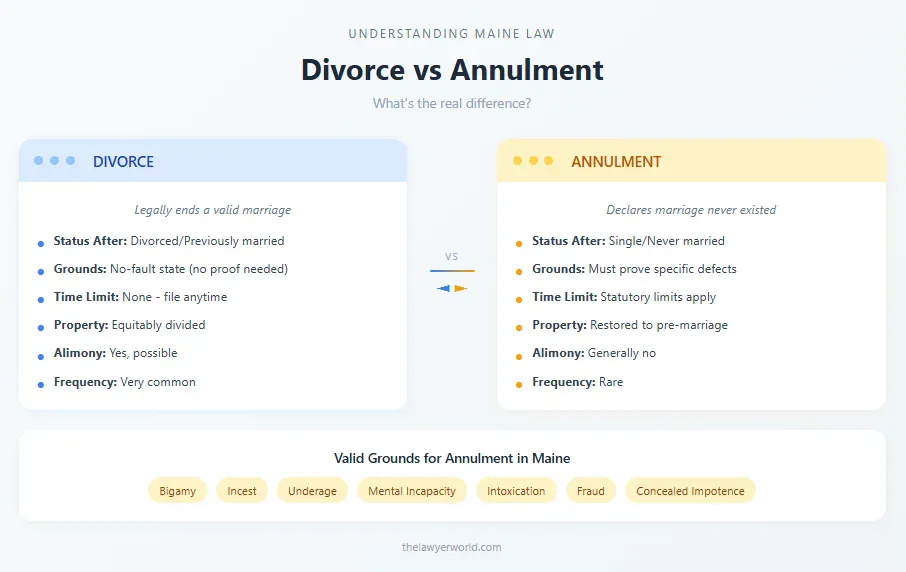
What Divorce Actually Means Under Maine Law
Divorce is the legal ending of a marriage that is considered as legal by the state law. The two are single at the end of the process, but the law acknowledges the fact that they were married. The affair had happened, had reckoned and was over.
The state of Maine is regarded as a no-fault divorce state and this is the reason as to why you need not prove that your spouse did anything wrong to divorce him or her. Inevitable grounds are irreconcilable differences the marriage is simply not working any more. It is simpler compared to the states which require proving adultery, abandonment or abuse but they can be used in case they are applicable to your case.
The actual effect is that any individual in Maine can proceed with divorce at any time he/she feels that the marriage is no more viable regardless of the length of marriage and the reasons to why they decide to divorce.
Maine Law What Annulment Really Means
The annulment is not a divorce of a marriage, but a declaration that renders the marriage null, or that that marriage should not have been there at all. The distinction is greater than it would seem. When you are annulled, then you are not a divorced person, you are somebody who was never married in the first place.
This is not what it means to pretend that the relationship is not occurring and forget. The legal effect has been that even the marriage contract was defective in the beginning due to the terms it contained which did not permit valid consent in the marriage or that the marriage was not legal as per the Maine rules.
The annulment, being a literal rewriting of the history of legal relationships and not necessarily putting an end to an existing one, is a concept that requires special reasons in order to be granted by the courts. You cannot get out of a marriage because you are regretting it or because things had gone wrong.
Side-by-Side Comparison
| Factor | Divorce | Annulment |
|---|---|---|
| Legal effect | Ends a valid marriage | Declares marriage never legally existed |
| Your status after | Divorced/previously married | Single/never married to that person |
| Grounds required | None in Maine (no-fault state) | Must prove specific legal grounds |
| Time limits | None—can file anytime | Statutory limits based on grounds |
| Asset division | Marital property divided equitably | Generally simpler, no marital property concept |
| Alimony possible | Yes | Generally no |
| Children’s legitimacy | Children are legitimate | Children remain legitimate despite void marriage |
| How common | Very common | Rare |
Grounds for Annulment in Maine
Maine courts will only grant an annulment if you can prove one of several specific conditions existed at the time of the marriage. These are not situations where the marriage went wrong over time—they are circumstances where something was fundamentally defective about the marriage from day one.
- Bigamy — One spouse was already legally married to someone else when the ceremony took place. The second marriage was never valid because the legal capacity to marry did not exist.
- Incest — The spouses are too closely related by blood for legal marriage under Maine law. These marriages are void regardless of whether either party knew about the relationship.
- Underage marriage without proper consent — If one or both parties were below the legal age of consent and did not have required parental or judicial approval, the marriage may be voidable.
- Lack of mental capacity — If one party could not understand what marriage means or could not consent to it due to mental incapacity at the time of the ceremony, this can be grounds for annulment.
- Intoxication during the ceremony — If one party was so intoxicated by alcohol or drugs that they could not meaningfully consent to marriage, the contract may be voidable. This is a high bar—simply being drunk at your wedding does not automatically qualify.
- Fraud or misrepresentation — If one party lied about something fundamental to the marriage and the other party would not have consented had they known the truth, this may support annulment. The fraud must go to the essence of the marriage itself, not just general dishonesty.
- Impotence concealed before marriage — If one party knew they were impotent and hid this from their spouse before marriage, the deceived spouse may have grounds for annulment.
These situations do occur, but they are genuinely uncommon, which explains why annulments represent such a small fraction of marriage dissolutions in Maine.
The Time Factor
Divorce has no deadline. Couples married for six months or sixty years can file whenever they decide to end the relationship. Maine law does not care how long you waited.
Annulment works differently because the grounds themselves often have statutory time limits attached. If you discover fraud, you generally cannot wait years before acting on it. If you married underage, you may lose annulment rights once you reach adulthood and continue living as a married couple.
Anyone considering annulment should consult with a vorce lawyer at The Maine Divorce Group as quickly as possible once they recognise their situation might qualify. Waiting too long can eliminate annulment as an option entirely, leaving divorce as the only remaining path regardless of what defects existed in the original marriage.
How Property and Finances Work Differently
- In divorce: Courts in Maine equally divide marital property which does not require equal division but rather fairly depending on circumstances. Assets and liabilities that accrue during the marriage are ironed out, one spouse might be liable to alimony to the other based on various other factors such as income difference and length of the marriage and the entire process is in recognition of the fact that two individuals have created a financial life together that will now have to be disentangled.
- In annulment: Since there was no marriage in the first place, the issue of marital property is confounded. Courts are usually keen on restoring the parties to their financial status before marriage instead of sharing the amount they had earned in marriage. Alimony is not usually granted since there was no good marriage that established such a responsibility.
The real world is not always this neat line of distinction and in this case it is mostly messy especially when the couples had lived making their love before they sought an annulment. There is a certain degree of discretion in courts that the other party is not put through a harsh trial because of the strictness of the marriage never happened argument.
What Happens With Children
Children born out of a marriage which is, subsequently, annulled are still legitimate under Maine laws. The divorce does not make a difference in their legal status, inheritance and the responsibility of the two parents toward them.
Whether parents divorce or annul their marriage, child custody, visitation and support are dealt with in the same way. These children are living and they require care and money and it is the duty of both parents to ensure that. The legal fiction of not the marriage not having taken place extends not into the fiction that the children never existed and that one of the parents has no liability.
What Are the Right Ways to Go about Your Case
The majority of individuals who divorce marriages in Maine will have no reasons but to divorce since they lack reasons to annul. It was a legitimate marriage, it took place, and it must be terminated by the normal legal procedure.
It is justifiable to annul when certain circumstances listed above actually work in your case. Annulment may be suitable in the following circumstances: your husband was already married when he weds you, or you were defrauded on a matter inherent, or the consent was unlawful–you see these are the cases.
The issue is not what one sounds better or what label you will prefer on your record. The inquiry is whether you have the special legal reasons of annulment. Failure to do this gives you divorce either way you like it or not.
Early legal advice assists in clarifying the option to be followed and the next steps, etc. The consequences of one decision or another bounce across the division of assets, support payments and your legal standing in the future, and the difference between them before you file can make more of a difference than many people at first realise is the difference.