 Dominique ( Personal Injury )
One wrong statement recorded while you’re on pain meds can slash your claim by 80%, that signing the wrong paper to get your car fixed quickly can eliminate your injury claim entirely, and that your Facebook post about “feeling blessed” after surviving the crash becomes evidence you weren’t really hurt. These aren’t honest mistakes that can be fixed later – they’re legal ammunition that permanently devalues your claim. Each mistake compounds the others, turning legitimate six-figure cases into five-figure nuisance settlements that don’t even cover your medical bills, let alone your lost wages, future surgeries, or the reality that you’ll never run again without pain.
When you suffer an injury due to the fault of another person, whether by car accident, slip-and-fall, or other event, you are entitled to compensation. A personal injury claim can assist in paying medical expenses, missed wages, and pain and suffering. Nevertheless, there are some mistakes that may be prevented and still ruin even a good case. Insurance companies will always seek to minimize or avoid paying out and a slip-up in the claims process can give them the opportunity to do so. Learning about these pitfalls can help defend your case and provide you with the best opportunity to receive a fair recovery.
Giving a Recorded Statement to the Other Side’s Insurance Within 48 Hours
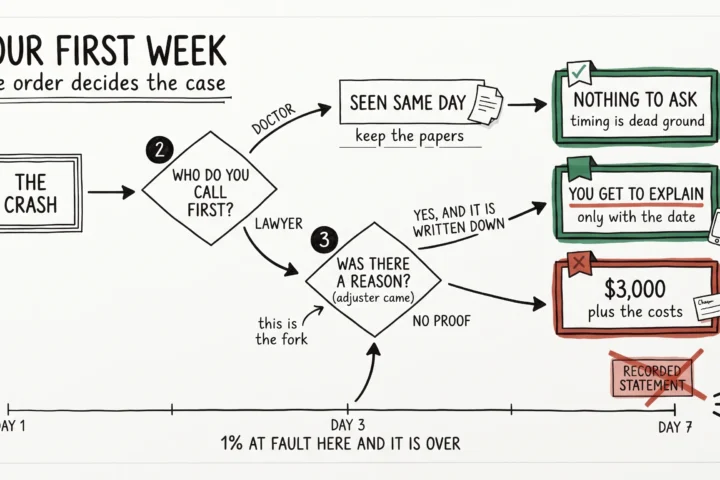
The adjuster calls you the next morning, all friendly. “Just need to get your version of events while it’s fresh.” They’re recording everything, hunting for ammunition to destroy your claim later.
Dante from Riverside thought he was being helpful. T-boned by a delivery truck, clear liability. The trucking company’s adjuster called him at 9 AM the next day while he was on Percocet from the ER visit. Dante rambled for 20 minutes about the accident. Mentioned he “felt fine except for some neck stiffness” and that he was “lucky it wasn’t worse.”
Six weeks later, when the herniated discs showed up on the MRI, that recorded statement became Exhibit A. The insurance lawyer played it in deposition: “Mr. Dante, you said you felt fine, correct?” They used his pain-medication-influenced ramblings to argue his injuries were pre-existing or fabricated. His $200,000 case settled for $35,000 because of that one phone call.
You’re not legally required to give a statement to the other side’s insurance. Ever. They’ll pressure you, say they can’t process the claim without it, threaten to close the file. All nonsense. Tell them to call your attorney. Don’t have one yet? “I’m still seeking medical treatment and will be in touch.” Then hang up.
Before talking to any insurer, it is prudent to talk to a skilled personal injury lawyer. As an example, companies like the Law Offices of Daniel Kim are known to represent victims of accidents and can communicate with others on your behalf, so that your rights are not violated and your words are not misinterpreted.
Signing the Property Damage Release Before Understanding the Full Scope
Your car’s totaled, you need transportation, so you take their first offer for the vehicle and sign the property damage release. Except that release had extra language releasing “all claims arising from the incident.”
Priya’s case was textbook what-not-to-do. Rear-ended on I-495, her Honda totaled. GEICO offered $8,500 for the car, which seemed fair. She signed their property damage release to get the check quickly – needed a car to get to work.
Three months later, when her back surgery bill hit $90,000, she tried to file an injury claim. GEICO’s lawyer pulled out the release she signed. Buried in paragraph four: “Claimant releases all claims, known and unknown, arising from the accident of March 15.” Her attorney spent eight months fighting to void that release based on fraudulent concealment. Eventually settled for $60,000 instead of the $250,000 the case was worth.
Always use separate releases – one for property, one for injury. If they won’t separate them, don’t sign anything. Rent a car, take the bus, borrow from family. That $8,500 check isn’t worth signing away $200,000 in injury claims.
Going to Your Regular Doctor Instead of Injury-Specific Providers
Your family doctor is great for flu shots and blood pressure medicine. They’re terrible for documenting crash injuries in ways that hold up legally.
Rashid went to his primary care doctor after getting sideswiped on the Beltway. Dr. Anderson, who’d treated Rashid for 15 years, wrote in the chart: “Patient complains of general soreness after minor fender-bender. Advised Tylenol and rest.” That became the insurance company’s favorite document.
Meanwhile, Rashid’s actually suffering from soft tissue damage, whiplash-associated disorder, and post-traumatic headaches. But Dr. Anderson doesn’t speak injury language. Doesn’t know to document range-of-motion restrictions, muscle spasms, or radicular symptoms. Just writes “soreness” and moves on to the next patient.
The personal injury doctors know how to document for legal purposes. They write “cervical strain with myofascial involvement, positive Spurling’s test indicating nerve root irritation, 30% reduction in cervical rotation,” which can significantly influence the outcome of a brachial plexus injury lawsuit. Same injury, completely different legal value.
Find doctors who regularly treat accident victims. They know what insurance companies look for, how to document properly, and won’t minimize your complaints. Your family doctor saying you’re “doing better” becomes the insurance company’s proof you’re healed.
Posting Absolutely Anything on Social Media
Not just photos of you playing volleyball. Anything. The insurance company’s investigator is watching your Facebook, Instagram, TikTok, and LinkedIn. Their job is finding posts to destroy your credibility.
Keisha had legitimate injuries – fractured vertebrae, torn rotator cuff. But she posted a motivational quote: “Push through the pain, warriors don’t quit!” Insurance lawyer at deposition: “Ms. Keisha, you described yourself as a warrior who pushes through pain. Were you exaggerating your injuries to this jury?”
Another client, Dmitri, posted nothing about physical activities. But he checked into a concert venue three weeks after the accident. Insurance argued anyone well enough to attend a three-hour standing-room concert wasn’t seriously injured. Didn’t matter that Dmitri left after 20 minutes and spent the next two days in bed. The check-in was all they needed.
Set everything to private. Don’t accept new friend requests. Don’t post inspirational quotes, vacation photos, or work achievements. That LinkedIn update about your promotion? They’ll argue you’re clearly functioning fine. Your kid’s birthday party photos? You’re obviously not suffering if you can host parties.
Having Your Doctor Write a Narrative Report Too Early
Doctors want to help, so when you ask for a letter explaining your injuries three months after the accident, they write one. Problem is, you’re nowhere near done with treatment.
Carlos asked his orthopedist for a report after four months of treatment. Doctor wrote a detailed letter: “Patient has recovered approximately 70% function and should reach maximum medical improvement within 2-3 months.” Insurance company immediately offered $25,000 based on the doctor projecting full recovery.
Eight months later, Carlos needed surgery. That “70% recovered” letter became a weapon. Insurance argued the surgery was unnecessary since his own doctor said he was almost healed. The truth? The doctor was being optimistic, trying to encourage Carlos. But optimism doesn’t pay medical bills.
Wait until you’re actually done treating or at least plateaued. Narrative reports should reflect your permanent condition, not your hopeful progress at month four. One premature report locks in your claim value before you know what you’re actually dealing with.
Talking to Your Own Insurance Like They’re On Your Side
Your insurance has a duty to defend you if you’re sued. They don’t have a duty to maximize your injury claim, even under your own uninsured motorist coverage.
Terrell had Progressive. Got hit by an uninsured drunk driver. Called Progressive thinking they’d help since he’d been paying premiums for 12 years. The Progressive adjuster was super friendly, said they’d “take care of everything.”
Then Terrell made the mistake of being honest about his pre-existing back issues from playing college football. Mentioned how this crash “aggravated his old injury.” Progressive used that to argue 80% of his problems were pre-existing. Their initial offer under his $100,000 UIM coverage? $8,000.
Terrell hired an attorney who got the medical records showing his back had been pain-free for five years before this crash. Settled for $70,000. But that casual conversation with “his own” insurance nearly destroyed the claim.
Accepting the First Doctor the Insurance Company Recommends
“We’ll send you to our preferred provider network. They’ll bill us directly!” Sounds convenient. It’s a trap.
Yuki got rear-ended by a commercial van. The company’s insurance offered to send her to “their clinic” for immediate treatment, no out-of-pocket costs. She went to Industrial Injury Associates for three weeks. They did basic adjustments, declared her “fully recovered,” and sent a report to the insurance company.
When Yuki still had pain two months later, she went to an independent doctor who found two herniated discs requiring surgery. But Industrial Injury Associates had already authored a “final report” saying she was healed. The insurance company argued any ongoing problems were unrelated to the accident since “their doctor” cleared her.
Those insurance-recommended doctors aren’t neutral. They get referrals by minimizing injuries and declaring people healed quickly. Get your own doctor, even if you have to pay upfront or work out payment plans. Control of medical care equals control of your claim value.
Hiring an Attorney Based on the Biggest Billboard
That lawyer’s face is on every bus bench and billboard. Must be good, right? Those ads cost $50,000 a month. Guess where that money comes from? Volume settlements where they take 40% of quick, lowball offers.
Destiny hired the “Hammer” lawyer she saw on TV. Big firm, impressive office, promised aggressive representation. What she got was a paralegal who’d been there six months, handling 200 cases, pushing her to take the first offer because the firm needed cash flow for next month’s advertising budget.
They settled her clear liability case with $50,000 in medical bills for $65,000. The firm took $26,000, medical bills took $50,000 through subrogation, Destiny got $11,000. A decent attorney would’ve gotten $150,000 minimum on those facts. But the TV lawyer never even met Destiny – she was just case number 2847 on a spreadsheet.
Interview three attorneys minimum. Ask how many cases they’re currently handling. If it’s more than 40-50, you’re going to be a number. Ask who’ll actually work your file – the attorney or a paralegal? Ask about their last three trial verdicts. Billboard lawyers don’t try cases; they settle everything because trials don’t scale.
Guessing at Your Future Medical Needs
You think the pain will go away. You hope physical therapy will fix everything. So you settle based on current bills plus “maybe a few more months of treatment.” Then reality hits.
Lorenzo broke his wrist in a motorcycle accident, other driver’s fault. Six months of treatment, seemed to be healing. Settled for $45,000 – medical bills plus a little for pain and suffering.
Two years later, arthritis set in at the fracture site. Orthopedist says he’ll need fusion surgery by age 50, maybe wrist replacement by 60. Those future surgeries? $200,000 minimum. But Lorenzo already signed a release for $45,000. No going back.
Get a life care planner or at least a medical opinion on future treatment needs. MRIs showing disc damage? That’s future surgery or lifetime pain management. Broken bones? Arthritis is coming. Head injury? Cognitive therapy might be needed years later. Don’t guess – get medical documentation of probable future care needs.
Lying About Anything, Even Small Stuff
The investigator will catch you. They always do. Then your entire claim becomes worthless because you’re a proven liar.
Hakeem claimed he couldn’t work construction after his shoulder injury. True. But on his deposition form listing prior injuries, he wrote “none” because he figured that old rotator strain from 2015 didn’t count – it had fully healed.
Insurance investigator pulled his medical records going back 10 years. Found the 2015 shoulder treatment. At trial, they spent two hours on his “lie” about no prior injuries. Jury stopped listening to anything else. His legitimate $200,000 shoulder surgery claim resulted in a defense verdict – zero dollars – because he lost credibility over something that wouldn’t have mattered if he’d been honest.
Tell the truth about prior injuries, prior claims, criminal history, work history. Your attorney can deal with bad facts if they know about them. They can’t deal with surprise lies uncovered by the other side.