 Mohammad Ahsan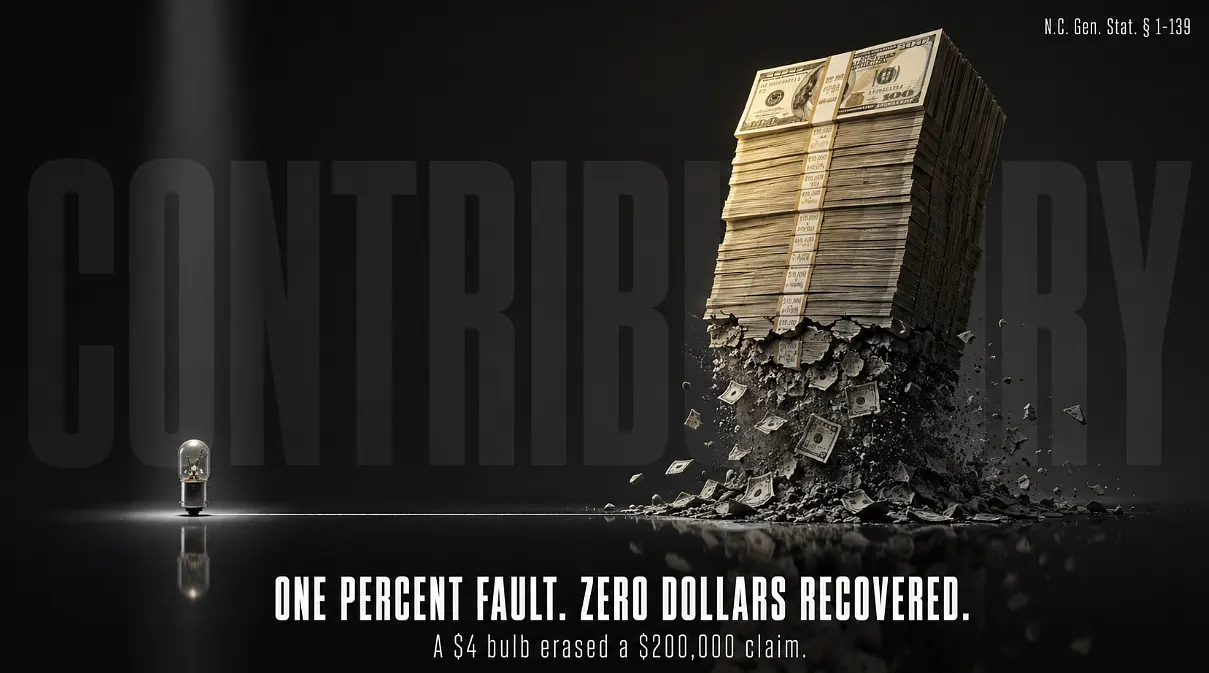
North Carolina bars injured people from recovering any compensation if they are even 1% at fault for the accident. Not reduced. Eliminated. A driver who is 99% responsible for a crash owes nothing to the person they hit if that person contributed even slightly to what happened. That is pure contributory negligence under N.C. Gen. Stat. § 1-139, and North Carolina is one of only four states plus the District of Columbia that still applies it.
The other four: Alabama, Maryland, Virginia, and D.C.
Every other state in the country uses some form of comparative negligence, where fault reduces your recovery proportionally. North Carolina never made that switch. Bills have been introduced. They keep dying in committee.
Meanwhile, 972,089 emergency department visits for injuries were recorded in North Carolina in 2024 alone. A significant number of those cases involve situations where the injured person could be assigned some percentage of fault, and in this state, some percentage means zero dollars.
How the Rule Works in an Actual Crash

You are rear-ended at a red light. Clear liability, right? The driver behind you was following too closely, looking at their phone, and hit you at 35 miles per hour while you were stationary.
Except your brake lights were out. One of them, the left one, burned out two weeks ago and you had not gotten around to replacing it.
The adjuster for the driver who hit you spots it. Burned-out brake light. They argue that the reduced visibility of your vehicle contributed to the crash. You are now 5% at fault, maybe 3%, maybe 1%. Does not matter what the number is. In North Carolina, any number above zero bars the claim entirely.
A $200,000 case becomes a $0 case because of a $4 brake light bulb.
That is not hypothetical. That is how the rule operates and insurance adjusters in this state are trained to find exactly these kinds of details.
The Adjuster’s Playbook in a Contributory Negligence State
Insurance adjusters working NC claims do not need to prove you caused the accident. They need to prove you contributed to it. Any amount. The threshold is not 50%. It is not 10%. It is anything above zero. That makes their job fundamentally different from adjusters in comparative negligence states, and the tactics reflect it.

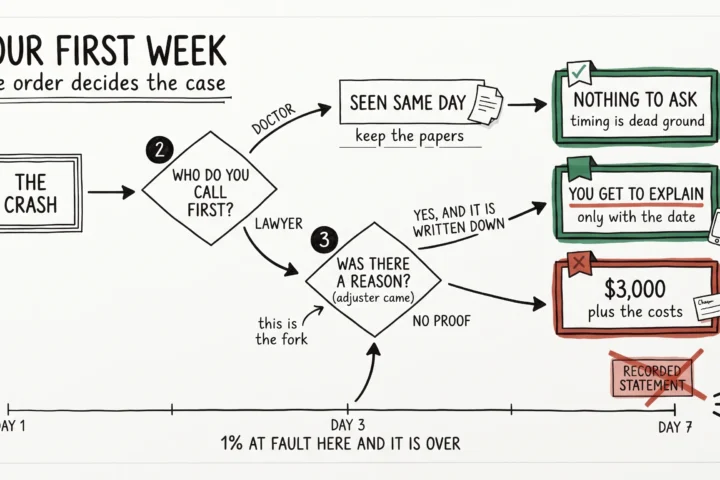
- The recorded statement. Adjusters call within 48 hours. The questions sound conversational. “Can you walk me through what happened?” “How fast were you going?” “Did you see the other vehicle before impact?” The goal is to get you to say something, anything, that implies you could have done something differently. “I didn’t see them until the last second” becomes evidence of inattention. “I think I was doing about 40” gets checked against the posted speed limit.
- The police report deep-read. Officers note details that seem minor at the time. Following distance. Lane position. Whether signals were used. Whether headlights were on. The adjuster reads that report looking for any notation that could be reframed as contributory fault.
- Social media. Posts about the accident, photos of the scene, check-ins at locations, even fitness app data showing activity levels after the crash. Adjusters and their investigators monitor social media accounts looking for anything that contradicts the claim or suggests the injured person’s own conduct contributed to the incident.
- Vehicle inspection. Bald tires. Worn brake pads. A cracked windshield that reduced visibility. Pre-existing damage that could be reinterpreted as evidence that the vehicle was not roadworthy. Any maintenance issue that could be argued to have contributed to the crash or the severity of the injuries becomes a contributory negligence argument.
Herbert W. Auger, among the personal injury legal experts at Auger Law, has pointed out that adjusters in North Carolina approach claims with a fundamentally different mindset than adjusters in comparative negligence states. In a comparative state, the adjuster is negotiating how much to pay. In North Carolina, the adjuster is looking for a reason to pay nothing. That distinction shapes every interaction from the first phone call.
The Seatbelt Exception is One of the Few Statutory Protections
N.C. Gen. Stat. § 20-135.2A specifically prohibits the use of seatbelt non-compliance as evidence of contributory negligence. If you were not wearing a seatbelt at the time of the crash, the defendant cannot use that fact to argue you were at fault for your own injuries.
Same rule applies to motorcycle helmets.
These statutory carve-outs exist because the legislature recognized that seatbelt and helmet use relates to injury severity, not to causing the accident. Not wearing a seatbelt did not cause the crash. It may have made the injuries worse, but in North Carolina the contributory negligence defense is about causation, not about mitigation. The statute draws that line explicitly.
Outside of these narrow protections, almost everything else is fair game.
Last Clear Chance: The One Doctrine That Can Save a Claim
Even in a contributory negligence state, the law recognizes one situation where the rule bends.
The last clear chance doctrine allows a plaintiff to recover despite their own contributory negligence if they can prove that the defendant had the final opportunity to avoid the accident and failed to act. The plaintiff’s negligence put them in a position of danger, but the defendant saw that danger, or should have seen it, and had time to avoid the harm but did not.
A pedestrian crosses against the light. Contributorily negligent, clearly. But the approaching driver sees the pedestrian in the road 200 feet away and has time to stop or swerve and does neither. The driver had the last clear chance to prevent the collision and failed to take it.
Courts apply this narrowly. The defendant must have actually perceived the plaintiff’s peril, or should have perceived it, and must have had a realistic opportunity to avoid the harm. A split-second reaction situation where the defendant had no time to respond does not qualify. The doctrine requires a window of opportunity that went unused.
It is a difficult argument to win but in a state where the alternative is zero recovery, it is sometimes the only argument available.
Gross Negligence Overrides Contributory Fault
If the defendant’s conduct was not ordinary negligence but gross negligence, willful and wanton behavior, or intentional misconduct, the plaintiff’s contributory negligence may not bar recovery.
Drunk driving is the clearest example. A driver with a BAC of .15 who runs a red light and hits another car, the defendant’s conduct is so far beyond ordinary carelessness that the court may hold the plaintiff’s minor contributory fault irrelevant. The logic is that a person acting with reckless disregard for human life should not benefit from the same defense available to a person who made an ordinary mistake.
This exception requires proving something beyond standard negligence, and the evidentiary bar is higher. But when the facts support it, gross negligence can be the path to recovery that contributory negligence would otherwise block entirely.
The Legislature Has Tried to Change the Rule and Failed
North Carolina lawmakers have introduced bills to replace contributory negligence with comparative negligence multiple times. The bills propose a system where fault reduces recovery proportionally rather than eliminating it, similar to what 46 other states already use.
Those bills have not passed.
The insurance industry lobbies heavily against the change because contributory negligence gives carriers an extraordinarily powerful tool for denying claims entirely. In a comparative negligence state, the adjuster negotiates how much to pay. In North Carolina, the adjuster can deny the claim outright if they can point to any contributory fault, and the threat of that denial gives them leverage in every settlement negotiation.
Whether the rule eventually changes is a political question. For anyone injured in North Carolina right now, the rule is what it is. One percent fault means zero recovery. Everything about how a claim gets documented, communicated, and presented has to account for that reality from the moment the accident happens.
References
- N.C. Gen. Stat. § 1-139. Contributory negligence as a defense in all actions for negligence, to be pleaded and proved by the defendant.
- Sorrells v. M.Y.B. Hospitality Ventures, 332 N.C. 645, 648 (1992). Plaintiff’s contributory negligence bars recovery from a defendant who commits an act of ordinary negligence.
- Newton v. New Hanover County Board of Education, 342 N.C. 554, 564 (1996). Definition of contributory negligence: failure to exercise the care an ordinarily prudent person would exercise under the circumstances.
- N.C. Gen. Stat. § 20-135.2A. Seatbelt non-compliance and motorcycle helmet non-compliance cannot be used as evidence of contributory negligence.
- North Carolina is one of four states plus D.C. using pure contributory negligence. The others: Alabama, Maryland, Virginia.
- North Carolina Department of Health and Human Services, 972,089 emergency department visits for injuries in 2024.