 Norma Harris
In many legal cases Hot-Tubbing, expert witnesses are important. They provide opinions on medical conditions, financial losses, technical failures, and scientific facts. Courts often rely on them to make fair decisions. But when two or more experts disagree, it can be confusing. Judges and juries may struggle to understand which expert is more reliable.
This problem led to a process called hot-tubbing, also known as concurrent expert evidence. Instead of experts testifying one by one, they sit together, answer questions at the same time, and discuss differences in front of the judge.
This article will explain in detail what hot-tubbing means, how it works, why it is used, and what it may mean for your case. You will also find examples, tips for lawyers, and tables comparing methods. The goal is to help you clearly understand this modern way of handling expert testimony.
History of Hot-Tubbing in Law
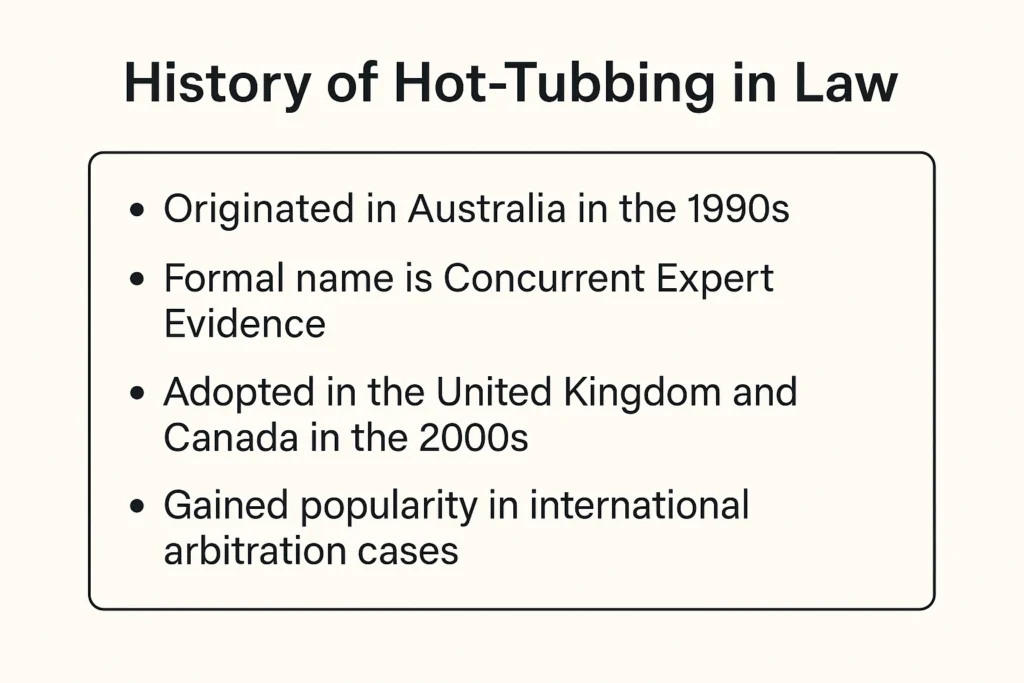
The term “hot-tubbing” may sound informal, but it is a serious legal process. It first became common in Australia in the 1990s. Judges wanted a more efficient way to deal with expert disagreements. Instead of hearing one expert and then another, they decided to put both in the witness box at the same time.
From Australia, the method spread to the United Kingdom, Canada, Singapore, and even to international arbitration cases. Today, it is widely recognized as a tool that can save time, reduce costs, and give judges a clearer picture.
Key points about History Hot-Tubbing

- Origin: Australia (early 1990s)
- Legal name: Concurrent Expert Evidence
- Informal name: Hot-tubbing
- Spread to: UK, Canada, Singapore, International Arbitration, US (limited use)
Growth of Hot-Tubbing
| Country / Region | When Introduced | Current Status |
|---|---|---|
| Australia | 1990s | Widely used in courts |
| United Kingdom | 2000s | Used in civil cases and arbitration |
| Canada | 2010s | Growing adoption |
| Singapore | 2010s | Accepted in commercial disputes |
| United States | 2010s | Rare, limited experiments |
Why Courts Use Concurrent Expert Evidence

Judges often face a challenge: two experts give very different opinions. One says the machine failed because of design flaws, another says it failed because of poor maintenance. If experts speak separately, lawyers ask long questions, and the judge must compare testimony without direct interaction.
Hot-tubbing changes this. Experts can answer the same question side by side, making it easier to see the contrast.
Reasons courts choose hot-tubbing:
- Clarity: Judges hear explanations in real time.
- Time-saving: Less repetition in cross-examination.
- Fairness: Both experts can respond directly to each other.
- Cost reduction: Shorter hearings reduce legal costs.
- Control: Judges can ask focused questions instead of waiting for long lawyer-led questioning.
Example situation
In a construction dispute, one engineer says the cracks in a building are due to poor design. Another says they are due to poor concrete quality. In a traditional trial, each expert testifies separately, and the judge hears two long stories. In hot-tubbing, both engineers sit together and answer:
- Judge: “What is the main reason for these cracks?”
- Expert A: “Design flaws caused stress.”
- Expert B: “Concrete strength was below standard.”
- Judge: “Could both factors be at play?”
This direct exchange helps the judge see the issue clearly.
How Hot-Tubbing Works in Practice
The process can vary between courts, but usually it follows certain steps.
Steps in hot-tubbing:
- Pre-trial: Lawyers and judge decide if hot-tubbing will be used.
- Expert reports: Each expert writes a report in advance.
- Joint statement: Experts meet before trial to agree on points they share and list points of disagreement.
- Concurrent session: Both experts sit in the witness box together.
- Judge-led questions: The judge asks questions, sometimes lawyers also ask.
- Discussion: Experts can comment on each other’s answers.
- Conclusion: The court records the agreed and disagreed points.
Comparison between traditional testimony and hot-tubbing
| Feature | Traditional Testimony | Hot-Tubbing |
|---|---|---|
| Order of testimony | One expert at a time | Experts together |
| Questioning style | Lawyer-led | Judge-led with open exchange |
| Time taken | Longer | Shorter |
| Cost | Higher | Lower |
| Clarity for judge | Sometimes unclear | Often clearer |
Benefits for Judges, Lawyers, and Clients
Hot-tubbing is not only about saving time. It can improve the quality of justice.
For Judges
- Clearer comparison of expert views
- Ability to ask precise questions
- Less confusion and less reliance on technical language
For Lawyers
- Focused arguments instead of long cross-examinations
- Opportunity to highlight weaknesses in the opposing expert’s opinion directly
- Ability to work with their own expert in real time
For Clients
- Lower costs due to shorter hearings
- Faster case resolution
- Better chance that the judge understands the technical issues
Example benefit
A business client in an arbitration saved weeks of hearing time because experts were examined together. Instead of 20 days of expert testimony, it took only 7 days.
Challenges and Criticisms of Hot-Tubbing
Despite its advantages, not everyone supports hot-tubbing. Some lawyers believe it gives too much control to judges. Others worry that experts may dominate each other.
Common criticisms:
- Judge’s role: Some argue judges should not act like investigators.
- Expert imbalance: A more confident expert may overshadow a quieter one.
- Preparation burden: Experts must coordinate before the hearing, which can be costly.
- Not suitable for all cases: Works better in technical cases, less so in sensitive issues like family law.
Risks of hot-tubbing
| Risk | Impact | Possible Solution |
|---|---|---|
| Dominant expert | May bias judge | Judge ensures equal speaking time |
| Judge over-involvement | May reduce fairness | Keep balance between judge and lawyer questions |
| High preparation cost | More time before trial | Save time during hearing |
Hot-Tubbing in Different Legal Systems
Hot-tubbing is not used in the same way everywhere.
Australia
- Birthplace of the method
- Used widely in civil courts
- Considered successful
United Kingdom
- Gained attention in the 2000s
- Used in commercial cases and arbitration
- Strong judicial support
United States
- Limited adoption
- Some federal judges tried it, but tradition of lawyer-led questioning makes it rare
International Arbitration
- Very popular
- Saves time in cross-border disputes
- Common in energy, construction, and trade disputes
Global use of hot-tubbing
| Region | Usage Level | Key Feature |
|---|---|---|
| Australia | High | Judge-led, standard practice |
| UK | Medium | Arbitration and civil disputes |
| US | Low | Rare, experimental |
| International | High | Arbitration hearings |
Practical Tips for Lawyers Handling Hot-Tubbing Sessions
If you are a lawyer, preparing for hot-tubbing requires a different mindset than traditional testimony.
Preparation tips:
- Work closely with your expert before trial
- Review opposing expert’s report carefully
- Practice short, clear answers with your expert
- Prepare simple visuals like charts or timelines to assist the judge
- Advise your expert to remain calm and respectful during discussions
During the session:
- Let the judge lead, but be ready with follow-up questions
- Take notes of agreements and disagreements
- Avoid long speeches; focus on clarity
Do’s and Don’ts for lawyers
| Do’s | Don’ts |
|---|---|
| Prepare your expert for open discussion | Do not rely only on long cross-examination |
| Encourage clarity and short answers | Do not let your expert dominate or interrupt |
| Use charts or tables | Do not overload with documents |
Case Examples
Example 1: Construction Dispute in Australia
Two structural engineers disagreed on the reason for a bridge crack. In hot-tubbing, both explained their views at the same time. The judge asked simple questions, and it became clear that both causes were valid but one was more significant. The case ended sooner than expected.
Example 2: Arbitration in London
A financial expert and an auditor disagreed on company valuation. During concurrent evidence, both sat together, explained their methods, and highlighted assumptions. The tribunal found the discussion more helpful than traditional testimony.
Example 3: Medical Negligence Case
Two doctors gave opposite opinions about patient care. In hot-tubbing, their professional debate helped the judge understand which treatment standard was realistic.
Future of Hot-Tubbing in Law
The use of hot-tubbing is growing. More countries are testing it, and international arbitration is leading the way. With rising case complexity, concurrent evidence is likely to expand further.
Possible trends:
- More digital hot-tubbing (online hearings with video panels)
- Increased use in environmental, medical, and financial cases
- Training programs for judges and lawyers on managing sessions
Frequently Asked Questions (FAQ) on Hot-Tubbing in Law
1. What does hot-tubbing mean in law?
Hot-tubbing in law, formally called concurrent expert evidence, is when two or more expert witnesses testify at the same time, side by side, instead of one after another. This helps judges compare opinions directly and makes hearings faster and clearer.
2. Why is it called hot-tubbing?
The term is informal. It comes from the idea of experts sitting together like people in a hot tub. But in reality, they sit in the witness box together during court or arbitration.
3. Which countries use hot-tubbing the most?
Hot-tubbing started in Australia in the 1990s and is widely used there. It is also common in the UK, Canada, Singapore, and international arbitration cases. The United States has tested it in some courts but does not use it widely.
4. What are the main benefits of hot-tubbing?
- Judges get clearer explanations.
- Trials are shorter and cheaper.
- Experts can answer each other’s points directly.
- Clients save costs and get faster results.
5. Are there any problems with hot-tubbing?
Yes, critics say:
- A confident expert may overshadow a quieter one.
- Judges take a bigger role, which some lawyers do not like.
- Preparing experts for joint sessions takes extra time.
6. Is hot-tubbing used in criminal law?
It is mostly used in civil cases, arbitration, and technical disputes. Criminal cases rarely use it, because witness protection and fairness rules are stricter.
7. How should a lawyer prepare for hot-tubbing?
- Train your expert to give short, clear answers.
- Study the opposing expert’s report carefully.
- Encourage respectful discussion between experts.
- Use charts or tables to make points easier for judges.
8. Does hot-tubbing replace cross-examination?
Not completely. Lawyers can still cross-examine, but the judge usually leads the discussion. Cross-examination becomes shorter and more focused.
9. What types of cases benefit most from hot-tubbing?
Cases with technical or scientific details, such as construction, engineering, financial disputes, and medical negligence, benefit most.
10. What is the future of hot-tubbing in law?
Experts expect it will grow worldwide. Digital hearings, online arbitration, and complex technical disputes will make concurrent expert evidence more common.
Conclusion
Hot-tubbing, or concurrent expert evidence, is reshaping the way courts handle expert testimony. It makes trials shorter, cheaper, and often clearer. While it has challenges, its advantages are strong. For clients, it may mean faster justice. For lawyers, it requires new skills. For judges, it provides sharper tools to uncover the truth.
Understanding hot-tubbing can prepare you for future cases and help you know what to expect if your case involves expert witnesses.