 David E. Keltner ( Texas )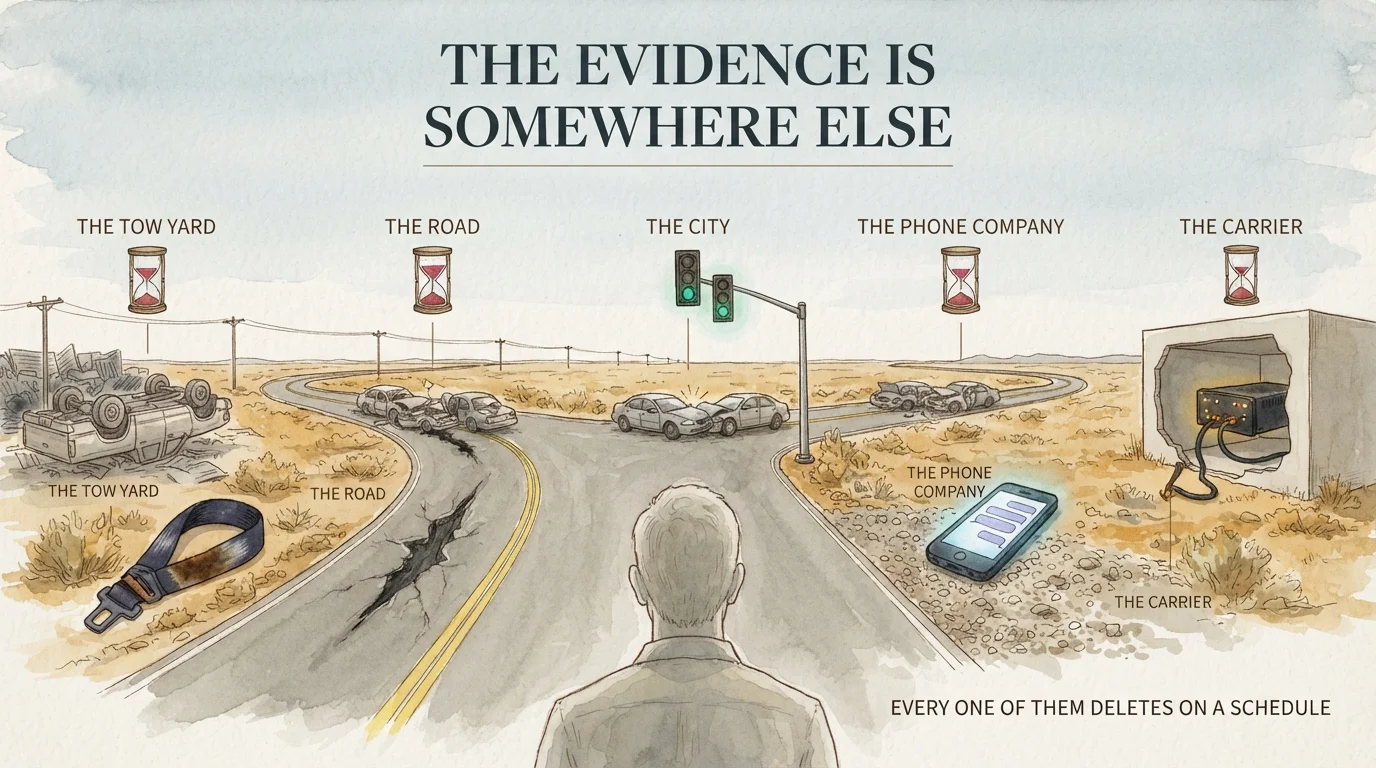
A wreck is happening somewhere in Texas every 59 seconds, by TxDOT’s 2025 count and most of them are bumper taps in a parking lot that no one ever sues over. Five kinds are not like that. In these five somebody is going to the hospital, the car is totaled and the insurance company on the other side is already working out how to pay less. What decides those cases is what evidence got kept in the first week and each of the five needs a different kind.
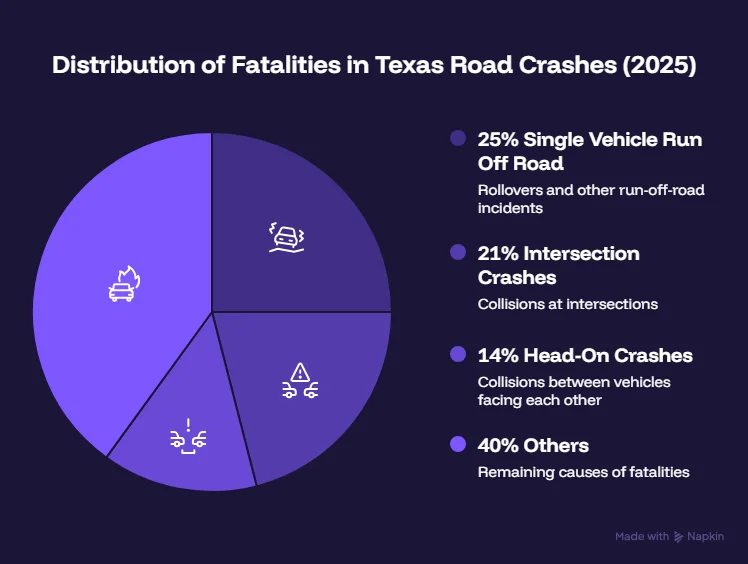
The state’s own numbers for 2025, so we are talking about real crashes and not scary ones:
- 3,769 people killed on Texas roads.
- 17,420 people with a serious injury.
- 1,201 killed in single vehicle run off the road crashes, most of them rollovers.
- 955 killed at or near an intersection.
- 555 killed in head on crashes.
- 46 percent of the people killed in a car were not wearing a belt.
Rollover Crash And The Seat Belt Question
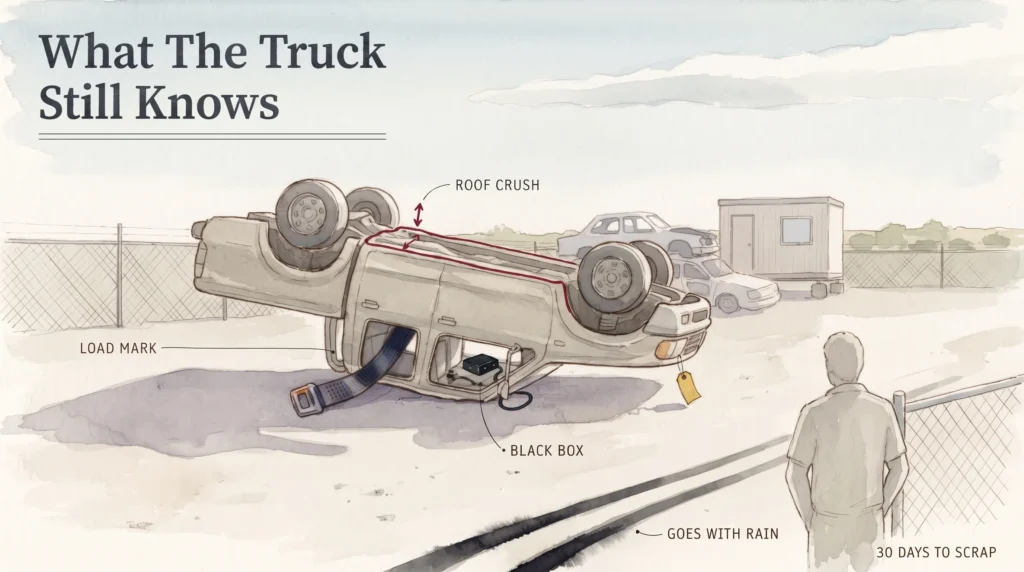
A rollover is what happens when a pickup or an SUV leaves the road at speed, catches a soft shoulder or a ditch and trips over itself. The roof comes down. Belted, you stay in the seat while the roof crushes toward you. Unbelted, you go out the window and in Texas that is nearly half the people who die in these.
The insurance company’s first question is going to be about the belt and the second one is going to be why you left the road at all. Admittedly, you are not going to be taking photos with the truck on its roof. So the evidence in a rollover comes from the truck itself and it has to be kept before the yard crushes it.
- The belt webbing. A belt that held under a rollover leaves a load mark on the strap and often on the buckle. That mark is the proof you were wearing it and the adjuster is going to say you were not.
- The roof crush, measured. How far the roof came down decides whether the car itself was defective and that is a second defendant if it was.
- The event data recorder, the black box under the seat, which has speed, steering and belt status for the five seconds before the roll.
- The tire marks on the shoulder, which go away with the next rain.
A rollover is won or lost on the belt strap and the black box and both of them are sitting in a tow yard that will sell the truck for scrap in thirty days unless somebody sends a letter.
Head On Crash On A Two Lane Road
This one was shared with me by Juan Aguirre, car accident attorney at Bad Crash and it is the crash that kills the most people per crash in the state. Two lane farm to market road, no divider, one driver drifts across the yellow line and two speeds are added together at the point of impact. Fifty five and fifty five is a hundred and ten.
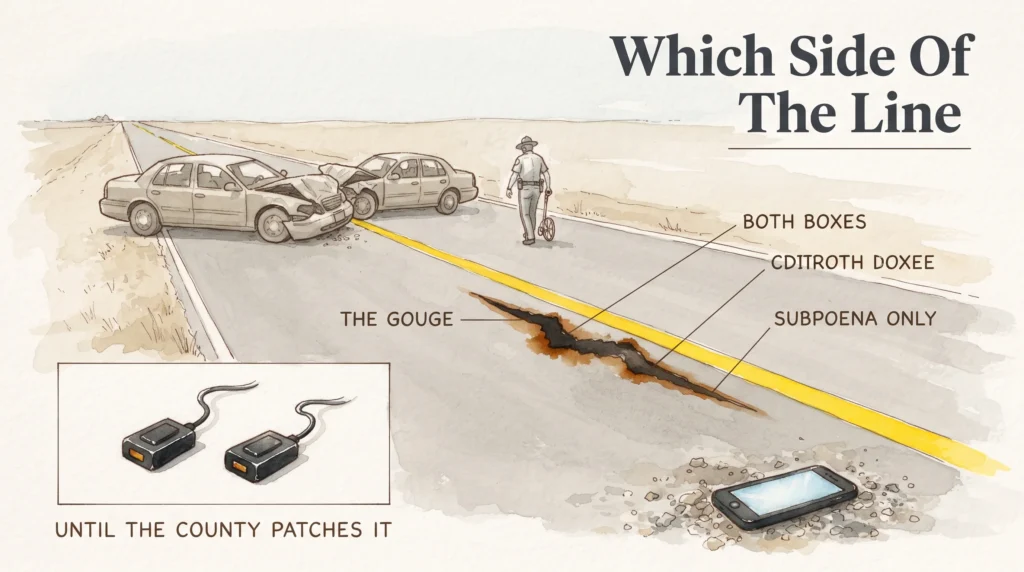
The other driver is very often dead or does not remember or says you were the one who crossed. So the whole case is about which side of the yellow line the cars met on and you cannot prove that from the damage alone, since both cars have the same damage.
- The gouge in the road. When two cars hit head on the frames dig into the pavement at the point of impact and that gouge sits on one side of the centerline or the other. A DPS trooper measures it. If he did not, somebody has to, before the county patches it.
- Both black boxes, not just yours. The other car’s event data recorder shows whether the driver braked, steered or did nothing and doing nothing usually means asleep or on the phone.
- The other driver’s phone records, which need a lawyer’s subpoena.
- Toxicology from the hospital, which the hospital will not hand to you but will hand to a lawyer.
In a head on, the road gouge is the evidence and it is the hardest evidence to argue with, so it has to be photographed and measured before anyone drives over it.
T Bone Crash At An Intersection
Somebody ran the light or the stop sign and hit you in the driver’s door where there is no engine and no trunk to take the hit. Intersection crashes killed 955 people in Texas last year. Granted, the person who ran the light will say it was yellow and their passenger will say it too.
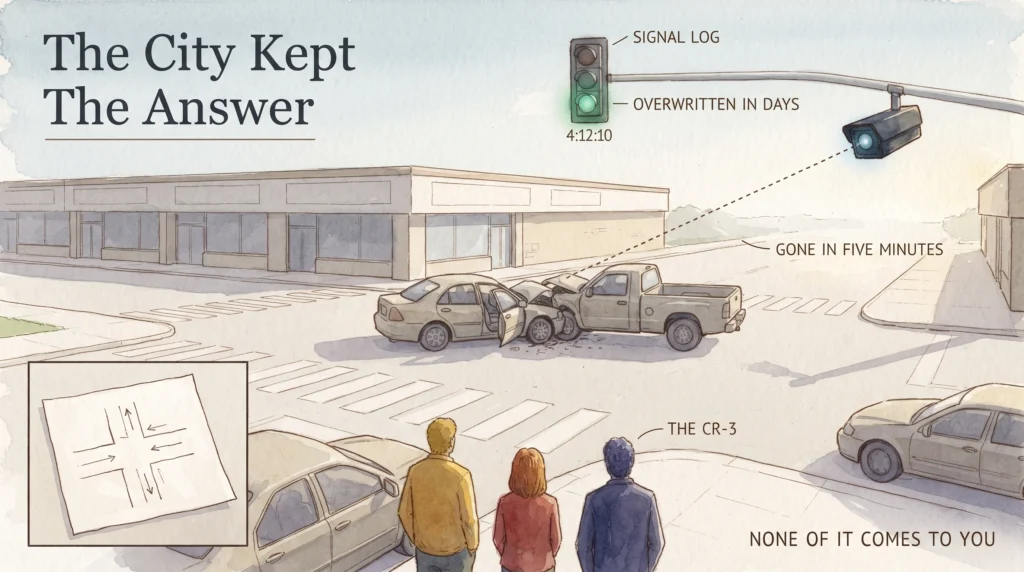
- The signal timing record. Every city keeps a log of how long each light was on each color and it can be requested. If the light was green for you at 4:12 and 10 seconds, the record says so.
- The intersection camera, if there is one. Many Texas cities have them at the big intersections and the footage is overwritten in days, not weeks.
- The two or three drivers who were stopped at the light and saw the whole thing. They leave in five minutes. Get a phone number before they do.
- The CR-3, the Texas crash report the officer files, with the diagram. It does not settle fault, but the adjuster reads it before anything else.
A T bone is proved by the city’s own signal log and by the stranger who was stopped beside you and neither of those is going to come to you on their own.
High Speed Rear End Crash On The Freeway
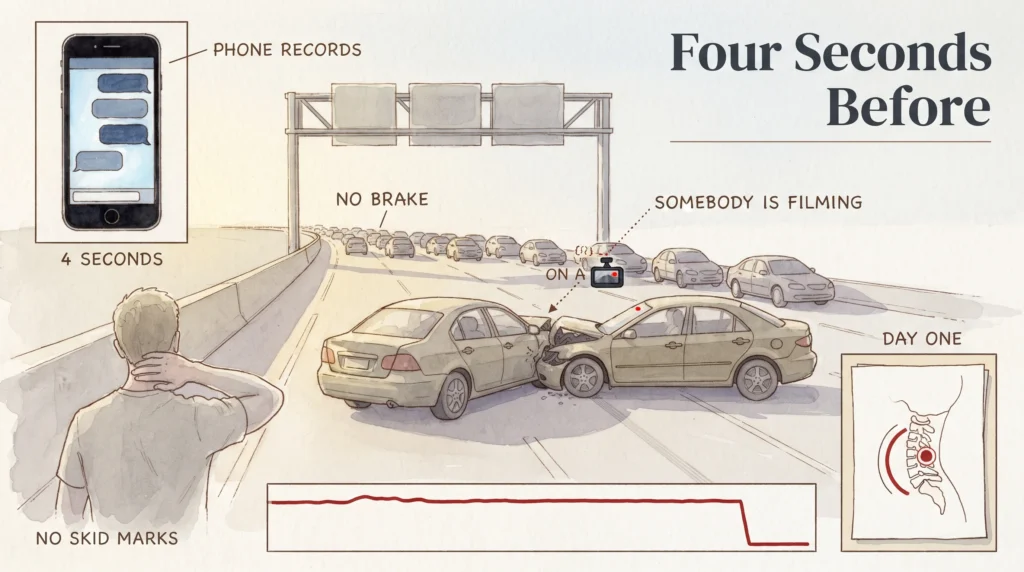
Traffic on Interstate 45 or the Katy Freeway stops dead and the car behind you does not. At seventy miles an hour into a stopped car, the injury is to the neck and the spine and the damage to the back of your car goes through into the cabin.
True, the driver in the back is at fault in nearly every rear end and Texas law leans that way. But in a bad one the argument moves off fault and onto how bad your injury is and onto whether the driver was texting, because texting turns an ordinary claim into one with punitive damages on it.
- The other driver’s phone records. If a text went out four seconds before impact, that is the case.
- Their black box, which shows whether the brakes were ever touched. Seventy to zero with no brake means no eyes on the road.
- The dashcam in the car behind them or the truck in the next lane. Somebody on a Texas freeway has a camera running and the footage is on a loop.
- Your own medical record from the first visit, because a neck injury that is not written down on day one is called “pre existing” by day thirty.
In a rear end at speed the fault is the easy part and the phone record is the whole difference between a normal payout and a large one.
Truck Hits A Car And The Company Keeps The Records
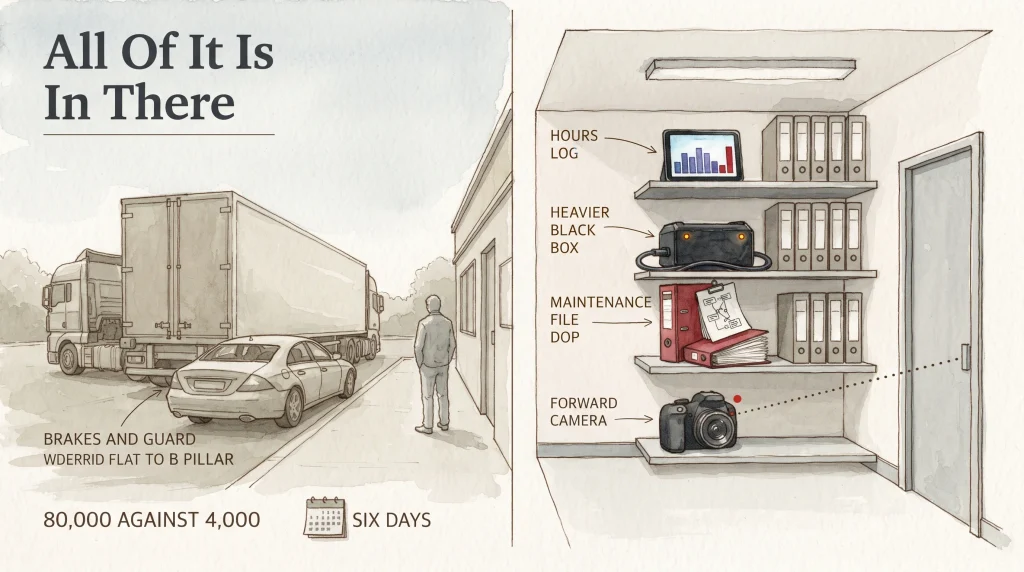
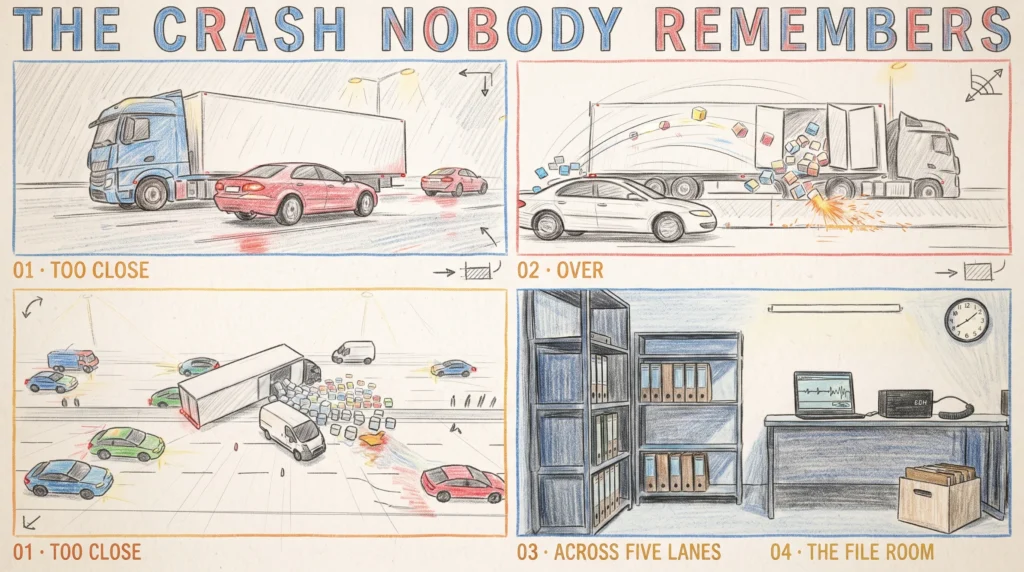
An 80,000 pound semi on a 4,000 pound car produces an underride, where the car goes under the trailer or a crush from behind and nothing smaller than that. Here the other side is a company with a lawyer rather than a driver with a policy and the company holds nearly all the evidence.
- The driver’s hours of service log, electronic now, showing how long he had been driving.
- The truck’s black box, which records far more than a car’s.
- The maintenance file on the brakes and the trailer’s rear guard.
- The forward facing camera most fleets run.
Unfortunately, the federal rules only make the company keep driver logs for six months and nothing stops them deleting the rest the day after. So a preservation letter has to go out inside the first week and in this crash type you cannot wait to see how you feel first.
In a truck crash you have about six days to freeze the evidence and after that the company’s records say what the company wants them to say.
What Is Basic And Who Holds It
| Crash type | The basic evidence | Who has it | How fast it goes |
| Rollover | Belt strap, roof crush, black box | The tow yard | Thirty days, then scrap |
| Head on | Road gouge, both black boxes, phone records | The road, the other car, the phone company | Days for the gouge |
| T bone | Signal timing log, intersection camera, witnesses | The city, the city, strangers | Camera in days, witnesses in minutes |
| Rear end at speed | Phone records, black box, dashcam, first medical visit | Phone company, other car, other drivers, you | Dashcam loops in a week |
| Truck | Hours log, truck black box, maintenance file, camera | The trucking company | Six months for logs, less for the rest |
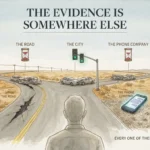
Indeed, the pattern is the same in all five. The evidence that decides the case sits somewhere else, a tow yard, a city office, a phone company or a trucking company and every one of them throws it away on a schedule. The first week is for sending the letters that stop the deleting and the story can wait.