 Olivia Florio Roberts ( Florida )
In Florida, the Strangulation Charge Under § 784.041 Can Be Filed With No Bruise
- In Florida, domestic battery by strangulation is a third-degree felony under § 784.041(2). The punishment is up to 5 years in prison, 5 years of probation, and a $5,000 fine.
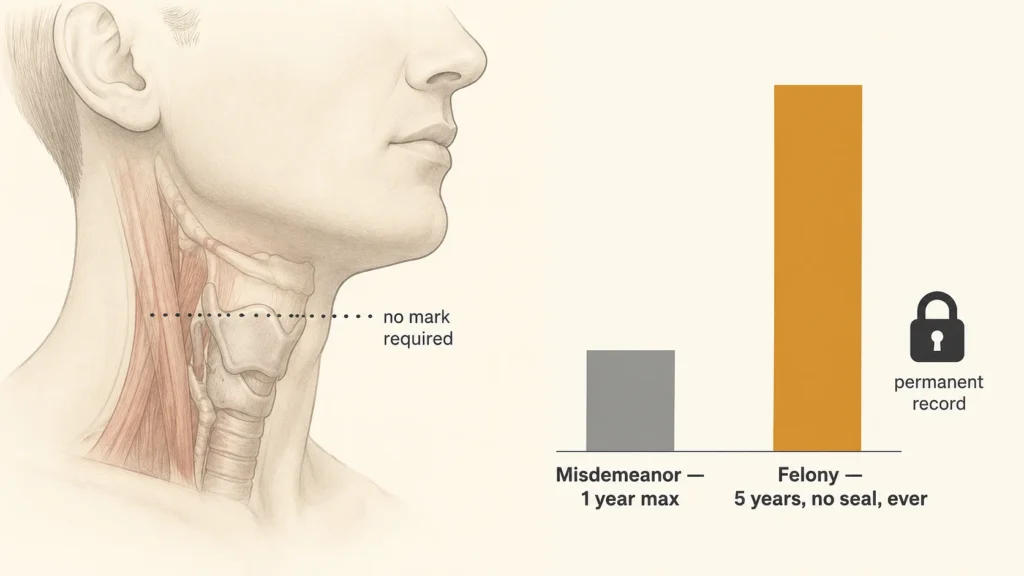
- It is not necessary that there should be any bruise or redness, or mark on the neck. The fact of impeded breathing can be established by the complainant’s evidence.
- A conviction cannot be sealed or expunged. Ever. It stays on your record permanently.
- The federal firearms prohibition under the Lautenberg Amendment applies automatically, even though this is designated a state felony.
- In Florida, it is the prosecutor, and not the alleged victim, who decides whether to charge. Even if the alleged victim recants, the state can proceed.
- In Hillsborough County, the first 21 days after arrest are important in the decision to prosecute, after which there are fewer options.
What the Statute Actually Says – § 784.041(2)(a)
Florida Statute § 784.041(2)(a): A person commits domestic battery by strangulation if the person knowingly and intentionally, against the will of another, impedes the normal breathing or circulation of the blood of a family or household member or dating partner, so as to create a risk of or cause great bodily harm, by applying pressure on the throat or neck or blocking the nose or mouth.
Look at the exact wording there. “Create a risk of” great bodily harm. Not “cause” it. The statute does not require that great bodily harm actually occurred. It is sufficient that the conduct created a risk of it. Putting one’s hand on another’s throat, during the heat of an argument, even if only briefly and without squeezing tightly enough to leave a mark, can meet that threshold if the prosecution argues that it created a risk of impeding breathing.
And here is where most people get confused. Simple domestic battery, which is a misdemeanor, means any touching that could be considered unwanted, or infliction of bodily harm. A shove, a slap, grabbing someone’s arm. That is a first-degree misdemeanor. One year in jail maximum. The moment the contact involves the throat or neck, or blocks the airway, it is raised to a third-degree felony. Same argument, same couple, same night. Whether a person faces a misdemeanor or a felony can come down to where on the body the contact occurred.
How the Charges Stack Up?
| Charge | Classification | Max Prison | Sealable? |
|---|---|---|---|
| Simple domestic battery (§ 784.03) | 1st degree misdemeanor | 1 year | Possibly, after diversion |
| Felony battery, causing great bodily harm (§ 784.041(1)) | 3rd degree felony | 5 years | No |
| Domestic battery by strangulation (§ 784.041(2)) | 3rd degree felony | 5 years | No |
| Aggravated battery, deadly weapon (§ 784.045) | 2nd degree felony | 15 years | No |
| Aggravated battery, pregnant victim (§ 784.045(1)(b)) | 2nd degree felony | 15 years | No |
The Evidence That Builds These Cases When There Are No Marks
So how do you prove strangulation, when the officer comes and there is nothing on the neck?
More easily than most people expect.
911 recordings. The call plays out in real time. The caller is terrified, maybe crying, maybe unable to get the words out. You play that tape for a jury, it has more weight than any photograph. The tone of their voice, the sound of their breathing, the sound of someone whose airway was just compressed, all of it becomes evidence.
Body camera footage. Officers from the Tampa Police Department and Hillsborough County Sheriff’s Office wear body cameras. The footage captures the alleged victim’s demeanor, the quality of their voice (was it hoarse, were they coughing), whether they were holding their throat, and what the accused said at the scene before being read their Miranda rights.
Anything you said to the police at the scene before arrest, and before being read your Miranda rights, can be used against you. “I barely touched her” is an admission of contact. “She was choking me first” is an admission of an altercation involving the neck. Both statements were volunteered in the heat of the moment; they are now prosecution exhibits.
Petechiae. Small burst capillaries appearing as red or purple spots on the skin around the eyes, eyelids, behind the ears, or on the face after pressure is applied to the neck. While they do not always present immediately, sometimes taking hours, forensic nurses with training in strangulation evaluation examine patients at Tampa-area hospitals; signs they look for include petechiae, subconjunctival hemorrhage, and changes in the voice. These nurses’ reports can be entered as expert witness testimony, and Hillsborough County prosecutors often rely on them in the absence of any visible bruising.
Photographs taken several days later. Bruising from compression around the neck takes 24 to 72 hours to surface. At times, the state presents photographs taken during a follow-up examination showing marks not visible the night of the suspect’s arrest.
Absence of marks at the scene does not imply absence of evidence. The evidence shows up by other channels and at other times.
The Pinellas County Case Before Judge Meyer
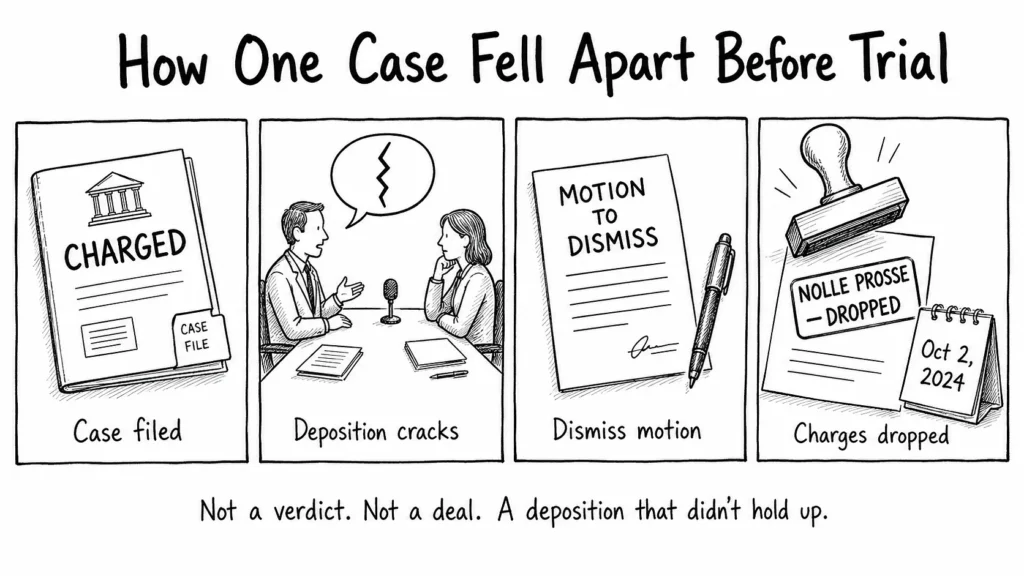
In Pinellas County, the defendant was charged by information with battery by strangulation under § 784.041, and Judge Meyer was assigned to hear the case.
In this case, defendant’s pre-trial discovery depositions of the alleged victim yielded testimony that contradicted the allegations in the criminal complaint and established that defendant did not strangle her.
The defense then filed a Motion to Dismiss, citing the testimony thus far and the state’s inability to prove the charge.
Before the judge could hear the motion, however, the State Attorney filed a Nolle Prosse on October 2, 2024, dropping the charge.
That outcome did not happen at trial. It did not happen through an agreement. It happened because the defense got to this early enough to do depositions and bring out the inconsistency and make the state really look at the question, can we prove this case? And the prosecutor looked at the deposition testimony and decided the answer was no.
But would the outcome have been the same had the defendant waited until arraignment to retain counsel?
Probably not. By the time of arraignment, the decision to charge has been made, the state has devoted resources to the case, and the wheels are turning. But when the state has not yet made a decision, in that 21-day pre-file period, the chance exists that mitigating evidence, witness credibility issues, and alternative theories could sway the outcome.
21 Days That Determine Everything
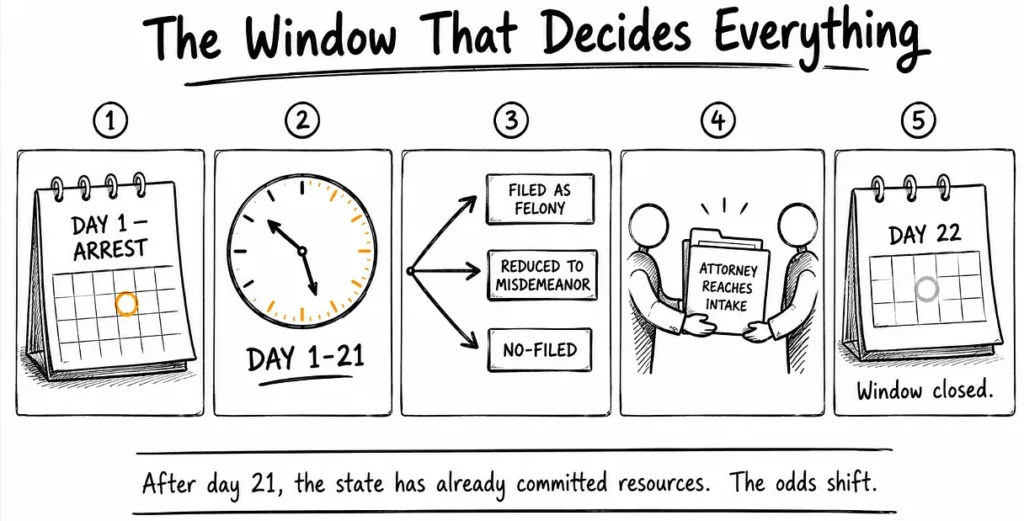
Once booked on domestic battery by strangulation in Hillsborough County, the 13th Judicial Circuit State Attorney’s Office prosecutor has approximately 21 days to determine whether to file charges.
Three things can happen during that window:
The state files the strangulation charge as arrested.
The state reduces the charge to misdemeanor domestic battery (under § 784.03).
It no-files the case entirely.
A domestic violence defense lawyer in Tampa can attempt to reach the State Attorney’s intake division during the 21 day period, and provide evidence of things not in the police arrest report, the relationship between the alleged perpetrator and victim, statements made by the alleged victim which contradict the charge, medical records showing no signs of strangulation injuries, and anything else giving the prosecutor doubt about whether they can prove the case beyond a reasonable doubt.
The alleged victim cannot “drop the charges,” and this catches families off guard constantly. In Florida, once the police have made a domestic violence arrest, under Florida Statute § 741.2901 the decision to file charges is left up to the State Attorney’s Office. The alleged victim can write a letter and can decline to cooperate. The victim can also recant his or her statement, but the prosecutor may still proceed. In a 2020 case in Tampa, the state no-filed (did not pursue charges) when the victim recanted, though this is not always the case. In Hillsborough County, prosecutors routinely proceed with strangulation cases over victims’ objections if the body camera footage and medical records are strong enough to stand on their own.
What a Conviction Does Beyond Prison Time?
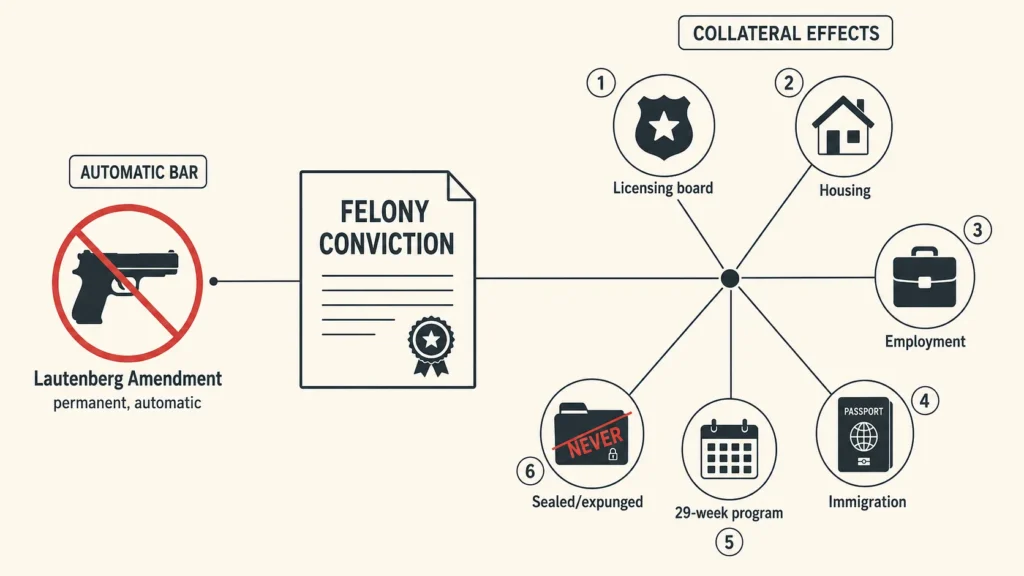
While the maximum term of imprisonment is five years, actual sentences vary depending on the facts of the case and the criminal record of the person. But a conviction has other consequences beyond a sentence of imprisonment.
Federal firearms ban, permanent. The Lautenberg Amendment prohibits anyone convicted of a misdemeanor crime of domestic violence from possessing firearms. A felony conviction also triggers the prohibition on felons possessing firearms under 18 U.S.C. § 922(g). For a gun owner, police officer, security guard, or soldier, this could end a career.
A felony domestic violence conviction will be reported on every employment, housing, and licensing background check. Typical professions that would see this in such checks include healthcare, education, law, finance, real estate, or any occupation that requires a state license. Some licensing boards treat it as an automatic disqualification.
29-week Batterers’ Intervention Program. Required as part of probation for most domestic violence cases in Hillsborough County. Weekly sessions for over seven months, mandatory, not negotiable, and failure to attend can be a probation violation.
Under federal immigration law, a domestic violence conviction (felony or misdemeanor) can trigger removal proceedings, visa denial, or permanent inadmissibility for noncitizens. For noncitizen defendants the immigration consequences of a plea may be more severe than the criminal consequences.
Cannot be sealed. Cannot be expunged. In Florida, a strangulation conviction under § 784.041 stays on your record permanently and cannot be expunged, appearing on every background check and every disclosure form after that.
Self-Defense in a Mutual Fight
Florida’s Stand Your Ground law applies in domestic situations. If the defendant had a reasonable belief that force was needed to prevent imminent great bodily harm, and the defendant was not the initial aggressor, self-defense is a valid argument.
In strangulation cases this comes up more than people realize. Two people are arguing, the argument gets physical, both are grabbing at each other, and the person who ends up with a hand near the other’s throat gets charged with the felony while the person who started the physical confrontation walks away as the “victim.” The officer arriving at the scene makes a judgment call based on what they see and hear in that moment. That judgment call is not always accurate and it is not always fair, but it determines who gets arrested and who gives the statement.
The problem with self-defense in strangulation cases is that the defendant has to show that the amount of force used was reasonable and proportionate in the circumstances faced by him or her; grabbing someone’s throat to prevent a punch is not the same as grabbing their throat in a scuffle or shoving match. The facts are weighed second by second, and the defense either stands or falls.
References
- Florida Statute § 784.041(2)(a), Domestic Battery by Strangulation. Third-degree felony.
- Florida Statute § 784.03, Battery (Domestic Violence), First-degree misdemeanor.
- Florida Statute § 784.045, Aggravated Battery. Second-degree felony.
- Florida Statute § 741.2901, Mandatory arrest and prosecution policies for domestic violence.
- Florida Statute § 741.28, definition of domestic violence and family or household member.
- 18 U.S.C. § 922(g), the federal prohibition on firearm possession by convicted felons.
- Lautenberg Amendment (18 U.S.C. § 922(g)(9)), a United States federal law prohibiting the possession of firearms by persons convicted of misdemeanor domestic violence.
- Pinellas County strangulation case, State v. [Defendant] before Judge Meyer; Nolle Prosse filed October 2, 2024; Sammis Law Firm case results.
- Tampa strangulation no-file, August 19, 2020. “Notice of Case Statute – Letter of Release.” Victim recantation. According to the Sammis Law Firm.
- 13th Judicial Circuit (Hillsborough County, Tampa): felony domestic violence charges; intake period of 21 days.